SLIME Survey

suggested for K – 12th grade
Overview
Malacology is the study of mollusks, which are invertebrates like the snails and slugs you see in your local flower beds and on the sidewalk after it rains. The SLIME project is a community science project where you and scientists at the Natural History Museum of L.A. County work together to better understand snails and slugs through research!
Did you know some species of snails are only known by their shells? Snails and slugs are important indicators of how a habitat is doing, but we know very little about them compared to other wildlife. Malacology is a field full of understudied mysteries, and you can help malacologists (scientists who study mollusks) shed some light on snails and slugs.
Use the button link at the top of this webpage to download the complete PDF of this lesson plan with the worksheets or CLICK HERE to view and download. Not ready to download yet? Keep reading this page to review the entire lesson before downloading.
Concepts
- Consistent observations can be compiled into workable data sets.
- Data can be evidence from which students can support a claim.
Objectives
- Students will practice making and recording observations outdoors.
- Students will improve their data-collection skills through practice and reflection.
- Students will analyze their own and open-source collected data and produce graphs or other visual representations of their observations.
Outline
- Students will practice recording observations in an outdoor setting for the first few sessions.
- During the following session, students will make more structured observations using a timed drawing exercise.
- For the last few outdoor sessions, students will collect data directly into the iNaturalist app.
- The class will analyze and pictorially represent its data at grade appropriate levels.
duration
- 5-week for complete lesson plan
location
Outdoors and in the classroom
materials
- Digital camera (phone or handheld), Internet Access
- Journal or Sketchbook and Sketching Supplies
- Data sheets or worksheets
- Pencil Watches or timers
- Clipboard (optional)
Resources and References
- "Opening the World Through Nature Journaling” – California Native Plant Society
cnps.org/education/documenting-natural-phenomena-6069
nhm.org/sites/default/files/2019-04/using_the_outdoor_classroom_handout.pdf
vimeo.com/162581545
vimeo.com/167431843
vimeo.com/331279497
nhm.org/community-science-nhm/slime
nhm.org/sites/default/files/2024-02/Field_Journal_Bilingual_English_Spanish.pdf
SLIME Community Science in the Classroom
Remind students to avoid handling wildlife as much as possible. If they do handle a snail or slug, make sure they can wash or sanitize their hands afterwards.
The 4 Steps of Making an Observation
Learning research shows that students engage in four steps while making scientific observations. This lesson plan takes students through each step, building essential skills to contribute to scientific data and research.
- Exploring the outdoors and natural habitat.
- Observing individual organisms.
- Identifying the organism.
- Recording information about the organism.
“We found that observing species was the most prevalent activity that youth took part in at BioBlitzes, with exploring and searching for organisms more commonly observed in younger ages. Relatively few youth were observed making and sharing biological records.”
- Enhancing youth learning through Community and Citizen Science: a guide for practitioners (education.ucdavis.edu/post/resources- practitioners-publications)
As educators you are encouraged to support students through to the recording step of making observations. Some ways to support students:
- Emphasize existing research based on their contributions (see FAQ).
- Reminders that 0 (no observations) is still important data to document.
- Logistic technical support in uploading to iNaturalist.
- Emphasize that recorded data will be used in Week 5 for analysis.
Lesson Plan
Week 1: Exploring and Observing, Two 20-Minute Sessions
In the first week, students will get comfortable looking for slugs and snails in the outdoor classroom. While in the classroom, establish the ground rules and safety measures for the outdoor classroom. Snails and slugs are typically found under deep leaf litter, logs, planters and flower pots, etc. They are most active at night, but can be found out and about after rain, watering the yard, and in the cooler early-morning hours. Print or draw a map of your outdoor classroom and have students mark the locations of snails and slugs, including a brief description of where they were found and weather conditions. As you begin to explore your outdoor classroom, ask students:
- Where might we find snails and slugs?
- What might their microhabitat look like?
- What time do you think snails and slugs would be most active and easy to find?
- What weather do you think snails and slugs would be most active in?
Extension: Develop a hypothesis with your students or have they develop a hypothesis in small groups predicting what they might see based on the environmental conditions of your outdoor classroom. Example: "I hypothesize that __________ because __________."
Using the Outdoor Classroom | nhm.org/sites/default/files/2019-04/using_the_outdoor_classroom_handout.pdf
Field Journal - Bilingual English/Spanish | nhm.org/sites/default/files/2024-02/Field_Journal_Bilingual_English_Spanish.pdf
Week 2: Observing and Identifying, One 30-minute session
In this second week, students will practice making observations in an outdoor environment simply by journaling. Lead students to your chosen outdoor location with journals and pencils, and explain that they will be sketching and taking notes about any snails and/or slugs they see. Remind them that observational drawings don’t need to be pretty or perfect, they just need to reflect what the student sees. Give students about 10-15 minutes of sketching time; then reconvene and ask what students noticed about snails and slugs. Alternatively, if students don't find snails or slugs, provide imagery via text, slides or models that students can sketch in the classroom.
- What parts of the snail/slug did they notice?
- What size and color was the snail/slug?
- Where was the snail/slug living?
"Opening the World Through Nature Journaling” - California Native Plant Society | cnps.org/education/documenting-natural-phenomena-6069
Week 3 – Week 4: Recording, Four 30-minute sessions
Week three asks students to begin recording data on iNaturalist by uploading observations. Alternatively, you can use the worksheets provided, make your own, or have students develop their own based on their hypothesis or areas of interest. Please note that recording on worksheets will not contribute to the SLIME community science project on iNaturalist. You may consider keeping your students final data sheets to track each year for comparison in your classroom.
Before heading outdoors, take a moment to review the previous week’s work with the students and remind them of all the information they’ve learned about finding and observing snails and slugs.
In week 1, students practiced Exploring and Observing by mapping out the locations of snails and slugs. iNaturalist observations should include location, time and date information to be a part of the research database. In week 2, students practiced Observing and Identifying by taking a close look at the different morphological features of snails and slugs. Some of these features are diagnostic for species identification.
If making iNaturalist observations students should aim for a “snail or slug photoshoot”, capturing different angles and morphological features of each individual that they find.
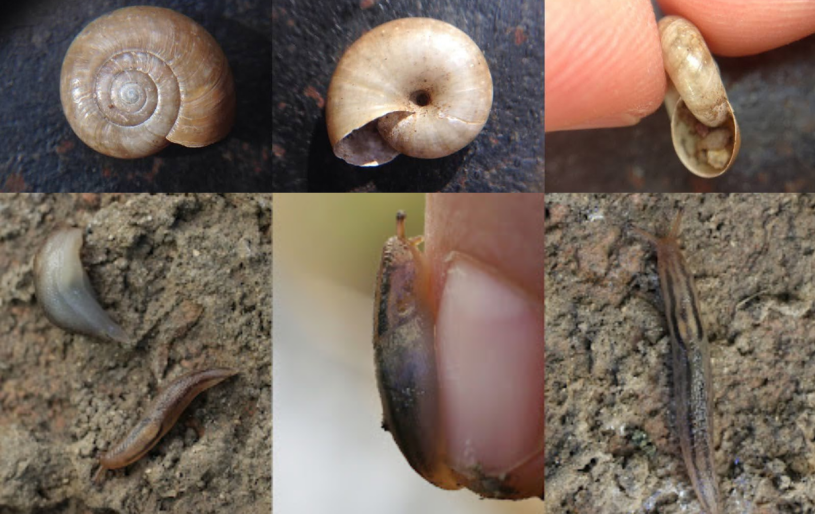
Recording data on iNaturalist incorporates your students’ data into one of our researchers’ ongoing Community Science Projects! It is probably easiest to upload the data with a class account managed by the instructor. Review more detailed instructions on how to navigate iNaturalist below. You’re ready to head outside and start collecting data!
Adding an Observation on the iNaturalist App | vimeo.com/162581545
Adding an Observation on the iNaturalist.org Website and Adding/Editing Bulk Observations | vimeo.com/167431843
- ELEMENTARY SCHOOL
- Explain to students that they’ll be counting the number of snails and slugs they see. You may also want them to record any other variables they may be interested in for the data analysis portion. You can go on a snail/slug hunt together or split groups into teams based on what data they are collecting.
- At the end of the survey period review the existing data on iNaturalist in your area for snails and slugs to show student contributions to research data.
- MIDDLE AND HIGH SCHOOL
- Explain to students that they’ll be documenting the snails and slugs they see. Upon finding a snail or slug, students should spend 1-3 minutes observing that individual and identifying any different species the snail or slug interacted or was found with, such as plants used for food or habitat or other species found sheltering with the snail or slug. Students should record species interactions, weather and temperature conditions on their iNaturalist observations under the notes section. Extension: Upper grades, split students into groups and have them observe different variables in addition to snail and slugs; i.e. different species, environments, make observations at different times of day, or other independent variables that the class has noticed over the past few weeks.
- At the end of the survey period review the existing data on iNaturalist in your area for snails and slugs to show student contributions to research data.
- Exploring Observations on iNaturalist | vimeo.com/331279497
Week 5: Data Analysis
In week 5 students will synthesize the observations they’ve collected as data, creating graphs and/or charts that answer questions about the terrestrial gastropods they’ve observed over the last four weeks.
- K-2ND GRADE
- As a class ask students count and/or add how many snails and slugs you've found together. For example, students can count how many snails vs how many slugs the class found from the class iNaturalist observations or their worksheets. Extension and variation: You can have students use snail and slug stickers to fill in a blank data sheet, have them count using manipulatives or color and tape the attached snail and slug images on the board into a visual of the number of animals you observed together.
- 3RD-5TH GRADE
- Ask students to create a graph based on their data or one that connects back to their groups' or the class's hypothesis from week one. Students can make comparisons between variables that you collected data on.
- Examples:
- Number of snails or slugs found on wet days vs. dry days
- Number of species interactions of snails vs. slugs
- How many snails or slugs were found on each data collection day
- Number of snails and/or slugs found in different locations (sidewalk, garden, wall, under rocks)
- Based on the graphs they create, ask students to make a claim about their data. Example: We found more snails on plants than we did on side walks.
- MIDDLE SCHOOL
- Ask students to create a graph depicting the number of snails and slugs versus any variable that they measured and were curious about. Graph an example data set together and then have students graph independently using the data they collected.
- Example:
- Snail/slugs found over time
- Number found in shady vs. sunny areas
- Slug vs. snail populations in different habitats
- Size of snails vs. location type
- Moisture level (dry/damp/wet) vs. number found
- Based on the graphs they create, ask students to make a claim about their data. Example: We found more snails in the shade than in the sun. Ask students to think about why that might be, and write up a short paragraph describing their answer and evidence.
- HIGH SCHOOL
- Ask students to create a graph showing two quantitative variables that they chose to measure or observe. Assist students on the type of graph they'd like to create to depict their data (scatter plot, line graph, bar graph etc.).
- Example:
- Temperature vs. snail/slug activity
- Humidity vs. population density (number of snails/slugs per unit2)
- Number of active snails/slugs before vs. after rainfall
- Comparison of species diversity across different locations
- Correlation between habitat type and population (species of snails)
- Number of snails/slugs across different seasons
- Mean, median, range of snail counts by location
- Then, ask students to present their graphs, and describe their findings and the relationship between their chosen variables (including no relationship).
- Extension and variation: Ask students to research the introduction of the Spanish Snail/Milk Snail (Otala lactea) to California. What kind of impact did that animal’s introduction have on native species? Using data from iNaturalist, ask students to create a scatter plot showing the number of Spanish Snails/Milk Snails versus the number of Native Snail species in the Los Angeles area (they can use a geographic area of their choice). Have them write a 1-2 page interpretation of the results of their graph. In their write up they can answer the following: What relationship(if any) do you expect to find based on your research? What does the graph you created show? What explanation can you give for the results of your graph and what evidence supports your explanation?
- Exploring Observations on iNaturalist | vimeo.com/331279497
- How to Search for Native Species on the iNaturalist Website: Under Taxon Status | inaturalist.org/pages/search+urls
Conclusion
Students have now completed their own field surveying, data collection and data analysis! Reflect on the process with students by recognizing their contributions to science and explore their curiosity with questions like:
- What further research would you like to follow up on?
- What did you think about snails and slugs before these lessons?
- What do you think about them now? What questions do you still have?
- Do you think you can answer them using the same process of field surveying, data collection and data analysis?
- If not, how do you think you can find the answer?
SLIME FAQ
Why is it important to study terrestrial gastropods (land snails and slugs)?
Since snails and slugs can’t travel far, their presence helps scientists understand the health of their local habitat. If an area has a native snail species present, that tells us that this habitat has been preserved and supports vulnerable species. On the other hand, introduced and invasive species in an area can damage habitats and native species, and it is helpful to know where they’re found and how they’re being moved from place to place.
How has community science helped us understand terrestrial gastropods?
iNaturalist observations in Brazil, for example, have contributed photos of live snails previously only known by their shells, potentially new species, and records of species that were previously thought to be extinct. For more information read “iNaturalist as a tool in the study of tropical molluscs” (journals.plos.org/plosone/article?id=10.1371/journal.pone.0268048). In L.A. County, NHMLAC’s own malacologist Dr. Jann Vendetti shares her research on introduced species using iNaturalist data - see the science on the Snail Search website (nhm.org/snail-search).
How are terrestrial gastropods studied at NHMLA?
Your photos that show details of slugs and snails help malacologists identify the different species that live in Southern California and where they are when you share them with the SLIME project. The Natural History Museum of L.A. County is home to a large collection of snails and slug specimens, which are used to understand species morphology (traits of the body) with tools like the Scanning Electron Microscope (SEM) (nhm.org/learning-resource/get-scoop-scope).
What is the SLIME Project? Snails and slugs Living in Metropolitan Environments (SLIME) (nhm.org/community-science-nhm/slime) is a community science project that aims to catalogue the biodiversity of terrestrial gastropods (land snails and slugs) in Southern California. The Natural History Museum’s collection of land snails includes thousands of specimens from locations throughout the Southern California region and spans the last 100 years. However, not much is known about this mollusk biodiversity today, especially within the cities of Southern California. That’s where community scientists come in! SLIME is the first community science snail survey focusing on urban Southern California, and adjacent wild lands. With this information we hope to identify the species that call Los Angeles home, those that are new to the area, and those that haven’t been able to survive the changes that urbanization has made to their homeland.
What is Snail Search? Snail Search, or “Snerch” for short, (nhm.org/snail-search) is a yearly effort to collect as many photos of terrestrial gastropods as possible during Southern California’s rainy season to the Natural History Museum of Los Angeles County's SLIME project. Join us each year for virtual and in-person events and prizes!
Vocabulary
Mollusks: Invertebrate(s) which includes snails, slugs, mussels, and octopuses. They have a soft unsegmented body and live in aquatic or damp habitats, and most kinds have an external shell.
Malacology: the study of mollusks, a Malacologist is a scientist who studies molluscs. Morphology: the study of traits of the body. Invertebrates: an animal lacking a backbone. Terrestrial: an animal that lives on land. Gastropods: comes from Greek that means “stomach foot”. A type of mollusk that typically has a flattened muscular foot and a head with stalked eyes. Includes snails, whelks, limpets, and slugs.
Habitat: the natural home or environment of an animal, plant, or other organism.
Microhabitat: a small, localized habitat within a larger ecosystem that might have unique qualities for specific species (example: under a log).
Endemic: a species that is native to an area and restricted to that area.
Native: a species that originated and evolved in their surrounding habitat and has adapted to living in that particular environment. Introduced: a species transported out of their native habitat range by people, either purposefully or accidentally, such as in shipping containers or releasing aquarium fish into a pond.
Invasive: An introduced, non-native species that spreads their range from where they were introduced and has the potential to cause harm to the environment.
Community Science: sometimes called “citizen science”, Projects in which volunteers partner with scientists to answer real-world questions. - Cornell Laboratory of Ornithology
Diagnostic (Species ID): characteristics of a species that differentiate that species from others similar to them, such as the shape of a snail shell.
Data: facts or statistics gathered for reference or analysis. In this case, students’ iNaturalist observations or worksheets are data.
Open-Source Data: data that anyone can access, use and share, such as the research-grade observations found on iNaturalist.
Explore More: Additional fun activities and resources
Create an iNaturalist Project for Your Classroom! Why an iNaturalist Project? (nhm.org/sites/default/files/2019-04/how_to_join_or_create_inaturalist.org_projects.pdf)
Follow @NatureInLA for Snerch and SLIME Updates, Prizes and Virtual Events instagram.com/natureinla
Meet Dr. SLIME: Featuring Dr. Jann Vendetti, NHMLA Malacologist and Research Scientist of the SLIME Project!
nhm.org/stories/meet-dr-slime
Snerch x The Snail Hospital: Check out the adorable and informational Instagram content by Chelsea Alexander, snail rehabber!
instagram.com/the_snail_hospital
Snails in the Classroom Image Credit: Chelsea Alexander /@The_Snail_Hospital on Instagram
Snail and Slug Illustration Credit: @The_Slime_Scholar on Instagram