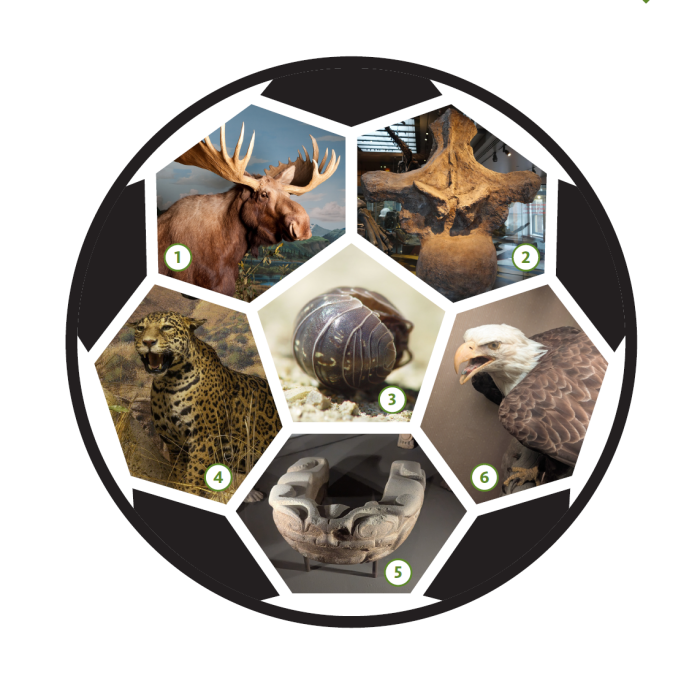
Soccer Connections: The Beautiful Game
Explore the collections of the Natural History Museum through the lens of soccer!

From Nature’s Stage to the Global Pitch
As the oldest natural history museum on the West Coast, we were bound to find references to the history of soccer in our vast collections. However, not all of our examples might be what you are expecting. From Cretaceous fossils to archival photos, take a virtual tour below to discover soccer around the Museum and explore ways L.A. connects to the Beautiful Game!
Anthropology
ARTIFACTS FROM THE ARENA
Archaeologists believe that the Mesoamerican ball game may have originated as long as 3,500 years ago. Ball courts have been discovered from Maya sites in Central America to Hohokam sites in southern Arizona. The game was played by teams of two to seven people, who attempted to keep a heavy rubber ball in play using only their arms, hips, or buttocks. More than an amusement, the ball game was a social and religious tool that settled political disputes, provided gambling entertainment, and symbolized the cosmic worldviews of pre-Columbian peoples. A team captain's loss could result in his decapitation.

Natural History Museum of Los Angeles County
A palma (so named for the object’s palm-frond shape) is protective gear worn in the ball game. It would be slotted into the top of the yoke and projected upward to protect the player’s chest and vital organs. This ceramic ball player figurine found in the Panuca area of Veracruz, Mexico is dated around AD 300-600.

Natural History Museum of Los Angeles County
In Mesoamerican art, ball game figures can be identified by their equipment, such as a yoke at the waist with or without hacha and palma, knee and arm pads, and a striking device. This ceramic ball player (AD 600-800) from Jaina, Campeche, Mexico, is wearing a headdress and large ear ornaments. He wears a yoke around his waist. Atop the yoke in front of the figure’s chest could be a palma that resembles an animal.

Natural History Museum of Los Angeles County
Stone Yoke
Yokes used during the Mesoamerican ball game were fashioned from leather and worn by the players. Stone yokes, like this one found in Veracruz, Mexico, were ceremonial objects or burial offerings that emulated the leather ones. This yoke’s (c. AD 300-900) toad design is associated with ritual reenactments that symbolized the relationship among creation, sacrifice, and the natural order.

Natural History Museum of Los Angeles County
The thick belt worn around the waist just above the pelvis is referred to as a yoke. The name is derived from the similarity of the shape to that of the equipment used to manage work animals. Stone yokes may have been used as molds into which leather was impressed to form the designs. The decorated leather would then be used for the actual belt worn in the games.
This stone yolk (AD 300-900) from Veracruz, Mexico depicts a face with only the nose and mouth visible—carved on the flattened end. Various designs are incised around the outside of the yoke.

Natural History Museum of Los Angeles County
Another element of the player’s equipment is the hacha. Worn with its notched base atop the yoke, hachas often depict heads, either that of a fallen rival, or of an animal, perhaps one possessing supernatural import. The objects are flattened into a shape that emphasizes the two-dimensional qualities, hence the name hacha (“axe” in Spanish). Stone hachas, like this one (AD 600-900) from Veracruz, Mexico, were probably used as ceremonial sculptures or burial offerings and not actually worn during the ball game. This hacha, carved from volcanic rock, depicts a vulture with its feet raised to its rounded belly. The bird may symbolize the sun or the carrying of sacrificial offerings to the sun.
Dinosaur Institute
ARGENTINIAN POWERHOUSE
If you think Argentina's soccer passion is massive, meet Argentinosaurus. As a towering titan of the Cretaceous period, it mirrors the gargantuan, undeniable weight that the reigning world champions bring to the global tournament.

Natural History Museum of Los Angeles County
This giant dinosaur vertebra, or backbone, belongs to one of the largest creatures ever to roam the Earth: Argentinosaurus—a fitting prehistoric titan for its namesake nation. Much like this dinosaur's gargantuan scale, Argentina’s devotion to fútbol is colossal.

Natural History Museum of Los Angeles County
Stand next to the cast of an Argentinosaurus huinculensis vertebra in the Dinosaur Hall, Level 1, to experience just how massive this long-necked dinosaur was when it roamed across South America 95 million years ago.

Natural History Museum of Los Angeles County
Argentinosaurus—mounted at the Museo Carmen Funes in Neuquen Province, Patagonia—reached over 100 feet in length and weighed 80 tons. It pushes the evolutionary limits of how large a terrestrial animal could possibly grow while remaining functional, agile, and dominant. Compare that to the outsized, monumental impact Lionel Messi has had on soccer. Messi's supernatural ability to track the ball, push past defenders unfazed, and flawless ball control has altered the game for generations to come. Both titans prove that Argentina specializes in producing giants.

Natural History Museum of Los Angeles County
Head to the Level 2 Mezzanine of the Dinosaur Hall to view a fossilized clutch of Titanosaur eggs unearthed at the Auca Mahuevo deposit in Neuquén, Argentina—the largest dinosaur nesting area ever found!
Entomology
TINY TACTICIANS
Argentine ants have built a global empire through unparalleled teamwork, much like their nation's fútbol players. By forming supercolonies, these resilient invaders coordinate with strategic precision to dominate new territories. Their relentless persistence and tactical unity have turned them into a worldwide powerhouse of the natural world.

The Natural History Museum of Los Angeles County
A fun, microscopic look at the Argentine ant. While the human players conquer the field with tactical precision, these tiny, cooperative insects build massive, continent-spanning interconnected, subterranean networks—proving that tactical dominance is in their DNA.

Richard Hasegawa, iNaturalist
Argentine ants have quite the sweet tooth. Aphids are tiny insects that feed on sap, which they turn into sweet drops of honeydew. Like a farmer tending its flock, Argentine ants will often protect a group of aphids from predators in order to keep the tasty honeydew flowing. The ants "milk" the aphids by stroking them with their antennae to initiate the release of the honeydew.

Josey Woodill, iNaturalist
As fascinating as they are, Argentine ants (Linepithema humile) are one of the most destructive and aggressively invasive species in the world. Native to the South America, this tiny, unassuming insect has successfully colonized every continent except Antarctica. Introduced through international trade routes in the late 19th century, they are highly aggressive toward native ant species, systematically outcompeting them for food and other resources. NHM Entomologists are studying the impact of invasive Argentine ants on local harvester ant colonies.

Philipp Hoenle, iNaturalist
While humans travel the world to compete on the soccer field, beneath the stadium turf, a tiny, multi-continental empire has already conquered the globe through the ultimate display of unbreakable, borderless teamwork.
Invertebrate Paleontology
NATURE'S PERFECT PATTERN
Ancient relatives of squid, octopus, and nautilus, ammonites thrived in prehistoric oceans for hundreds of millions of years. The interior of their coiled, chambered shell was often divided by complex, interlocking walls—called sutures—just like the stitched panels on balls to create a strong, spherical structure.

Natural History Museum of Los Angeles County
In 1972, former NHM curator Ed Wilson un-crated NHM's Parapuzosia seppenradensis specimen—displayed on Level 2—from the Landes Naturkunde Museum in Münster, Germany. This colossal fossil measures nearly six feet across; however, that's not nearly its full life-size. The original fossil was unearthed with the body whorl broken off. If reconstructed with its full shell, the animal would have measured nearly ten feet across, with an estimated weight of 2-3,000 lbs!

Natural History Museum of Los Angeles County
Ammonites were remarkable marine mollusks that thrived in ancient oceans for hundreds of millions of years. While many are famous for their flat, coiled shells resembling a spiral rope, certain species evolved a globose, inflated architecture that mirrors the geometry of a modern soccer ball. These shells featured a robust, rounded volume that provided excellent protection against the crushing depths of the sea.

Natural History Museum of Los Angeles County
The interior of ammonite shells is divided into numerous chambers, separated by complex, interlocking walls called sutures. Just as the stitched panels of a ball create a strong, spherical structure, these intricate patterns reinforced the shell's integrity. Sutures, like these in the ammonite pictured here, are revealed by polishing the outer surface of the fossil.

Natural History Museum of Los Angeles County
This primitive ammonoid underwent a stunning metamorphosis as fossilization replaced its shell with shimmering pyrite. This natural masterpiece perfectly mirrors soccer's Ballon d'Or trophy. Just as nature refined a primitive organism into a golden treasure, the sport elevates raw talent into the ultimate, timeless standard of global greatness.

Natural History Museum of Los Angeles County
Take a look at the ammonite fossils around the Museum. Many are spherical with chambered designs that mimic the exact geometric paneling of a modern soccer ball. However, they evolved into myriad shapes and sizes related to their lifestyles, showing how nature mastered structural engineering long before the first whistle blew.
Living Collections
ROLY-POLY ROSTER
Roly-polies, or pill bugs, have a series of overlapping plates in their tough exoskeleton that give their body more flexibility. This allows them to roll into a ball to protect themselves against predators. When an animal rolls itself into a ball shape, it’s called conglobation (what a fun word!). Roly-poly conglobation is made possible by segmented, overlapping plates that give their armor-like exoskeleton more flexibility.

Natural History Museum of Los Angeles County
Due to the significant environmental role of roly-polies, they are considered an important biological indicator. Their sensitivity to environmental changes allows them to provide important information about the health of their ecosystem. In other words, wherever you find roly-polies in soil, like these in the Museum's Bugtopia exhibit, you’ve got a healthy habitat. So go dig in the dirt a little and find some roly-polies in your neighborhood!

Natural History Museum of Los Angeles County
Roly-polies are a type of terrestrial crustacean known as an Isopod, meaning they have multiple pairs of identical-shaped legs. Like all crustaceans (think crabs and lobsters), roly-polies have a tough outer exoskeleton that protects their thinner, more vulnerable underbelly and 14 little legs. This preserved pill-bug specimen (Armadillium spp.) from the Museum's Living Collections allows you to easily count all seven pairs of legs.

Franco Folini, Wikimedia Commons
Roly-polies have a series of overlapping plates, visible here, in their tough exoskeleton that give their body more flexibility. This feature allows them to roll into a protective ball in order to defend themselves against predators.

Franco Folini, Wikimedia Commons
Today, roly-polies can be found worldwide in moist temperate climates; however, they were originally native to the Mediterranean. They are so successful at adapting to terrestrial ecosystems that they can be found almost anywhere there is soft, damp soil. Because they're so easy to find, many young bug enthusiasts first start observing bugs thanks to how cute and gentle roly-polies are!
Mammalogy
THE MIGHTY MAPLE
The moose is a rugged icon of the Great White North, embodying the vastness of the Canadian wilderness. This towering figure serves as the resilient mascot for the Canadian national team.

Natural History Museum of Los Angeles County
Standing up to seven feet tall and weighing more than 1,000 pounds, a moose completely shuts down passing lanes. Good luck trying to sneak a ball past a defender with that kind of natural spatial presence and reach. Visit the moose diorama in the North American Mammal Hall, Level 1.

Ryan Hagerty, Wikimedia
As the largest member of the deer family, moose are truly gigantic and formidable. A bull moose’s antlers, used for territorial displays and battling other males, can reach up to six feet in length. Antlers, only found on males, increase in size as the animal grows. Each winter, moose naturally shed their antlers and regrow a new, larger set the following spring.

Glacier National Park Service
Like any good soccer team, moose don't back down in challenging weather. Moose thrive in the cold, wet climates of North America and northern Eurasia (where they are known as elk). They are excellent swimmers that will take a dip to cool off and get rid of pesky insects, like mosquitos.

Alaska Region U.S. Fish & Wildlife Service
While professional soccer players are great sprinters, they would have a hard time competing against a moose. Shortly after it's born, a calf is fast enough to outrun a human at over 30 miles per hour.
THE LATIN AMERICAN STRIKER
The jaguar is a powerful symbol of Mexican heritage, long associated with strength, mystery, and spiritual significance in Maya and Mexica/Aztec traditions that continue to live on through communities today. As the mascot for Mexico’s host cities, this sleek predator reflects the nation’s fierce agility, pride, and passion for the game.

Natural History Museum of Los Angeles County
Stealthy, explosive, and possessor of the strongest bite relative to size of any big cat. The jaguar perfectly represents a star forward with its agility, devastating acceleration, and lethal finishing skills. You can view this jaguar stalking its prey in the North American Mammal Hall, Level 2.

Jeremy Bodycomb, iNaturalist
Jaguars can be found in North, Central, and South America. The word "jaguar" likely derives from the South American Indigenous word yaguara, which roughly translates into "he who kills with one leap" in Guarani. A world-class soccer player might use a similar gravity-defying leap to soar above defenders and strike a header into the back of the net.

Cburnett, Wikimedia
Across its range, deforestation for logging and large-scale agriculture have caused significant habitat loss that threatens this endangered species. Conservation efforts are being made to repair their fragmented habitat, target illegal poaching, and establish safer borders between human settlements and jaguar territory. Governments across Latin America recently committed to building wildlife corridors that span international borders, in an attempt to provide protected areas for jaguars to move between nations.

Natural History Museum of Los Angeles County
In Mesoamerican cultures, the jaguar was revered as an apex predator, a divine being, and a fundamental pillar of spiritual, political, and military power. From the Gulf Coast to Central America, its influence spanned millennia through the Olmec, Aztec, and Maya—a heritage that remains vibrantly alive today. Head to the Visible Vault (Level 2), to view this metate from the Atlantic Watershed region of Costa Rica that was carved in the shape of a jaguar (AD 850–1500). Because the metate was important in grinding maize into flour, scholars believe it became a symbol of transformation from death to rebirth.
ARMORED ROLLERS
The southern three-banded armadillo (Tolypeutes matacus), so named for the three overlapping bands across its back, is one of only two species of armadillos—the other being the Brazilian three-banded armadillo (Tolypeutes tricinctus)—that can roll itself into a tough ball to protect against predators.

Natural History Museum of Los Angeles County
Three banded-armadillos (NHM Specimen No.27349) is a nocturnal insectivore, hunting insects—mostly ants and termites—at night. Using its strong legs and large claws, the armadillo digs in the ground or pulls off tree bark to find its food, lapping up the tasty insects with its long, sticky, straw-like tongue.

Guillermo Menéndez, iNaturalist
Native to the central region of South America, three-banded armadillos live in open forest, grassland, and marsh habitats extending across parts of northern Argentina, southwestern Brazil, Paraguay and Bolivia. These armadillos are solitary creatures that live in dens formed under dense vegetation or in abandoned burrows they find underground.

Cleveland Metroparks Zoo
The animal’s carapace (protective outer covering) is made of keratin, the same tough, versatile material that makes up our hair and fingernails. The three segmented bands across its back allow flexibility of such a tough outer ‘shell’.

Polyoutis, Wikimedia Commons
The armadillo’s thick, leathery body armor is quite roomy underneath, allowing the animal to pull its entire body inside and curl up into a tight ball. The armadillo’s triangular head and tail fold together, sealing the animal safely inside. The armadillo’s steel-trap of a shell isn’t just used for defense. It’s also quite efficient at trapping air and body heat, helping the animal stay warm on cool nights.
SCALES ON A ROLL
When threatened, pangolins roll into a protective ball, using their thick skin and hard, overlapping scales as a tough suit of armor. When a mother pangolin feels threatened, she will surround her small baby (known as a pangopup!) and roll it up within her defensive ball of a body.

Natalja Kent
The African ground pangolin in the Museum's Reframing Diorama exhibit depicts a riverine forest in western Uganda, East Africa at nightfall. This animal was collected by the 1963 Knudsen-Machris East African Expedition.

U.S. Fish and Wildlife Service
Beyond rolling into a ball, an ability known as volvation, pangolins have additional defense mechanisms. They can use muscles under their skin to move their sharp scales back and forth, creating a slicing, cutting-like motion. Pangolins can also emit a noxious-smelling chemical from their anal glands, similar to skunks, that deters predators such as leopards and hyenas.

Yon-lu, Goh, iNaturalist
There are eight species of pangolins, also known as scaly anteaters, that inhabit woodland and savannah habitats across Sub-Saharan Africa and southern Asia. Depending on the species, pangolins may have either an arboreal or terrestrial lifestyle. Tree-dwelling pangolins—like this Sunda pangolin—live in hollow trees, while ground-dwelling species nest in deep underground burrows.

Russell Gray, iNaturalist
All eight species of pangolins are considered Threatened by the IUCN, vulnerable to overhunting for their meat and scales, deforestation of their natural habitat, and poaching for the exotic pet trade. While pangolins are protected under international law, they have become the most trafficked mammal in the world. Thanks to its strong conservation laws and wildlife rehabilitation centers, Taiwan has the largest population of pangolins around the world. The establishment of World Pangolin Day on the third Saturday of February has also helped raise awareness about this extraordinary animal in need of our protection.
Mineral Sciences
GEOLOGY OF THE GAME
Step away from the pitch and enter nature’s ultimate trophy room. Across the globe, master artisans have transformed rare minerals and vivid gemstones into spectacular wildlife carvings. From defensive powerhouses to sacred cultural icons, these brilliant stone figures prove that the spirit, pride, and strategy of the world’s game are beautifully set in stone.

Natural History Museum of Los Angeles County
In the early 19th century, Japanese rice farmers began selectively breeding colorful varieties of koi fish—known as nishikigoi—transforming koi into a canvas of vibrant, decorative patterns. Just like this dazzling koi fish carving made from Australian opal (NHM#22701) turns the humble koi into a canvas of living art, Japan's men's national soccer team—the Samurai Blue—have meticulously refined their game into a masterclass of fluid coordination and teamwork.

Natural History Museum of Los Angeles County
Carved from talc, this rhinoceros (NHM#52583) highlights a species that bridges African nations, from Eswatini (formerly Swaziland)—where the mineral was mined—to the savannas of the Democratic Republic of the Congo—where rhinos have recently been reintroduced. This carving represents the sheer physical dominance required on the global stage. For the DRC national team, the rhino symbolizes the relentless drive and unbreakable strength needed to conquer the tournament.

Natural history Museum of Los Angeles County
Carved from cave-formed calcite, this fierce hippo (NHM#52568) channels South Africa’s deepest roots. This type of calcite is found near Johannesburg’s Sterkfontein Caves, an archaeological site known as the "Cradle of Humanity" for the wealth of ancestral human fossils (hominin) found there. Just as these ancient caves anchor human history, South Africa's men's team, Bafana Bafana, anchors national pride—combining bedrock strength with a legendary, unstoppable spirit on the pitch.

Natural History Museum of Los Angeles County
Carved from rich New Zealand nephrite (jade stone valued for its strength and color), this carved kiwi (NHM#52581) represents both national and Indigenous pride. More than just an endemic bird, kiwi are a Māori symbol of humility, courage, and guardianship that inspires New Zealand’s athletes to defend their home turf.

Natural History Museum of Los Angeles County
Shaped into one of Australia's most beloved native icons, this nephrite wombat (NHM#47482) captures the country's unique natural heritage. Just as the wombat is fiercely loyal to its home soil, Australia’s athletes carry a deep connection to their land, stepping onto the pitch with the courage of the Outback and that famous Aussie pride.
Ornithology
THE U.S. CLUTCH
Bald eagles are a globally recognized emblem of America. This majestic bird has been chosen as the official representative for the U.S. host cities–a symbol of the nation’s soaring ambition and competitive spirit.

Natural History Museum of Los Angeles County
In the wild, eagles rely on unmatched vision and split-second spatial awareness to dominate the sky. On the pitch, those same traits make for a brilliant midfielder who can read the game three steps ahead of everyone else. Check out NHM's bald eagle in the Bird Hall, Level 2.

Natural History Museum of Los Angeles County
Atop the Museum's historic eastern entrance sits a majestic bald eagle—a symbol of national pride—but this statue is a replica. The original bald eagle that presided over the Rose Garden since 1913 was damaged during the 1920 Inglewood earthquake (magnitude 4.9). A Museum staff member saved part of a wing that fell off and donated it to the History Department. During the Museum's 2009 restoration project, this same wing fragment was used to reproduce today's replica eagle—matching the original's material, size, and style as closely as possible.

Andy Morffew, Wikimedia
Bald eagles are truly iconic birds and represent major conservation successes for North American wildlife. At the time of FIFA's inaugural tournament in 1930, bald eagle populations were already in steep decline due to habitat loss, pesticides, and intentional killing. This decline continued into the 1960s: as few as 417 nesting pairs remained in the lower 48 in 1963. As a result of subsequent legislation and the establishment of the Environmental Protection Agency, with public support largely inspired by Rachel Carson's Silent Spring (1962), a 2020 report shows that the population has grown to 316,700 in the lower 48, including more than 71,000 nesting pairs.

Andy Morffew, Wikimedia
As aerial predators, bald eagles have incredibly keen vision and can spot prey over a mile away! With powerful, razor-sharp talons—a trait common to all raptor, or birds of prey—bald eagles often fish for prey just below the surface of the water.

AngMoKio, Wikimedia
Bald eagles are highly territorial and would make excellent goalies. Since their reintroduction to the Channel Islands in the early aughts, bald eagles have helped to effectively boot out golden eagles that formerly preyed on endemic island foxes. The populations of these Near Threatened foxes are now recovering thanks to an unexpected defender.
Seaver Center for Western History Research
THE EARLY DAYS OF L.A. SOCCER
Soccer was introduced to Los Angeles by European and Latino immigrants in the late 19th century, establishing amateur athletic clubs as competitive and social venues. In 1925, these clubs were incorporated into the Los Angeles Soccer League. Clubs were often organized around ethnic, neighborhood, and workplace identities, with players frequently transferring between teams.

Seaver Center for Western History Research
The growth of local soccer teams in the 1930s attracted sponsorship from famous actors such as Béla Lugosi with the Magyar Athletic Club. Lugosi, a Hungarian-American, was particularly devoted to the Magyars and provided financial support such as purchasing their uniforms, as seen here in this 1934 photograph from the P-110 Carroll Photo Service Collection. Lugosi provided such significant financial support that he was named honorary Los Angeles Soccer League president in 1935.

Seaver Center for Western History Research
An athlete himself, actor Victor McLaglen was a major supporter of the league. He built the Victor McLaglen Sport Center on Riverside Drive, serving as the league's primary venue from 1935 until its destruction in the flood of 1938. Following World War II, the organization rebranded and expanded as the Greater Los Angeles Soccer League in 1951 to manage the sport's increasing national popularity. Photo courtesy of the P-110 Carroll Photo Service Collection.

Seaver Center for Western History Research
Early matches in the 1920s were generally held at athletic fields across many different neighborhoods, such as Loyola Field on the Loyola College campus on Sixteenth Street (now Venice Boulevard) and Vermont and in Westchester near Mines Field (now LAX). Photo courtesy of the P-110 Carroll Photo Service Collection.

Seaver Center for Western History Research
Corporate and studio teams like Douglas Aircraft Flyers and Fox Studios also competed in the league. In this photograph from the P-110 Carroll Photo Service Collection, Douglas Aircraft Flyers players strike poses at Mines Field, circa 1930-1934. Look closely and you can see multiple planes and hangars in the background.

Seaver Center for Western History Research
This photograph from the P-110 Carroll Photo Service Collection, captures a great save during a Los Angeles Soccer League match, circa 1920s - 1930s. David Carroll was a freelance news photographer in Los Angeles from the 1920s through 1940s.

Seaver Center for Western History Research
Prominent teams included the Los Angeles Athletic Club (L.A.A.C.), Hollywood Athletic Club, Victoria Athletic Club, Hollywood Sheiks, Magyar Athletic Club (Hungarian), Viking Athletic Club (Scandinavian), Los Angeles Scots (Scottish), Sons of St. George (English), Juventus (Latino), and Germania (German). This shot of a Germania goalie, passionately attempting a save, is courtesy of the P-110 Carroll Photo Service Collection.
Vertebrate Paleontology
BRAZIL'S LETHAL ATTACKER
The Paraphysornis brasiliensis, a giant carnivorous "terror bird", hunted large mammals across prehistoric Brazil with lethal precision. This ancient apex predator perfectly mirrors the Brazilian national team’s fierce, unstoppable attack—a historic powerhouse ready to hunt for global glory on the pitch.

Natural History Museum of Los Angeles County
Towering up to two meters in height, Brazil’s "terror bird" once dominated the landscape—a prehistoric embodiment of a futebol nation that strikes fear into the hearts of any opponent.

Snowmanradio, Wikimedia
With strong powerful legs, vestigial wings, and a large powerful beak—as depicted in this artist's rendering, Paraphysornis brasiliensis, ambushed prey with brute force. Similar to how Brazilian futebol attackers approach anyone who gets between them and scoring a goal.

Paul Hermans, Wikimedia
This life-sized model of Paraphysornis brasiliensis on display at the Natural History Museum, Vienna imagines what a giant terror bird looked like over 20 million years ago.