Strange Sharks
Unbelievable Adaptations Hidden in the Museum’s Collections

By Bridget Paskil
When most people picture a shark, they probably imagine something large, sleek, and unmistakably “sharky.” But the truth is that sharks are wildly diverse, and many species have adaptations so unusual that they can seem almost unreal.
From sharks that carve cookie-shaped bites out of whales to species that glow in the dark, these animals represent millions of years of evolutionary experimentation. Some of the most fascinating examples can be found not just in the ocean, but in NHM’s own Ichthyology Collections, where preserved specimens allow scientists to study their anatomy, biology, and evolution in detail. Below are just a few examples of the strange and remarkable sharks that researchers are fortunate enough to examine in our fish collections.
Cookiecutter Shark (Isistius brasiliensis)

Cookiecutter shark (LACM 46048-1 Isistius brasiliensis)

Cookiecutter shark (LACM 46048-1 Isistius brasiliensis)
The cookiecutter shark may be small, but it has a pretty unusual feeding strategy. Found in tropical and subtropical waters around the world, these sharks typically inhabit deep offshore environments but vertically migrate closer to the surface at night.
What makes this species so distinctive is its round mouth, with its lower set of teeth fused in one uniform plate (rather than many teeth with individual roots). The shark attaches itself to larger animals and twists, removing a perfectly round plug of flesh, leaving behind the distinctive “cookie-cutter” shaped wound that gives the species its name.
Despite adults measuring only about 40–50 centimeters (16–20 inches) long, cookiecutter sharks have been documented taking bites from animals many times their size, including whales, dolphins, large fish, and other sharks like the Great White Shark. Their characteristic round bite marks have even been found on submarines and underwater cables! Not to be disregarded by their relatively small size, the cookiecutter shark has the largest teeth proportional to their body size of any shark species! Our collections currently include five specimens of this unusual species.
Megamouth Shark (Megachasma pelagios)
Few sharks have surprised scientists as much as the megamouth shark. The species was first discovered in 1976 when an unfamiliar shark became entangled in boating equipment off the coast of Hawaii. Since then, only 30-50 individuals have been documented worldwide. The specimen at NHM was the second megamouth shark ever discovered, and it is currently on display at NHM! Southern California is one location where this species has been seen multiple times. Megamouth sharks inhabit deep offshore waters in tropical and temperate oceans. They are especially remarkable because they are one of only three shark species known to feed primarily on plankton, alongside the whale shark and basking shark.
Rather than actively hunting prey like their more toothy cousins, megamouth sharks swim slowly through the water column with their mouths open, filtering plankton and other small organisms using specialized structures along their gills called “gill rakers.” Despite their reputation as plankton feeders, they may also consume small schooling fish encountered during feeding. NHMLAC researchers were the first to discover that this species actually migrates vertically in the water column—from the deep seas to closer to the surface,—n search of their favorite foods.
Making this shark even more unusual is that their lips have a reflective, luminous sparkle that attracts their prey, even though they are not actually creating their own light. Todd Clardy, NHM’s Ichthyology Collections Manager, says “When scientists investigated, they found there is no bioluminescent tissue in the mouths of megamouths. Instead, it's their planktonic prey that make light. Basically, megamouth sharks wear glowing plankton-like lipstick to attract prey.” Our collections currently include one specimen of this rare and still-mysterious species.
Horn Shark (Heterodontus francisci)
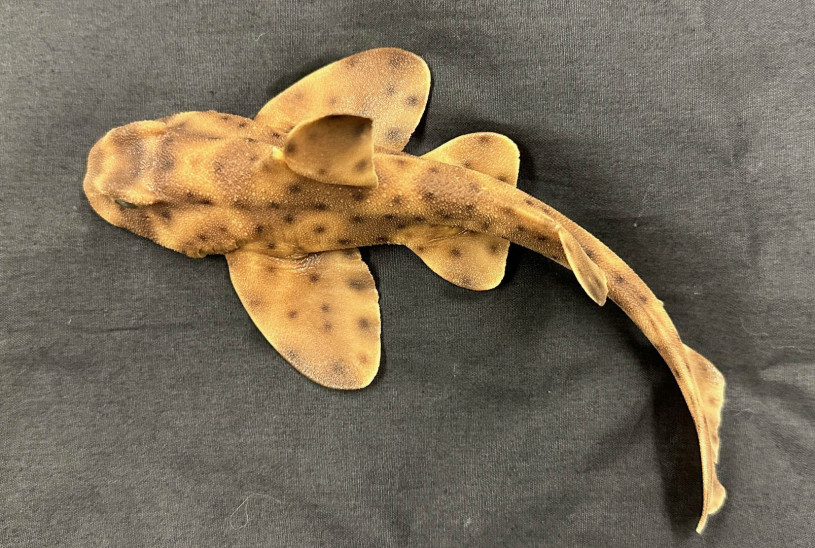
Another one of our “hometown heroes,” the horn shark is one of the most common sharks found along the rocky reefs and kelp forests of Southern California. These small, bottom-dwelling sharks are named for the short, horn-like spines located in front of their dorsal fins that help deter predators. Horn sharks spend much of their time resting on the seafloor and feeding on hard-shelled prey such as sea urchins, crabs, and mollusks.
They are also known for their distinctive egg cases. Female horn sharks lay spiral-shaped eggs that resemble corkscrews. These screw-like cases can wedge securely into rocky crevices, protecting the developing embryo from currents and predators.
Our collections include 54 horn shark specimens, providing valuable material for studying a species that lives right off our own coastline.
Lantern Sharks (family Etmopteridae)
Deep in the ocean, where sunlight barely reaches, some sharks have evolved an extraordinary ability: they glow. Lantern sharks are small deep-sea sharks equipped with specialized light-producing organs called photophores embedded in their skin. These organs allow the sharks to produce bioluminescent light. Scientists believe this light may help camouflage the sharks through a process known as counter-illumination.
By matching the faint light filtering down from the surface, the shark can hide its silhouette from predators below. Bioluminescence may also help with communication or possibly attracting prey. Our collections contain 39 specimens of lantern sharks, representing nine species, offering researchers rare opportunities to study these fish species that are otherwise difficult to observe in the deep ocean.
Scalloped Hammerhead (Sphyrna lewini)
Perhaps no shark has a stranger silhouette than the hammerhead. With their wide, flattened heads, known as cephalofoils, these sharks are instantly recognizable. There are currently 12 recognized species of hammerhead sharks, and the scalloped hammerhead is one of the most widely distributed. It is found in warm temperate and tropical oceans, including waters along the California coast.
The hammer-shaped head may help these sharks detect prey by spreading out sensory organs that can pick up faint electrical signals produced by animals hidden in the sand, functioning almost like a biological metal detector.
Today, scalloped hammerheads face significant conservation challenges and are listed as Critically Endangered on the IUCN Red List due largely to overfishing and the global shark fin trade. In 2025, the Convention on International Trade in Endangered Species of Wild Fauna and Flora (CITES) reported a reduction of more than 80% of the individual scalloped hammerheads over three generations. Our collections include 32 scalloped hammerhead specimens, providing important material for researchers studying the biology and conservation of this iconic and critically endangered species.
Why Collections Matter
Specimens like these highlight the extraordinary diversity of sharks and the many adaptations that have helped them survive in Earth’s oceans for hundreds of millions of years. Museum collections like ours play a vital role in advancing our understanding of these animals. Researchers can study preserved specimens to examine anatomy, genetics, physiology, and evolutionary relationships, often revealing insights that cannot be observed in the wild. For rare species such as the megamouth shark and lantern sharks, collections may represent some of the only opportunities scientists have to investigate these elusive animals. Every specimen holds the potential for discovery. Each time a researcher opens a collection jar or examines a specimen more closely, we gain a deeper understanding of the remarkable diversity of life in our oceans, and the adaptations that have allowed sharks to thrive there for more than 400 million years.

