The Songs of the Coquí Frog
The soothing sounds of home or a sonic menace? How you feel about the coquí's call depends on context, but when coquí frogs call in L.A. County, NHM's Herpetology Curator Dr. Greg Pauly answers.

Key Takeaways
- NHM’s Curator of Herpetology, Dr. Greg Pauly, tracks potentially invasive reptiles and amphibians in Southern California, like the incredibly loud coquí frog from Puerto Rico
- Dr. Pauly and a team of community scientists collected coquís at a local nursery to better understand how they arrived and how to prevent them from damaging local ecosystems
- While nuisances in regions where they've become truly invasive, like Hawaii, the distinctive call of these frogs is beloved in their native Puerto Rico and celebrated by artists like Bad Bunny
Published January 8, 2026
The first thing you notice is the sound, an almost perfectly enunciated “co key” coming from every direction inside the nursery.
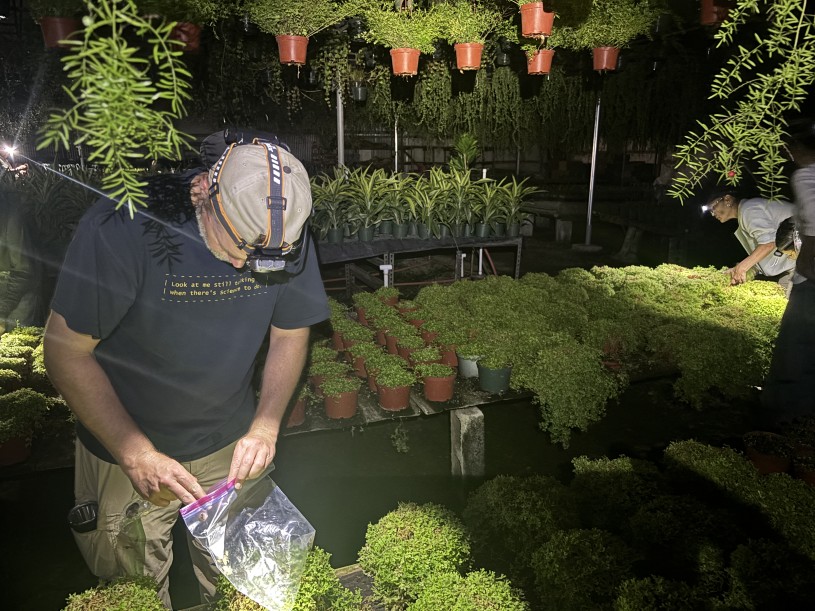
“They really do announce themselves,” says NHM’s Curator of Herpetology, Dr. Greg Pauly, who put this search party together, more than a dozen of us who will catch as many coquí frogs as we can. In this walled but open space, among rows and rows of house plants at this Torrance nursery, the chirps of these tiny frogs amass into something hard to follow but impossible to ignore, and the night’s survey aims to understand how many coquís are calling the nursery home with an eye on managing their numbers and preventing the frogs from establishing themselves as permanent residents.
“A lot of potentially invasive species can sort of fall under the radar,” says Pauly. “If a new population becomes established, starts expanding, and causes problems for an ecosystem before anyone notices, it makes eradicating them that much more difficult once we do detect them. You want to decrease detection times to increase the chance that invasive populations can be managed. This isn’t really an issue for coquís because their sheer volume makes them hard to miss, but we still want to prevent coquís from getting shipped across the Greater Los Angeles Area, where they then cause problems for people.”
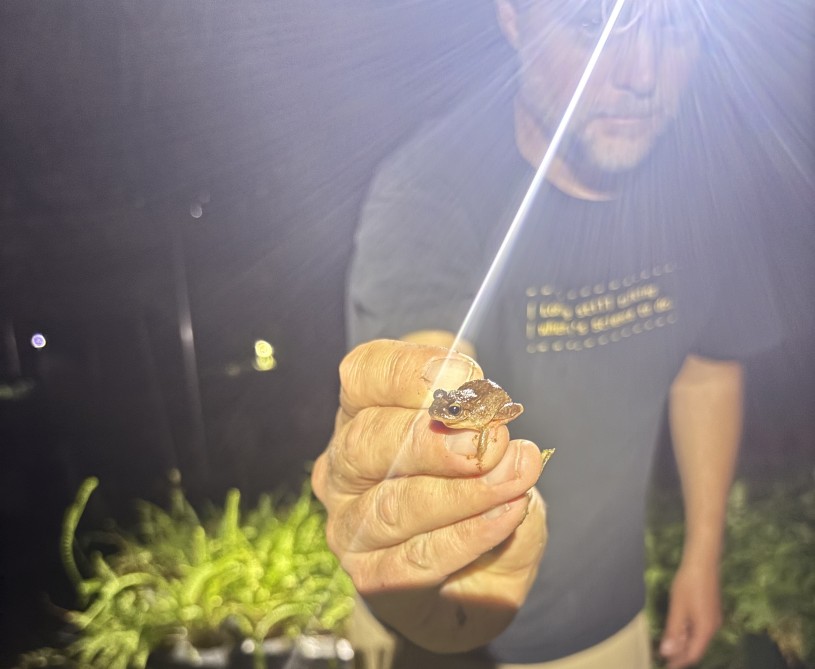
Coquís are now on the islands of Hawaii, Maui, and Oahu (Kauai’s population was successfully eradicated), where their chirps threaten the mental well-being of human residents and lower property values. The coquí frog’s call can reach up to 95 decibels, about as loud as an approaching subway train, only it’s coming from the side of your house. Without natural predators, the frogs collect in larger numbers than on their home island, estimated to be fifty times as dense as on Puerto Rico. The frogs also disrupt already threatened native ecosystems, decimating pollinators and stressing native species. Coquís have established breakthrough populations in a handful of Southern California nurseries, where the frogs likely hitchhike on plants imported from Hawaii. Most of these populations were eradicated when they were small or disappeared within a year or two, but the population at the Torrance nursery has grown.
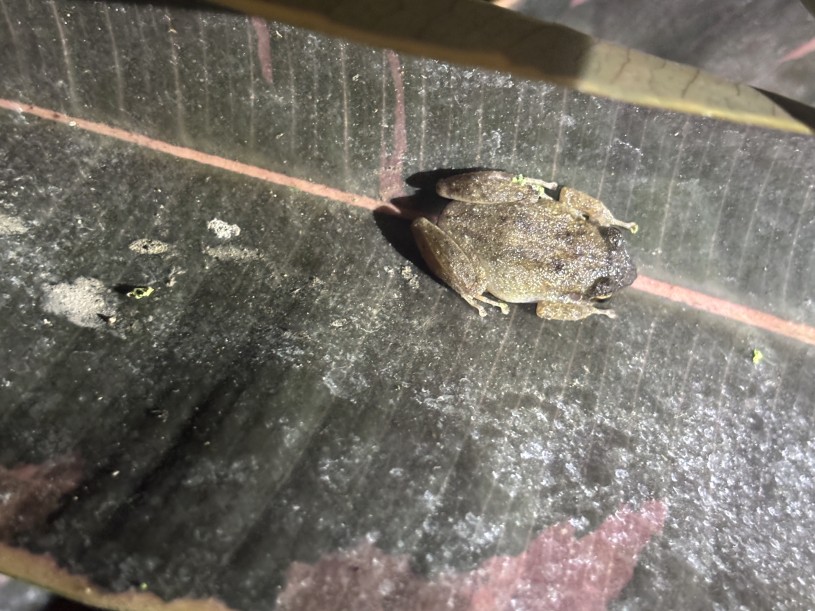
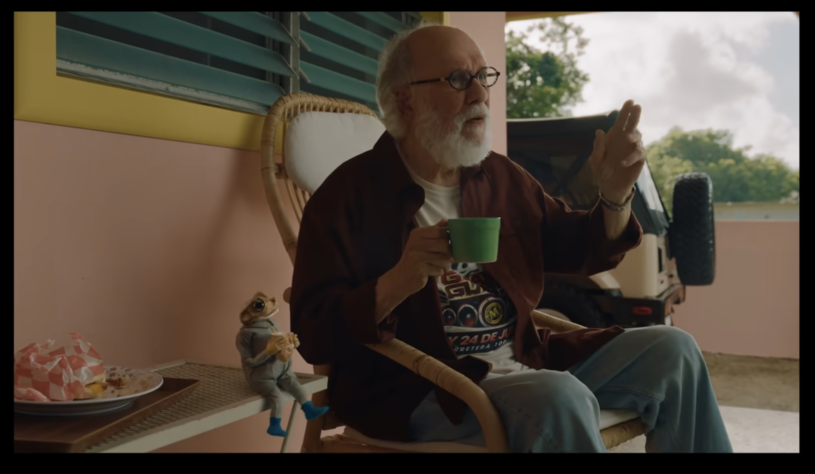
Coquís are native to Puerto Rico, where their familiar calls help lull people to sleep. They are a source of pride, even featuring as a sound element on Bad Bunny’s track LO QUE LE PASÓ A HAWAii, which warns against the island transforming into Hawaii in terms of tourism and investment from outsiders. While beloved on their home island, the nights full of ‘coquí’ are a problem for the frogs’ neighbors outside of PR. It’s another layer complicating how we think about ‘invasive species.” It is not a value judgment on the animals, but a designation that the introduced animal is harmful to its adopted ecosystem.
Non-native species are those that are not naturally found in a given region, but an invasive species causes damage to an ecosystem by outcompeting or consuming the animals or plants that naturally occur there, or by harming the economy or health of the local human population. Studying the frogs collected from the survey will help Pauly and other researchers, as well as state wildlife officials, better understand where the frogs are coming from, whether they’re becoming more capable of survival outside the nursery, and uncover unseen threats the frogs might be carrying, such as diseases and parasites.
Ecosystems can be fragile, especially those threatened by urbanization and a changing climate. You can think of them like tapestries, where a misplaced thread can change the whole picture in ways that can be difficult to predict. So Pauly and the California Department of Fish and Wildlife are hoping to nip the California coquí thread as close to the source as possible. Finding and monitoring these loose threads isn’t the most visible or celebrated work for NHM curators like Pauly and others, but it is among the most impactful.
Once an invasive species embeds itself in a habitat, it can be almost impossible to eradicate, and the effects of its presence can cascade in unpredictable ways, from outcompeting native animals to spreading novel diseases that can devastate ecosystems. Their impact goes beyond environmental and conservation concerns, affecting industries like agriculture. Imported pests cost the state some three billion dollars annually.
While many non-native species like coquís struggle to survive in Southern California’s Mediterranean climate, that won’t always be the case. As climate change produces hotter, drier weather and as development squeezes out and warps native habitats, more kinds of non-native species will be able to find new footholds to establish themselves in the region.
“International trade brings organisms from all over the world into Southern California every day,” says Pauly. “You’ve got this situation where an animal that might not have become invasive ten years ago is now able to thrive in the region because it’s hotter, there’s more water through things like watered lawns, and native competitors are already struggling from habitat destruction. It’s kind of a perfect storm.”
A Frog in the Hand
Walking past the ‘look out for coyotes’ sign into the darkened nursery with a ziplock bag in hand, I immediately see a coquí frog, but I’m too slow, and it vanishes into the foliage. After following the calls down several dead ends on my own, Pauly steps in to guide me through the ins and outs of finding coquís.
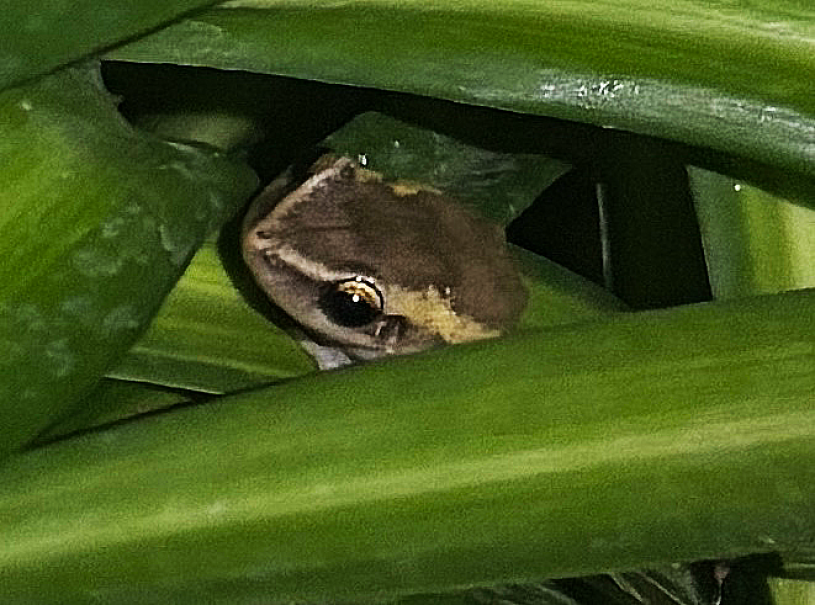
We follow the loudest “co key”, but just as we close in, the frog stops calling. Without their high-decibel call, we have to leaf through individual plants, and the frogs are pretty hard to spot. While adult coquís are about the size of my thumb, juveniles are more like the size of my pinky fingernail—and they’re tucked between the thick leaves where they can easily pass for, say, a bit of mud. Luckily, this isn’t Pauly’s first frog hunt.
Headlamps off, cupping our ears, we first get as close as we can. Then we point to the plant or at least the direction of where we think the call last sounded. While their calls are overwhelming at the entrance of the nursery, the frogs get speechless as you close in. When the frogs go quiet, Pauly holds up his phone and plays a recording of their calls from YouTube.
The hope is they’ll take the recording as another male intruding on their territory. The call itself both warns other males off and attracts females as a sign of fitness: a fitter, larger frog produces a louder call.
The male responds to the recording, and we pour through the leaves, pick up the plants, and look under them, until suddenly Pauly has one in his sights, and then another. But these are small frogs, not the larger male making all the racket. They jump, and especially in the dark, they blend in well with pebbles, clumps of dirt, everything in the nursery that’s not a plant, pot, or table, really.
Then, after some successful catches, a number of us converge, following a deep “co key” to a table with smaller plants. It feels like every pot has a frog underneath it, prompting mad dashes, pointing, along with some empty hands where we’d imagined a small frog should be.
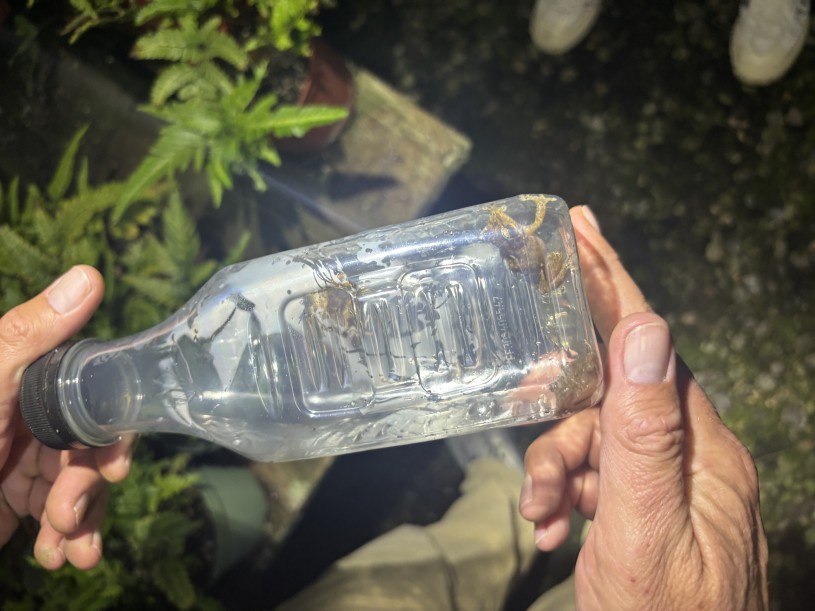
The frogs are still pretty jumpy once they’ve been caught in cupped hands, and getting the tiny spring-loaded amphibians into the bags and bottles brought along to collect them is one of the trickier maneuvers, especially with the juveniles. They slip through our fingers. They hop out of hands specifically opened to check if there actually was a frog there in the first place, because they’re so small, it can be hard to tell. Just when you’re sure you were too slow to catch it, the frog shows you you’re too slow to keep it, leading to searches on hands and knees through the dirt and even more frog-shaped pebbles and dirt, and occasionally, a frog.
With help from Pauly and the other surveyors, my ziplock ends up with coquís of all sizes (but no eggs), as do the bags and bottles of my fellow frog hunters. By the end of the night, we’ve collected 144 coquís. Along with the 352 from an earlier visit, that’s nearly 500 frogs from this location in a single month. That’s larger than the last four years combined.
“The number definitely seems high, and that should worry folks,” says Pauly. “But, this spike in numbers will prompt CDFW to implement new approaches to managing the coquí situation.”
Only future surveys will prove how effective those strategies are, but Museum scientists like Pauly and other curators at NHM are always on the lookout for non-native species that might be causing problems for Southern California’s wildlife—and they might just need your help. Check out the Museum’s community science programs and discover how you can contribute to protecting L.A.’s biodiversity.

