
Ancestral Spirits, Pre-Hispanic Flavors, and Culinary Craft
Max Reis & Chef Alan Sanz | Mírate

NHM Online Presents L.A. Culture in a Cup, a year-long initiative celebrating the stories of the diversity of Los Angeles and its people through the lens of the beverages and their significant vessels that bring us together.
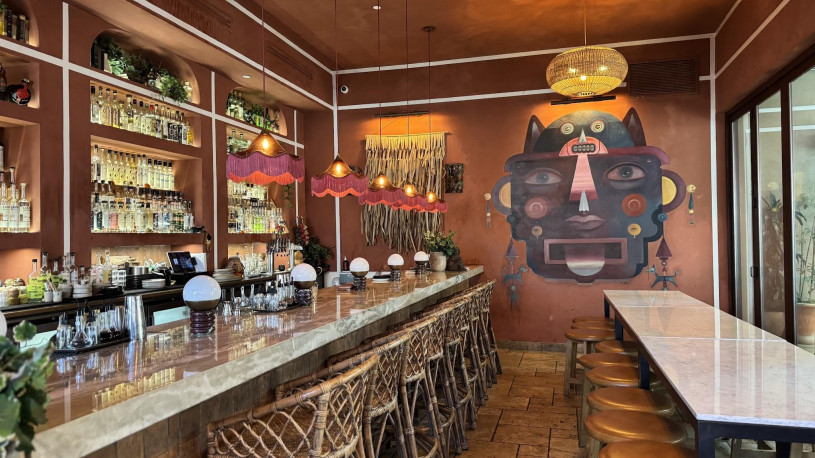
In the heart of Los Feliz, Mírate, named one of North America's 50 Best Bars, stands as an ambitious homage to the rich tapestry of Mexican gastronomy, ancestral fermentation, and pre-Hispanic drink culture. Co-led by Executive Chef Alan Sanz and Beverage Director Max Reis, the restaurant and bar go far beyond conventional dining, offering a deeply researched, ethically sourced exploration of Mexico's native spirits, wild agaves, and ancient fermented beverages. By pairing deep cultural respect with cutting-edge culinary technique, Alan and Max create a vibrant sanctuary where nostalgia meets innovation, and where every glass tells a story of community, land, and ancestral memory.
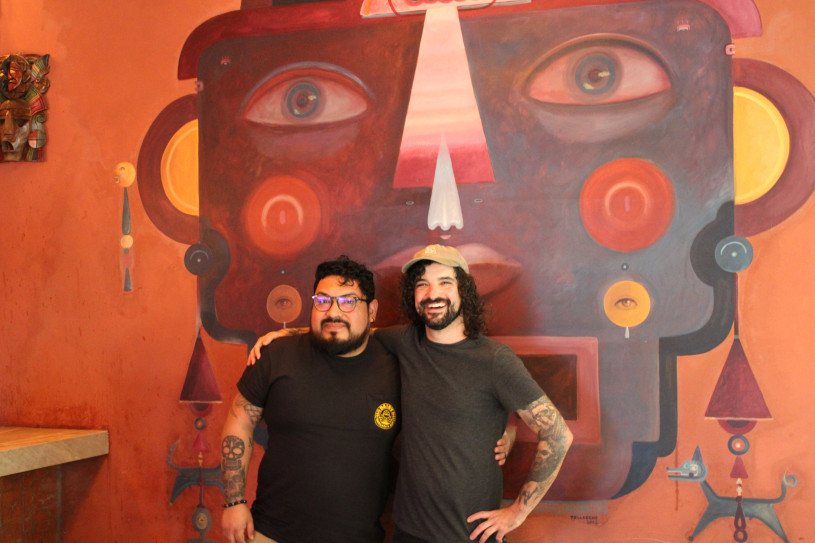
Without tradition, there is not an evolution, and everything that doesn't evolve dies. The way we present things here is by going back... understanding the roots, the heritage, and seeing what everything is surrounded by... and then having an evolution.
Chef Alan Sanz
How did your personal journeys lead you to Los Angeles and to working with Mexican spirits and cuisine?
Max Reis (Beverage Director): I was actually born [in L.A.], but I was not raised here. I come from a pretty L.A. family. My grandpa [Irving Reis, a radio program and film director] has a star on the Walk of Fame, but I was raised up in Napa. Back in the day, and still, Napa was an agricultural town, this was before year-round tourism. My high school was about 85% Mexican and 15% white, so my comfortability with a lot of Mexican culture was founded there. I moved here to L.A. when I was 17 years old. It was the day I graduated high school, with $500, and I never moved home. I was in a band that toured around... I remember playing in Juárez when I was 19, and I tried mezcal for the first time. I remember thinking, 'This is insane, I love this' and I brought it back. I was working at fine dining restaurants, and sharing it with bartenders, and it was very polarizing. Mezcal wasn't available really in the United States yet. There were two bottlings that were available at that time, which would be the Del Maguey Chichicapa... and Don Amado, that had landed shortly beforehand, but didn't have the same kind of backing, so it never made a splash, even now. My focus kept shifting more and more towards the culinary and beverage space in L.A.
Alan Sanz (Executive Chef): I was born and raised in Mexico City. My grandparents on my mom's side are from Oaxaca. I grew up going to the town every year around all this agriculture. My grandma had coffee trees in the backyard, so she used to grow coffee, toast it, and make salsas from the chili trees. My grandpa had big clay pots under the earth fermenting aguamiel. All those things, like aguamiel and pozontle, all the ancestral beverages that I had, it was because of that, the relationship that I had with my grandparents and holidays, growing up there, visiting every year, and helping with all those things that happen there, I learned and I still love all those things.
On my dad's side, my grandma is from Michoacan, so a lot of the same cultural aspects around the food. And then being born and raised in Mexico City, I got to grow up with all these influences from everywhere from Mexico.
I was also in a band, and I went to the music school for a little bit, but… I guess at some point I was just like school wasn't for me, or I wasn't for school. My dad was okay, but he said 'You're not gonna be in my house for free, so find a job.'
At that point, I was still playing with a band, they paid me, so I just wanted to find a job during the day to satisfy my dad. I went knocking on the door of a hotel, one of the biggest hotels in Mexico City, and I said I was just available for something in the mornings. The only position that was available for me was the dish washer in one of the restaurants inside the hotel. I was like, yeah sure, I mean, how hard is it gonna be washing dishes, right?
I learned my lesson that day, and I was like, 'Jesus, why did I say yes?' But, I started falling in love with the kitchen. I was watching the chefs and the cooks, they were cooking with fire, yelling at each other, and the chefs getting angry because something wasn't perfect. For me, in my head, something clicked. It was like the chef was the director of the orchestra. He's directing everybody and all the musicians are playing for him. I thought that was so cool. And then I started seeing when he had a chef as a guest for collaborations. All the chefs came with dreadlocks and tattoos, and I thought they looked more like a musician than a chef. Soon, I wanted to be on the other side. So I started, like, asking the chef to teach me a little bit, and then after that, I joined culinary school.
During and after I went to culinary school, I cooked in Chile, Spain, and France, and then realized all my style was super European. In order to connect with my roots, I moved to Oaxaca for almost four years, traveling all eight regions and researching mezcaleros and grandmas.
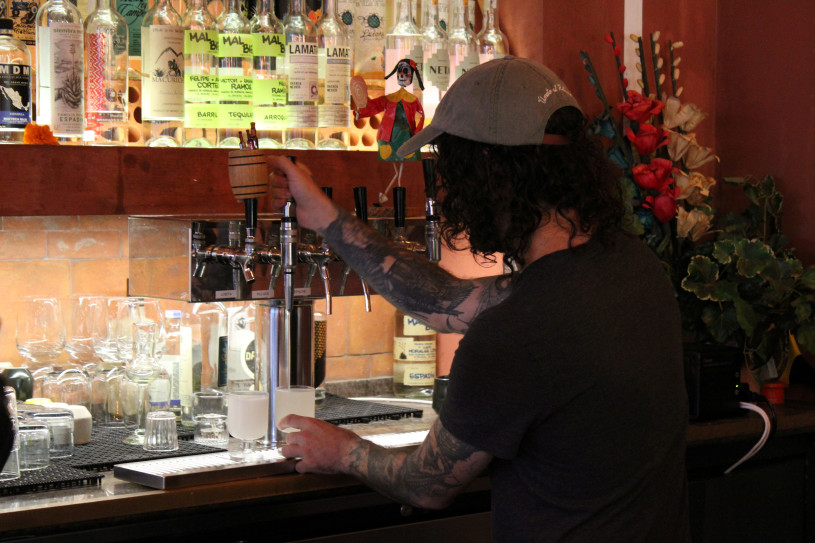
Beverage Director, Max Reis, pours fresh pulque from a tap at the bar.
How did the two of you connect to bring this collaboration at Mírate to life?
Alan: Through a fellow chef I was friendly with. He was like, hey, I have a friend in L.A. who is looking for a chef, and I recommended you. They contacted me. Then they literally said, 'Hey, we heard a few things about you, and we want to offer you to come to work for us.'
I was in Mexico City and about to open a second location for a restaurant. I didn’t think that was something that I wanted right now. But I was like, you know what, I'm just gonna go say no thank you, face-to-face. I had come to L.A. in 2019, right before the pandemic, to check out the project, and that's when I met Max and he convinced me.
Max: Alan had come over to my house for the first time, and I was living in an 1830 house that was fully restored in Highland Park that had a period soaking bathtub. It was gorgeous, like, Pinterest, Airbnb, and he came over, and I was brining a whole pig in my bathtub, and he was like, 'I think you and I are gonna hit it off'.
This is the first time since we opened where we have a very uniform front, consistency, and creativity alignment. People come for our food and come for our drinks, and we share the same mission.
What is the core philosophy behind your beverage and culinary program?
Max: Culturally, it had been more indigenous and indigenous-leaning people producing mezcal. These people were victims of colonialization. So when I first started going to Oaxaca, for example, the older generation all drank Buchanan's, because for them, it's very Western, and it makes them feel more European, right? But no one is drinking mezcal, because if you drank mezcal you would be seen as more Indigenous, and you'd be seen as lesser, getting denied these opportunities. It's all very colorist, you know?
But I was here when the first mezcal landed on the commercial market, and the second, and the third, and the fourth, and the fifth, the sixth, seventh, the eighth, so I've been privileged enough to have a slow build that not a lot of people had. I teach all these seminars and everything now, where I'm like, 'Man, I wish somebody had laid this all out for me.'
When people ask me what books are good for mezcal, I don't often have an answer, because I don't think that any of them are that comprehensive. There's a lot of fetishization of the culture, I think a lot of the books are reflective of that. Whereas my mission, and I think this is where it kind of goes back to the pre-Hispanic beverages, this is why Alan and I have gotten along, is finding aspects of the culture that we think are beautiful, that don't necessarily permeate the American perception of acceptability, and we elevate that without altering it.
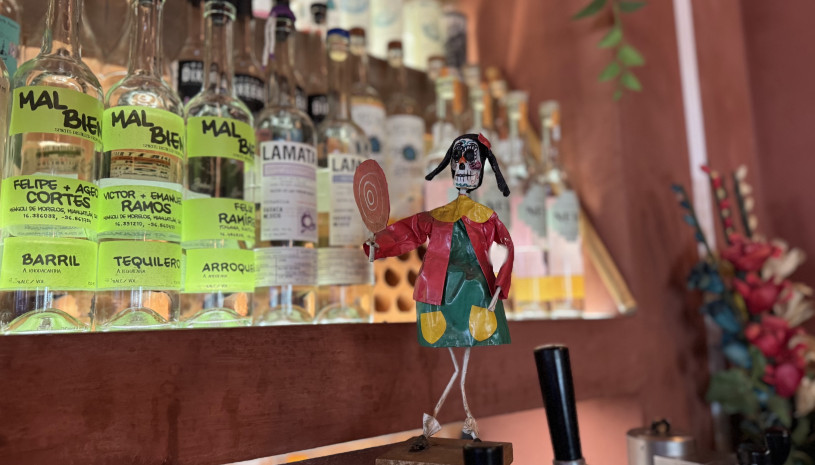
On our back bar, we carry Mexican wine, Mexican beer, and Mexican spirits exclusively. A lot of products I source directly from developing relationships with families over years and years. We make sure we're paying due diligence and respect to the product and the community.
Alan: Mexican gastronomy, it's amazing, everybody recognizes it in the world now, like UNESCO. But it's a heritage, I think the Mexican cuisine has a big romanticism behind it. It doesn't go through anything documented. When you go to culinary school, you learn from the French cookbook's techniques. There is no Mexican cookbook to show you how to use a molcajete or a metate. We have techniques, but we don't have it in a book in a way you teach all the new generations of cooks. There's a lot of books, for example, Ricardo Muñoz Zurita is one of the pioneers. His is an amazing book, but if you don't understand the actual culture and the social aspects of Mexican food, that book is not gonna tell you anything. That book is for the people that are from Mexico. Oaxaca has a little town that's called Neveria, and there they have 175 different species of corn. Why is that not in a book?
It's about connecting back to how it's traditionally made, connecting back to my childhood, my grandma, and the authentic ways of our heritage.
The featured drink here is El Pulquero. What is the story and technique behind this beverage?
Max: Pulque was the nectar of the gods, the original alcohol in Mexico, fermented from the sap of agave. Mayahuel is the goddess of fermentation and fertility. But because fresh pulque spoils within a couple of days, you don't easily find it outside production areas. I built a relationship with a family from Michoacán who has been in San Bernardino for 25 years cultivating agave and making fresh pulque using completely traditional methods.
I was inspired by a savory pulque curado I had in Mexico City with tomato juice, onion, and cilantro. To preserve the pulque without wasting a single drop, we serve fresh pulque on tap, and then take the remaining pulque to make pulque vinegar to pickle our onions. The cocktail itself uses a distillate of pulque, a vermouth substitute made from pulque, and clarified tomato water using a medical centrifuge as the dilution. It takes an ancestral beverage and turns it into a Gibson martini modeled after old Hollywood.
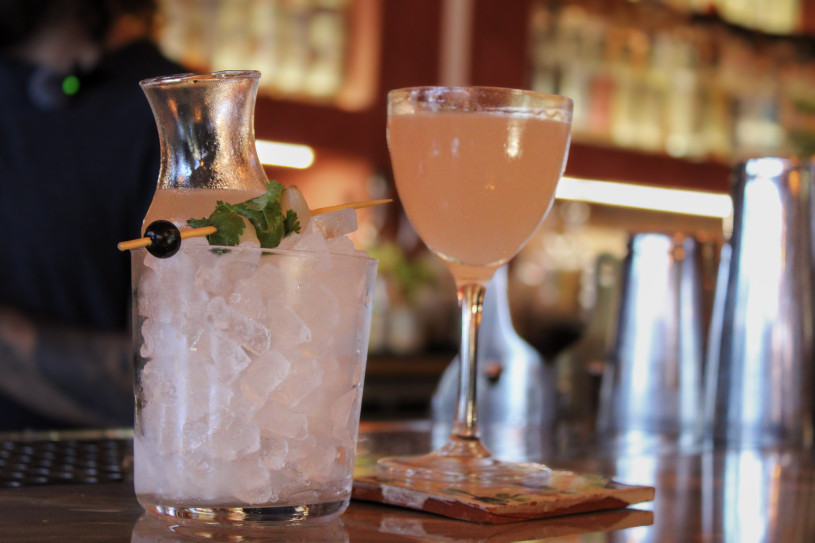
El Pulquero, Mirate's take on a Gibson, is made with destilado de pulque, fresh pulque, pulque vinagear, paranubes, clearmato, and pulque onions.
How does community and cultural pride gather around these drinks at Mírate?
Max: A lot of my friends from Mexico say they feel like this is the first time in multiple generations where it's cool to be Mexican. You get people who come in, see pulque or colonche on the menu, drinks they grew up with when they were broke in school or in their home towns, and see them served in a place like this with awards makes them feel not isolated anymore within their culture. They get so communicative and enthusiastic.
Alan: Nostalgia is super important for a lot of us. Somebody from Pachuca can have pulque here, or someone who grew up eating huitlacoche can taste it fresh. People come together, look at the table next to them, ask 'what is that pink drink?', and start explaining it to each other. That is how community perpetuates.
Max: We vote with our dollar. California is the number one consumer of agave spirits in the world. When people understand the value, support ethical producers, and respect the land, we help preserve these authentic traditions so they don't disappear forever.
Alan: The last thing that I would say is that without tradition, there is not an evolution, and everything that doesn't have an evolution, it dies. So, the way that we presented things here is, like, going back, understanding the roots, the heritage.
Explore more from Mirate
To learn more about preserving and uplifting Mexican culture through thoughtful innovation of food and beverage, visit their website.
What’s your L.A. CUP Story?
Do you know an L.A. beverage crafter who lovingly connects to your community? Join the conversation by tagging @NHMLA with #LACultureinaCup!

