Fangsgiving and Hissmas Sea Snake and Sea Turtle Search
El Niño is bringing venomous yellow-bellied sea snakes and endangered olive ridley sea turtles to Southern California beaches. We need your help to document these new arrivals and to learn how species are responding to warming oceans.

This winter, El Niño has brought strangers to SoCal’s shores.
This winter, El Niño has brought strangers to SoCal’s shores. On Sunday, November 22, a yellow-bellied sea snake (YBSS) washed up at Bolsa Chica State Beach, an event we were anticipating, even though this is only the eighth sea snake ever documented in California. More unexpected, however, is that at least four olive ridley sea turtle nests were laid on Southern California beaches.
From now through February, it is likely that more sea snakes will wash up on SoCal’s beaches and that more sea turtle nests will be discovered. We need the public to help in searching Southern California’s beaches so we can better document these new arrivals.
A NEW OLIVE RIDLEY SEA TURTLE NEST IN CALIFORNIA
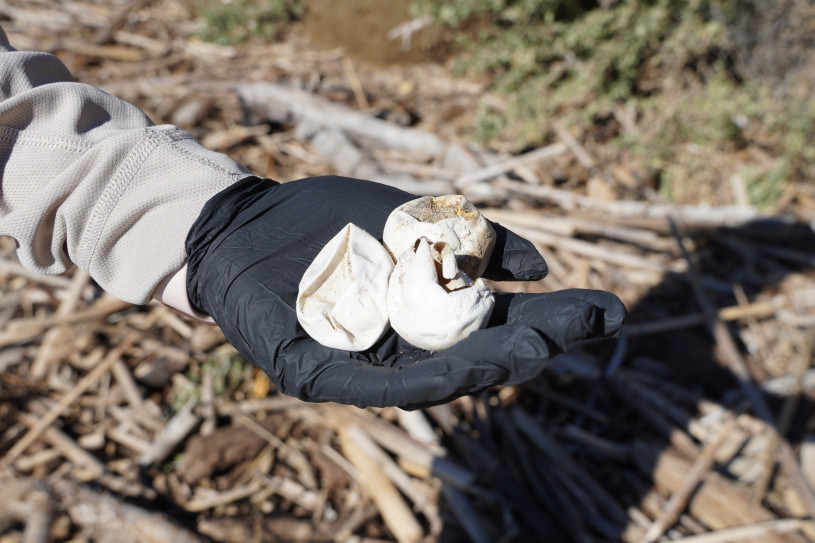
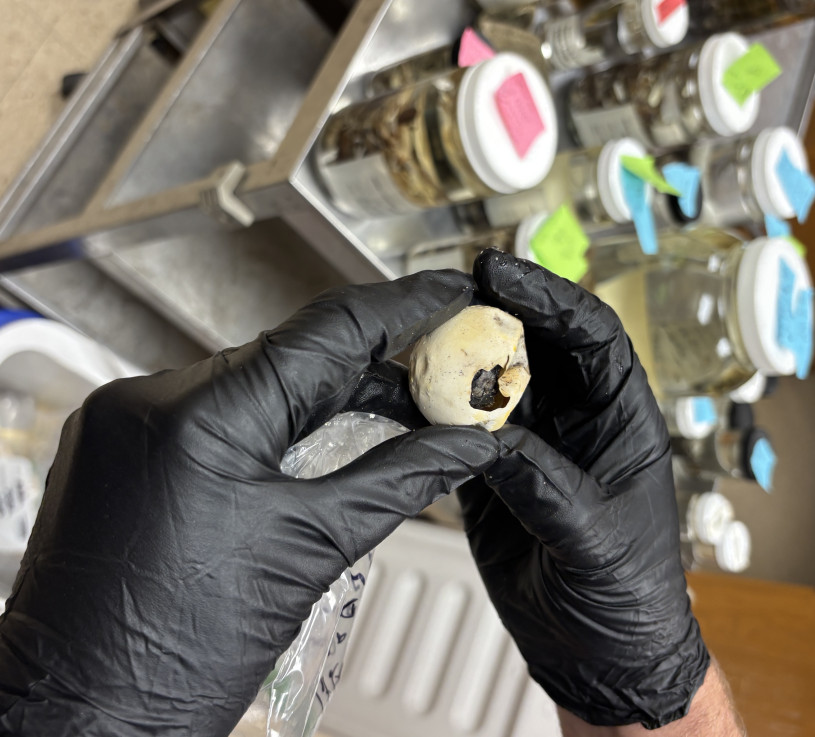
Typically, the northernmost nesting locations for olive ridley sea turtles along the Pacific coast are at Todos Santos near the southern tip of the Baja California Peninsula. However, this year, olive ridleys have nested much farther north, with the first-ever California sea turtle nesting events at Seal Beach on September 16, Huntington Beach on September 19, and San Buenaventura State Beach (Ventura) on November 1. Then, on November 18, members of the public discovered several sea turtle eggs on a beach in Carpinteria (Santa Barbara County). Those were reported to Channel Islands Marine and Wildlife Institute staff, who then found two eggs and a near-term embryo. Scientists with the US Fish and Wildlife Service conducted a follow-up survey on November 20 and found 11 decomposing eggs and another near-term embryo no longer in the egg. Subsequent examination of the salvaged eggs and embryos here at the Natural History Museum revealed that some of the embryos were likely within days of hatching when they were exposed from their nest.
The Santa Barbara County nest sets multiple new records. This is the northernmost nest ever recorded, approximately 13 miles northwest of the Ventura nest. It is also the first recorded nest in California, an honor previously held by the Seal Beach nest. Given likely temperatures in the nest, the embryos would have needed much longer time to develop than the typical 45–60 days that it takes for eggs in warmer conditions. This nest was very likely laid before the Seal Beach nesting event. The discovery of this nest suggests that olive ridley sea turtle eggs could successfully incubate in situ on California beaches under certain environmental conditions, namely that they are laid early enough in the season for sand temperatures to reach higher than 79 F for much of the incubation period.
.
YELLOW-BELLIED SEA SNAKES IN CALIFORNIA
At the start of the 2026 El Niño, only seven yellow-bellied sea snakes had ever been documented in California. Yellow-bellied sea snakes are the world’s most wide-ranging snake species, occurring in tropical and subtropical waters of the Pacific and Indian Oceans. They had never been documented in California until Thanksgiving morning 1972, when one washed ashore on San Clemente State Beach during another very strong El Niño. During the 2015–16 very strong El Niño, another four were found (in Ventura, Orange, and San Diego Counties), and two more followed in 2018 (both in Orange County). The 1972 and 2018 observations were both on Thanksgiving morning.
Because all but one of the sea snakes in California arrived during El Niño events, this species was again expected to show up during this year’s record-breaking El Niño. That has now happened with an adult male sea snake washing ashore on Bolsa Chica State Beach Sunday morning November 22. We expect more in the coming days and months. As California’s ocean waters begin cooling down in fall and winter, the sea snakes stop eating, become lethargic, and are pushed ashore during the lunar tides, storm surges, and/or strong onshore wind events.
What is the Fangsgiving and Hissmas Sea Snake and Sea Turtle Search?
Female olive ridley sea turtles usually come ashore to nest at night, often coinciding with the evening high tide. Because they can arrive after dusk and leave before dawn, it is possible that they can go undetected even on Southern California’s busy beaches. The Santa Barbara County nest demonstrates this and forces one to wonder: how many more sea turtle nests have been deposited in the past few months on Southern California’s coast?
The king tides and storm surges have the potential to erode away sand, uncovering nests. This is likely what happened at the Santa Barbara County Beach (although we can’t rule out that dogs or other animals exposed the nest). As a result, the king tides and any winter storm surges have the potential to reveal additional nests.
Similarly, the king tides have the greatest likelihood of washing ashore sea snakes. The November king tide is during Thanksgiving week and the December king tide is Christmas week. Add in some science puns, and you have the Fangsgiving and Hissmas Sea Snake and Sea Turtle Search.
With hundreds of miles of coastline, biologists are not able to survey all of Southern California’s beaches for these rare reptiles. This is where the public can help. What better way to celebrate with family, than to wander a beautiful Southern California beach looking for a wayward tropical reptile?
Although the November and December king tides are the most likely to yield interesting reptile discoveries (especially exposed turtle nests), relevant observations could be made any time now through February.
What to look for?
Turtles:
If sea turtle nests are exposed by wave action or by predators (including people’s pet dogs), there could be eggs, pieces of eggshells, and even developing embryos on the beach. The eggs are off-white and about the size and shape of a ping-pong ball. They could be a perfect sphere, or areas could be dimpled. The eggshell is leathery and more flexible than in bird eggs. It is also rather thin. If the eggs had developing embryos, the embryos could be found outside of the eggs.
Snakes:
All YBSS that have washed up in California have been adults (1.5 to 2.5 ft long). They have a yellow belly and dark, nearly black, back (this is termed countershading and is common in many marine species). The yellow turns into a wobbly line towards the tail, which is modified into a fin-like structure. The snakes can be stunningly beautiful if alive or recently deceased, but several found in California were several days post-mortem, desiccated, coated in sand and, as a result, had muted coloration.
When to look?
Turtles:
Turtle nests are most likely to be exposed by the November and December king tides and by storm surge. Thus, now through November 29, December 20–27, and after storm surges will be the best times. It will not be safe to be near the water’s edge during the high tide; instead, visit during the receding tide (at least 1.5 hours after high tide) or even at low tide. Please also read our safety advice below!
Snakes:
In short, now through February. All YBSS documented in California were observed October 4 through Jan 14*. As sea surface temperatures drop below about 74 F, sea snakes can become lethargic, feed less, and may then be washed ashore in poor health. While they have shown up in California in October in previous years, fall 2026 sea surface temperatures were so warm that any sea snakes should have been happy at sea through October. As temperatures continue to drop, sea snakes are more and more likely to be stranded. Given current sea surface temperatures, strandings are likely to be more common in December and January and may even occur into February. As for the sea turtles, it is best to look on a receding tide or even at low tide.
*Media reports of a YBSS washing up at Crystal Cove State Beach, Orange County, September 11, 2026 remain unconfirmed. While a video clearly shows a YBSS on a beach, there is no information in the video that substantiates date or location. There have been several other claims of this species washing up in California early in the 2026 El Niño posted to social media but the observed species was not a YBSS or the location was obviously not California.
Where to look?
Whether searching for stranded sea snakes or remains of exposed sea turtle nests, look amongst the beach wrack (the debris pushed up the beach by storm surge and high tides) and along that day’s high-tide line. Deceased sea snakes are likely to be amongst the beach wrack or at the high-tide line, and YBSS that are still alive could be there or on the beach below the high-tide line. Beaches in Santa Barbara, Ventura, Los Angeles, and San Diego Counties are most likely.
Snakes:
Hard to know which beaches will be best, and that will likely vary with prevailing winds and currents on any given day. If you know of a beach where you have seen fish, birds, or even litter stranded previously, try there. If past strandings can be a guide, they have shown up at (north to south:
- Silver Strand Beach in Oxnard (Oxnard State Beach or Ormond Beach also seem possible)
- Sunset Beach, Bolsa Chica State Beach (twice, in 2015 and 2026), Huntington Beach, and Newport Beach (the nearby Seal Beach, Crystal Cove State Park, or Laguna Beach also seem possible)
- San Clemente State Beach
- Coronado Beach (Silver Strand or Imperial Beaches also seem possible)
How to document?
Safety first. Second, take photos or videos! If possible, try to take some photos or videos that also include background objects that help to identify the location (e.g., a lifeguard tower, a building, a pier). Send photos of eggs, egg shells, or sea snakes to nature@nhm.org
Turtles:
Report any nesting sea turtles or possible sea turtle eggs uncovered through beach erosion to local lifeguards. If a lifeguard is unavailable, please report the incident by contacting the NOAA California Sea Turtle Stranding Line at (562) 506-4315 and/or by submitting a report to the West Coast Sea Turtle Sightings Submission Form. As stated above, please also email nature@nhm.org
Snakes:
Send photos of eggs, egg shells, or sea snakes to nature@nhm.org. Please include a cell phone number, and Museum staff will contact you as soon as possible. Most lifeguard departments in Southern California have been provided with the contact info for local experts and can also quickly notify Museum staff.
How to be safe.
WARNING: WARNING: People should avoid high tides, be observant of waves, including possible sneaker waves, and follow local closures due to coastal flooding. These recommendations are especially important during king tides and storm surges.
More generally, do not search the beach wrack or walk near the high-tide line in the few hours before or after the high tide. Look up your local high tide time and try to be on your favorite beach a few hours after the high tide (on the receding tide is best, but a bit before or after low tide is fine too).
Sea snakes are venomous and should not be handled. Even sea snakes that appear to have recently died, may in fact still be alive and capable of biting. They can be photographed from a distance, and then lifeguards should be informed. Please do not move the snake back into the water, as this will only tire them even more. The lifeguards will place the snake in a bucket or tub with a little bit of seawater so that local experts (usually staff from this Museum or the San Diego Natural History Museum) can assess its condition.

