Newly Described Snake from the Age of Dinosaurs, Tametara mirim, Reveals the Ancient Brains and Surprising Diversity of Snakes
Newly Described Snake from the Age of Dinosaurs, Tametara mirim, Reveals the Ancient Brains and Surprising Diversity of Snakes

Published July. 22, 2026
Scientists know that snakes are a highly modified group of lizards, but precisely why snakes developed their slithery, limbless, extra-long bodies (and very short tails) is an age-old, much-debated question in evolutionary biology.
Were they adaptations to help snakes burrow underground? Or were they adaptations for an aquatic lifestyle? Or did having long bodies and no limbs help early snakes better navigate the ground? Their fragile skeletons and relatively small size limited the presence of snakes in the fossil record. Researchers could look for answers in only a handful of specimens—until now.
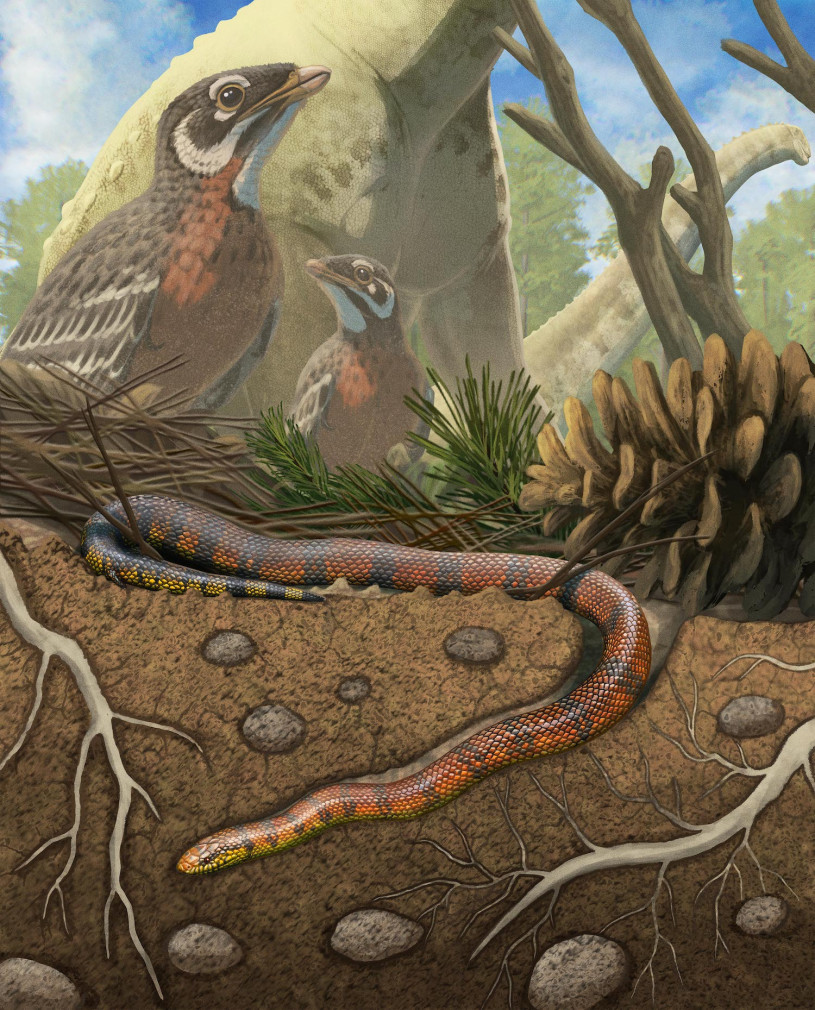
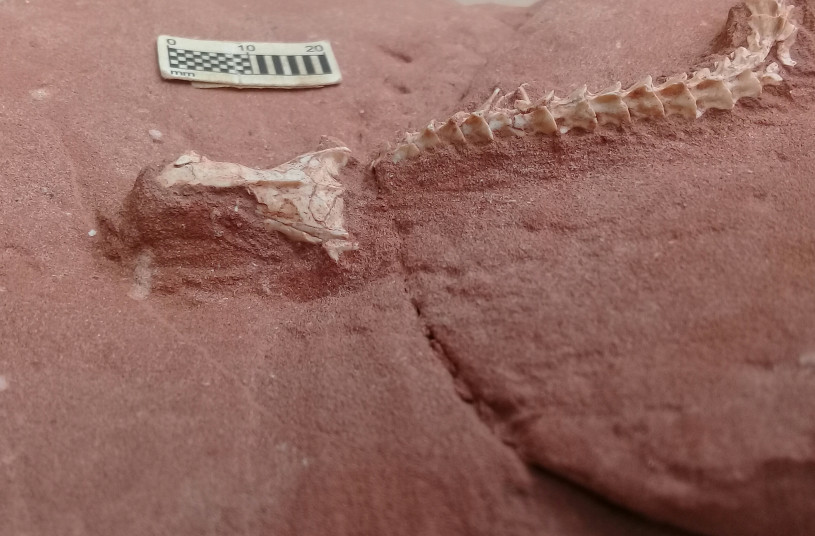
Found in Late Cretaceous deposits of southeastern Brazil, the newly described Tametara mirim is one of the best-preserved and earliest-evolving snakes discovered, and may have helped uncoil the mysterious evolutionary origins of snakes. In a new study in the journal Nature, an international team combined the discovery of Tametara with a new analytical framework to shed the old way of thinking about the evolution of snakes in the Age of Dinosaurs.
“We overhaul the old debate on the ecological drivers for the origin of snakes,” says Dr. Tiago Simões, lead author and Assistant Professor in the Department of Ecology and Evolutionary Biology at Princeton University. “We show that it is possible to accurately predict ancient ecologies from preserved morphological data in fossils, and that tells us snakes attained a remarkably wide ecological and neuroanatomical diversity by the Late Cretaceous, around 80 million years ago.”
The Head of the Snakes
The researchers behind the study, including NHM’s Senior Vice President of Research and Collections and Curator of the Dinosaur Institute, Dr. Luis Chiappe, used state-of-the-art morphological and molecular data techniques to identify Tametara as one of the earliest-evolving snakes in the fossil record.
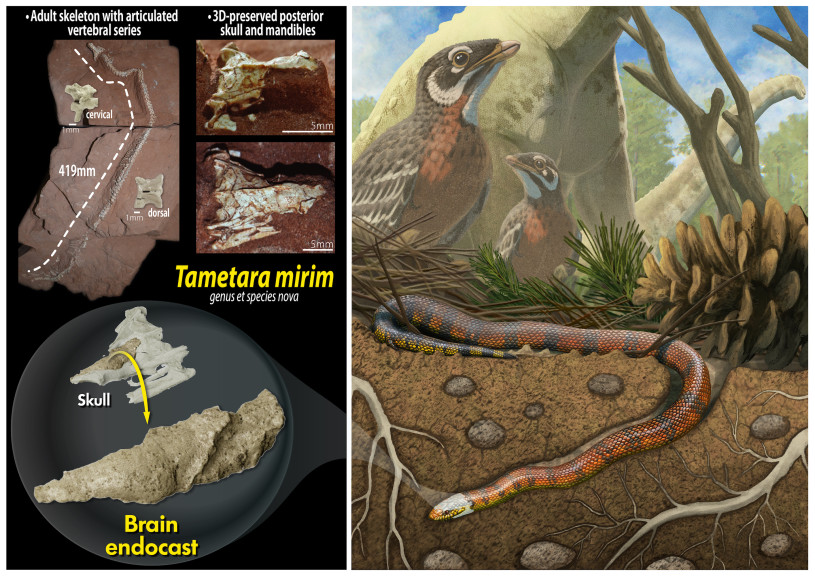
Theey then reconstructed the fossil skeleton through high-resolution computer tomography (CT) scanning. The incredibly detailed reconstruction let them digitally recreate details of Tamtara’s skull, including its brain, cranial nerves, and inner ear anatomy, called an endocast. They repeated the process with another well-preserved snake fossil, also from the Late Cretaceous: the previously described Dinilysia patagonica from Argentina. Combining the data from the endocasts of these two early snakes gave the team the clearest picture yet of the origin of snake brains.
The team compared this new portrait of ancient snake brains with data from more than 100 snake species. They found that the ancient snakes’ brains were both very different from each other and from most living snakes. The surprising disparity reflects a highly diverse brain structure at the dawn of snakes.
The authors also found that the microstructures and brain shapes they studied could predict what kind of habitat a snake preferred. Using their new framework, they identified Tametara as a burrowing snake adapted to life underground, while Dinilysia would have preferred slithering on the surface. Combined with fossil evidence of snakes from the Cretaceous in marine sediments, shows that snakes were transitioning into all three habitats at their evolutionary beginnings.
“The ancestral condition for all snakes was not one strongly adapted to a single habitat. Rather, it was a transitional one, lying in the interface of fossorial and ground-dwelling environments,” adds Dr. Simôes.