One Tropical Bird's History Through the Lens of Lice
NHM's new Ornithology Collections Manager, Juliana Soto-Patiño, discovers the evolutionary origins of the mysterious Sapayoa aenigma through its parasitic louse

Updated July 14, 2026
Key Takeaways
- Sapayoa aenigma is found in a section of the rainforest that spans over Central and South America, including Colombia
- The Sapayoa's only close relatives are found on the Eurasian and African continents, meaning it didn't evolve in the Americas at all.
- Researchers traced its evolutionary journey by analyzing the genetic history of its lice.
When is a bird a mystery? When it’s an aenigma.
Sapayoa aenigma is a little green bird found in a thin slice of tropical rainforest cutting through Central and South America, including Colombia, the most bird-biodiverse country on the planet. Just one of the incredible menagerie of the region’s birds, Sapayoa is unlike any of its feathered neighbors on a genetic level. In a sea of biodiversity, Sapayoa is an island unto itself.
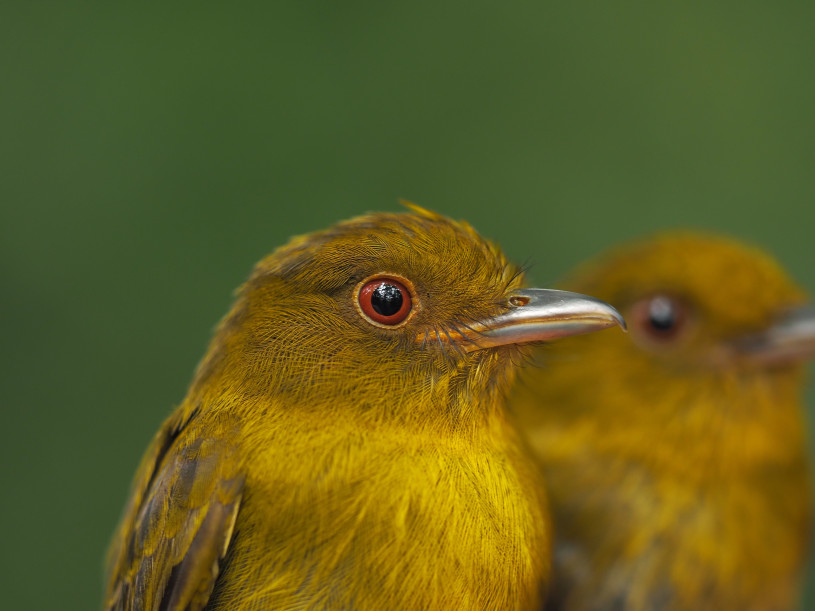
“It's fascinating because the bird species is currently distributed in the Pacific of Colombia, Ecuador, and Panama. So it's kind of unique and endemic to this area,” says Juliana Soto-Patiño, lead author and NHM’s new Ornithology Collection Manager. Before the advent of genetic analysis, Sapayoa’s morphology—its body plan and physical adaptations—made it difficult to confidently classify among other Neotropical birds. “So ornithologists put it in its own family, and then with the boom of genetics and genomics, they were very surprised to find this South American bird’s closest relatives are in Africa and Asia, and it's the only one of this group that occurs in South America. How is this bird distributed in this geographic region if their closest relatives are in the other part of the world?”
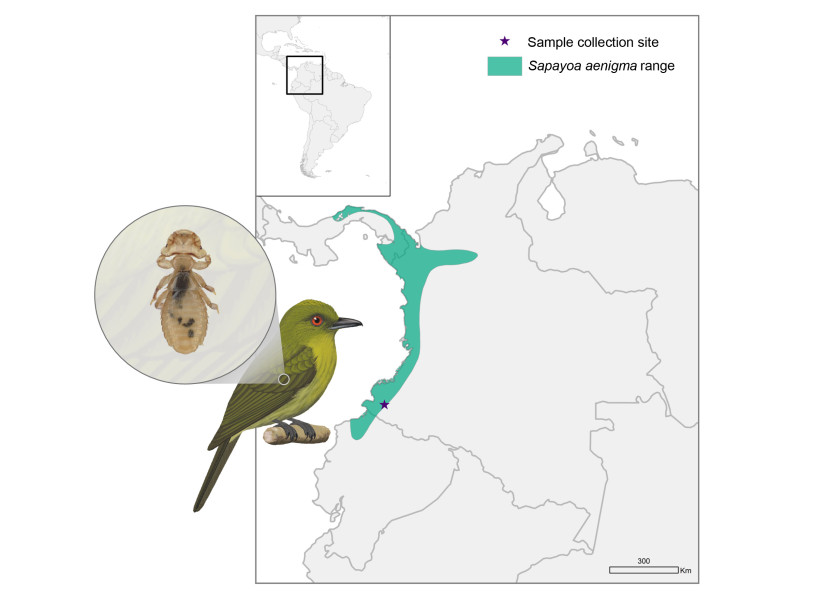
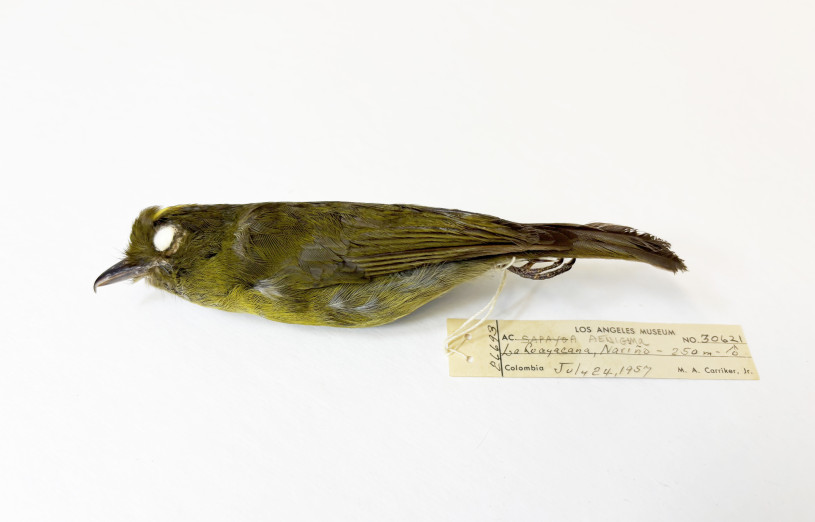
Published in the journal Biology Letters, Soto Patiño’s research solved a part of the mystery while highlighting the value of collections, particularly as part of extended specimens that include samples like tissues and parasites as well as traditional preserved skins.
“There are two main hypotheses,” says Soto-Patiño, “One is that the entire lineage of this group originated in South America and, for some reason, the other members went extinct, leaving Sapayoa as a relict lineage. The alternative is that the group originated in the Old World—Asia or Africa—and that this lineage somehow dispersed to the Americas.” Genetic analysis of the birds themselves could only answer part of the question. To understand how and when Sapayoa landed in her neck of the rainforest was a decades-long mystery for researchers. To gain new insight, Soto Patiño and her colleagues turned to an unexpected source of evidence: the tiny chewing lice that live on the bird.
Truth in Parasites
The lice of the genus Myrsidea parasitize many bird species around the world. Soto Patiño and her international team analyzed genomic data from over 90 specimens collected across continents to reconstruct the evolutionary history of the unique louse that lives on Sapayoa.
“I was interested in tracing the complex history of these enigmatic birds using genetics and evidence from its parasites to see what they could reveal about its geographic origin,” says Soto Patiño.
"One of the advantages of studying parasites is that they have much faster generation times,” notes Soto Patiño. While a bird might take millions of years to diverge into new species, parasites like lice evolve more rapidly. That means events in the host’s history can leave detectable signatures in the DNA of the parasites.” Viewed through the lens of parasites, shifts in geography and evolution can become much clearer.
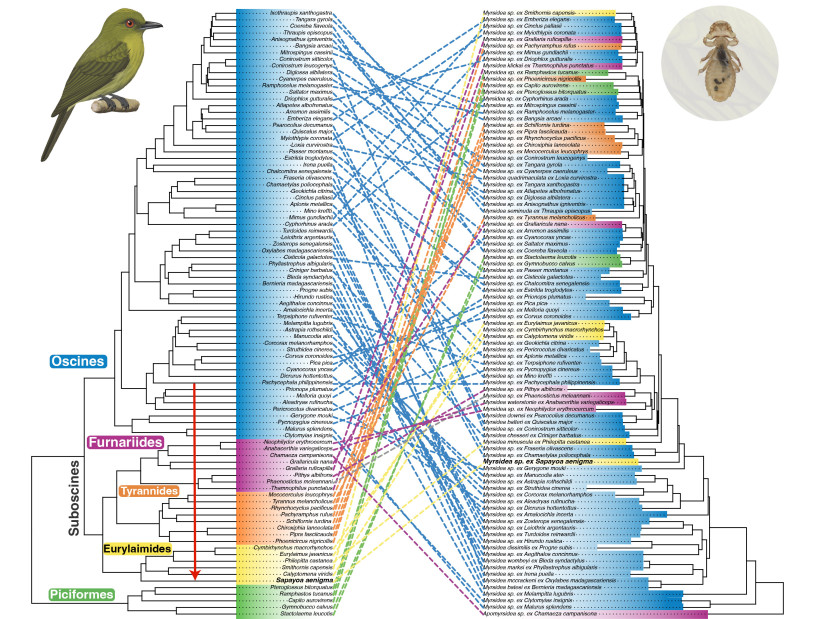
are used for both tip labels and the connecting lines, highlighting cophylogenetic structure across lineages; trees were rotated to minimize line crossings. The red arrow marks the direction of the host switch inferred from the reconciliation analysis in eMPRess, representing the event that gave rise to the Myrsidea lineage currently found on Sapayoa aenigma.
Bird illustration: © Avifauna Colombiana, F. Ayerbe-Quiñones.
By reconstructing the genetic history of the parasite, Soto Patiño and her team were able to retrace not only the louse’s journey but also Sapayoa’s deep evolutionary past. Their study shows that Sapayoa acquired its distinctive louse lineage in the Old World after Sapayoa had already become a distinct lineage among its relatives. From there, both bird and parasite appear to have dispersed together, eventually reaching the tropical rainforests of South and Central America.
Our New Bird Collections Manager
As Collections Manager of Ornithology, Soto Patiño will play a key role in advancing the Museum’s work with “extended specimens”—modern approaches to collecting that expand the scientific value of collections. “Traditionally, when preparing specimens like birds or mammals, we preserved primarily the skin. But with new technologies and capacities, we now also collect tissues and associated organisms, like parasites. Parasites were overlooked for so long, but they can teach us so much.”
Alongside managing the Museum’s important bird collection, Soto Patiño will continue her research examining birds through their parasites. Currently finishing her PhD in Ecology, Evolution, and Conservation Biology at the University of Illinois at Urbana–Champaign, Soto Patiño was born and raised in Colombia.
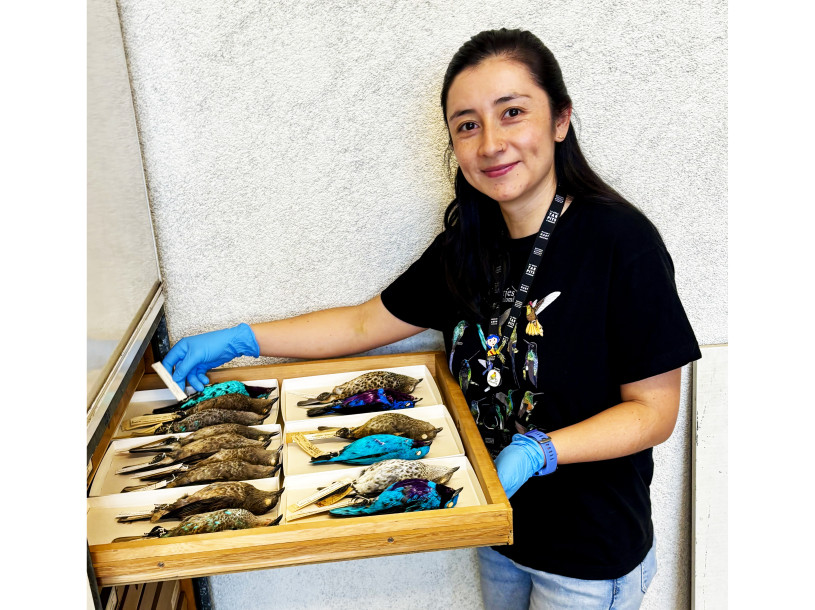
“Growing up in Colombia, you’re surrounded by nature,” says Soto Patiño. “We just have so much biodiversity—it’s very easy to fall in love with nature.” Her home’s staggering biodiversity enchanted Soto Patiño from an early age, leading her into biology, extensive field expeditions, and into the halls of natural history collections. When the collections manager opening posted, Soto Patiño saw the job description and knew she had to apply.“I read everything, and I was like, yeah, that's me.”
Beyond the collection, Soto Patiño is committed to advancing diversity, equity, inclusion, and belonging in the sciences. She’s also a lively voice for communicating scientific discovery to broader audiences. As she continues her PhD and her work at the Museum, she has an eye on expanding research on parasites and strengthening the role of collections as engines of discovery.
“I am thrilled to have Juliana as our new Collections Manager,” says Dr. Allison Shultz, Curator of Ornithology. “She not only brings a wealth of knowledge on birds and bird specimens, but will help us to make our Ornithology Collection even more useful to current and future researchers by expanding our collection of associated parasites. As someone who specializes in feathers, I couldn’t be happier to have a partner whose knowledge is so complementary—after all, feathers are essentially the habitat for chewing lice!”
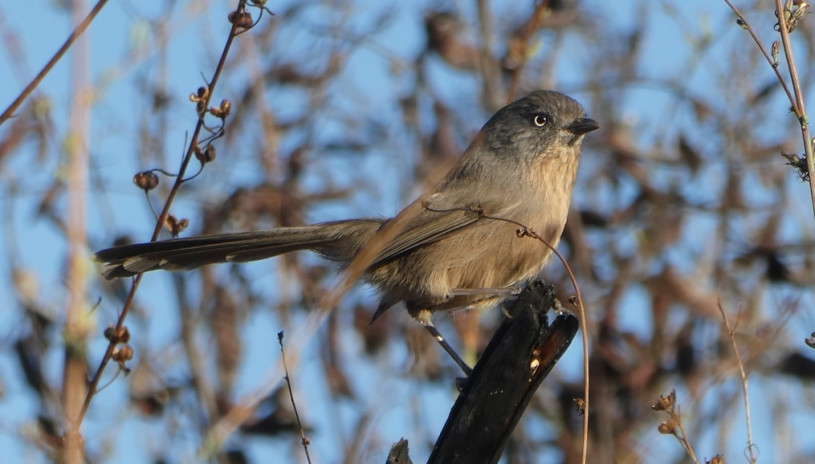
iNaturalist observation uploaded by Dan Horowitz

