
Coffee for Collective Connection
Amanda-Jane Thomas and Shanita Nicholas | Sip & Sonder

NHM Online Presents L.A. Culture in a Cup, a year-long initiative celebrating the stories of the diversity of Los Angeles and its people through the lens of the beverages and their significant vessels that bring us together.
For Amanda-Jane Thomas and Shanita Nicholas, coffee is more than a beverage; it serves as a powerful conduit for community, creativity, and connection. Both practicing attorneys before becoming entrepreneurs, they founded Sip & Sonder together, a place born from their personal craving for a truly representative "third space", a locale outside of home and work, where Black and Brown communities could freely gather, collaborate, express themselves creatively, and simply be without reservation. By roasting their own beans and building direct relationships with farmers in Mexico, Thomas and Nicholas are not only guaranteeing the quality and ethical sourcing of their beans but are actively working to reclaim and recenter the narrative of coffee, a narrative often decoupled from the labor and heritage of the Black and Brown people who cultivate it.
The founding of Sip & Sonder is a compelling testament to the power of manifestation and conscious design. Amanda-Jane and Shanita invite their community to follow their journey, offering a transparent look into the process of turning a collective need into the tangible reality it is today.
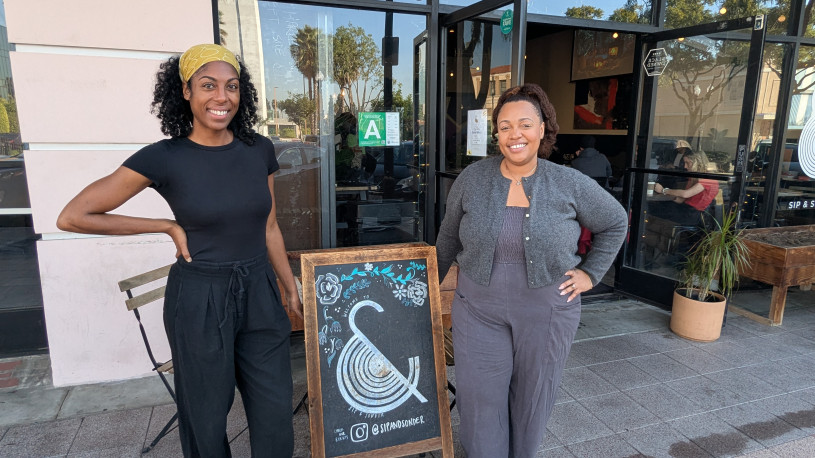
Shanita (left) and Amanda-Jane (right) stand proudly outside their storefront, where they welcome community into their shared "third space".
Natural History Museum of Los Angeles County
I never really dreamed that I'd be in food and beverage, right? And I'm always very honest about that. But what I'm doing with Sip & Sonder is also the manifestation of all of the things that I am passionate about and have dreamed of.
Amanda-Jane Thomas
Both of you practiced law in New York before entering the coffee scene, what was it that brought you on this specific journey in Los Angeles?
Amanda-Jane: I always dreamed of moving to Los Angeles since I was a kid, viewing it as a place where dreams come true, much like how others viewed New York. My initial plans to move there for college didn't work out, nor did my subsequent attempt to relocate for law school. It's really hard to get into California law schools, and so that didn't work out either. I practiced law in New York for about two years before applying for jobs and interviewing in Los Angeles, hoping to transition my legal career there.
While at that first law firm, I met Shanita. I realized that my passion wasn't fully met by being an attorney. I loved certain things about being an attorney, but it didn't speak to my true passion within. I began this path of self-discovery, I began this journey of asking myself and everyone around me, you know, "What do I really want to be when I grow up?" Shanita and I became friends at the firm and would hold space for each other through these discussions.
Shanita: It's so funny because I started remembering when I was a child, and we'd have sleepovers with my cousins in Maryland. We'd always talk about when we got older and how life would look. We would always say we would be in L.A. living together, and I actually forget about those moments. So hearing you, Amanda, I've heard you say this before, but for some reason, I was like, oh yeah, we used to dream about this life in L.A., and living all together. So returning to past selves in that way is really interesting to think about.
While practicing law in Bed-Stuy, New York, I began contemplating opening a coffee shop there or moving. This was a pivotal time. I founded "and Drink Coffee," a group to meet at local coffee shops, reflecting my deep belief in community and space. A true turning point came when I read "The Untethered Soul" in a Bed-Stuy cafe. Inspired by an exercise on manifestation, I decided my move to L.A. hinged on three signs: getting a second-round interview at an L.A. law firm, securing a way to get there, and a reason to stay. Within four days, my friend offered me a recruiting trip to Stanford, which got me to the West Coast, and the L.A. law firm asked me to fly out for a second-round interview that very week. That rapid sequence confirmed I was meant to be in L.A. I got the job and moved.
Later, in conversations with Amanda about our next steps, the enduring importance of coffee led us to the idea for Sip & Sonder. I realized the choice wasn't between starting a coffee company in New York or moving to L.A., but a bigger picture that beautifully culminated in Sip & Sonder.

Courtesy of Sip & Sonder
Shanita, like Amanda-Jane, got her start as a lawyer in New York. She frequented coffee shops in search of a third space.

Courtesy of Sip & Sonder
In 2018, Shanita was recognized as one of 40 under 40 emerging civic leaders that represent the highest levels of service in the fields of labor, business, public service, NGO/philanthropy or media by the Empowerment Congress and the Office of Los Angeles County Supervisor Mark Ridley-Thomas.
You describe Sip & Sonder as a space for "culture." What was the non-negotiable vision when you started?
Shanita: Thinking about the non-negotiables, I started with the idea of why. Creating Sip & Sonder was a way to open a coffee shop and build communities that authentically reflect who we are as Black women. There is a deep cultural element to this vision. As an Army brat, I had the privilege of traveling and experiencing the unique spaces and communal experience a coffee shop offers. However, returning to my “default” home in Maryland, I realized these spaces were non-existent in my community. Accessing such a place, a "third space" where you could feel a sense of immediate ownership, spend time for yourself, or connect with others, required traveling an hour into D.C. I understood the profound importance of this access.
It was crucially important for Sip & Sonder to be physically located in and connected to Black and Brown communities. This commitment meant taking up space unapologetically, especially within an industry that has a supply chain and history deeply connected to Indigenous, Black, and Brown communities worldwide.
A non-negotiable for Sip & Sonder is its identity as a culturally connected, non-confused coffee company. We deeply understand the product's origins, what community surrounding the product looks like, and how we integrate that into our physical spaces. While being grounded in culture and community that reflects who we are remains a deal-breaker, a beautiful and somewhat unexpected extension of this journey has been our growing global connectivity. This global connection continues to be a hopeful and expanding surprise.
Amanda-Jane: I think the one thing that I'd add is, I think in starting this journey, it was really important to me that I didn't want to just open a coffee shop. I wanted it to be more; it was about a deep "regard for humanity." This is a guiding principle for everything we do.
This regard starts at the origin, recognizing the real people, from South America, the Caribbean, Africa, Oceania, and elsewhere, who pour their lives and love and labor into cultivating the product that arrives in our cup. Our appreciation for humanity is at the beginning of the process and extends all the way to you and I, right? By putting this appreciation and guiding principle at the center, we've built a company where coffee is the "golden child," but its also the central spoke. Around that center is a wheel of connectivity, where coffee becomes the foundation for something larger.
This intentionality is captured in one of our taglines: "Come for the coffee, stay for the culture." This refers both to the culture of coffee and the culture of people, all of our diverse backgrounds, experiences, and community activations. The humanity piece is not a negotiable; it is a "guiding force" and a profoundly important piece of everything we set out to accomplish.
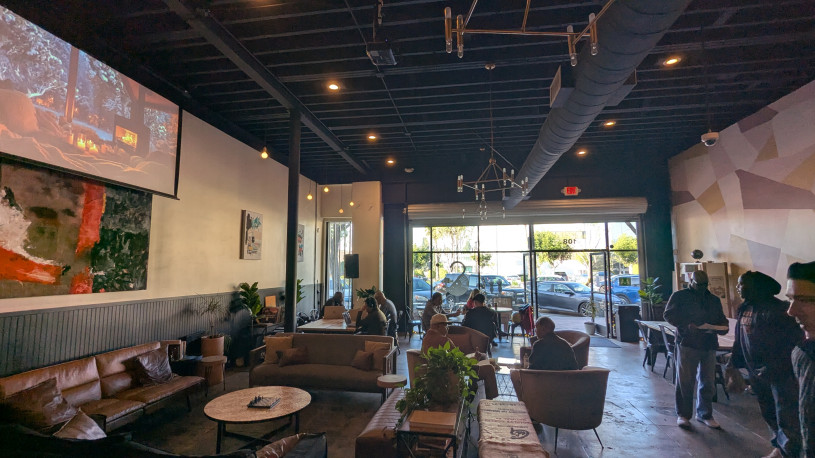
"Come for the coffee, Stay for the culture" Sip & Sonder's catchphrase reflects not only the intentionality behind how they source their coffee, but also as a reflection for how Amanda-Jane and Shanita have created a welcoming third space that is reflective of the communities in which these coffee shops are located.
Natural History, Museum of Los Angeles County
Your featured drink for this initiative honors a historical figure. Can you tell us about the "Nod to Nicaud"?
Shanita: The "Nod to Nicaud" is a seasonal drink that holds deep historical significance for us, reflecting who we are and the path we've taken to grow in this space.
It is inspired by Rose Nicaud, a woman who was enslaved in the New Orleans area. She is believed to be one of the first people to establish a coffee cart to sell coffee to the community—a profound act of innovation, ingenuity, and entrepreneurship. Rose Nicaud used the funds earned from her coffee cart to purchase her own freedom.
Her story is rich and complex, touching upon many facets of history that often go untold. When we look at the history of coffee, especially within the U.S., the narrative is overwhelmingly dominated by white males. Rose Nicaud provides a vital connection to a lost history, in particular, that of Black women who utilized available resources—such as coffee—not only to foster community engagement but also to forge a literal path to freedom for themselves and, by example, for others.
The core meaning behind the drink's name and Rose Nicaud's story is a reflection on several key themes: How do we engage in capitalism? How do we build meaningful relationships? How do we create social impact and community connection using coffee as a central resource? This approach challenges traditional, prescribed notions of what a business should look like, how a community should engage, and the levels of freedom we are entitled to.
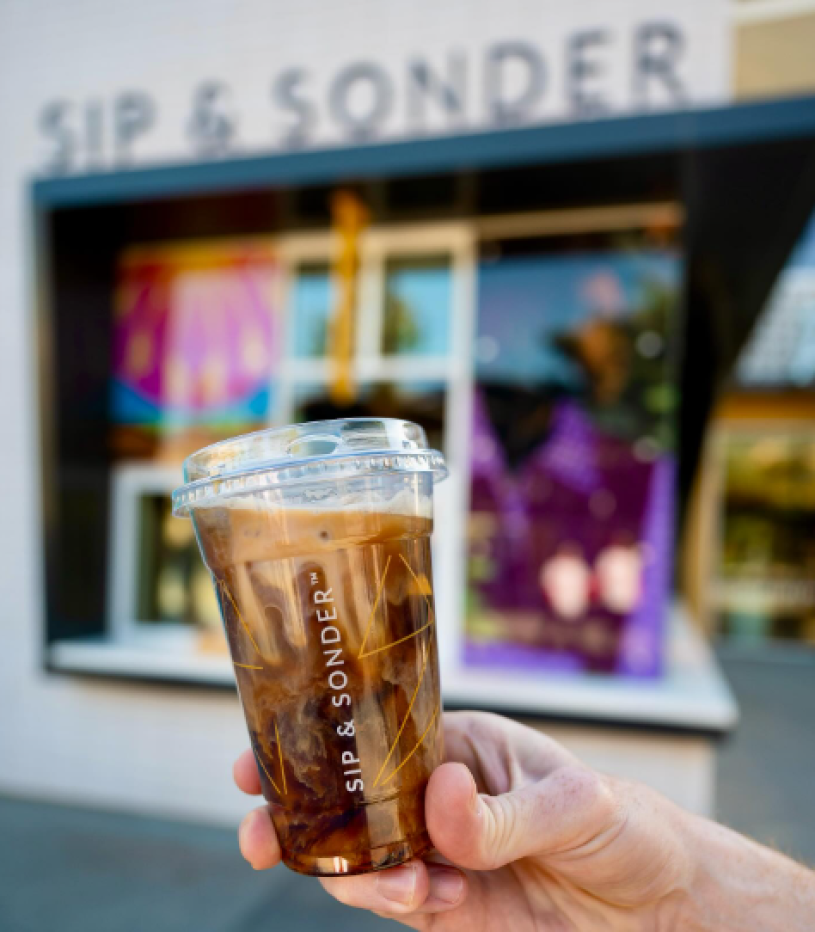
The "Nod to Nicaud" can be found at Sip & Sonder's coffee shop seasonally but it's always a great reminder of the history and heritage that the shop (and Shanita and Amanda-Jane) continue to uplift.
Courtesy of Sip & Sonder
While the "Nod to Nicaud" isn't a permanent fixture on our menu, it serves as a powerful acknowledgement of Rose Nicaud's legacy. Her journey is deeply reflective of our own collective paths, viewing the product of coffee as a vehicle for community activation and a continuous journey toward freedom, in all the diverse forms that it takes for all of us.
Amanda-Jane: We've tended to opt for a richer, darker roast profile. The one we're developing is the one that we'll be utilizing for this drink next. The origins, Ethiopia and Mexico, are deeply meaningful, offering a comprehensive understanding of coffee's provenance. We also incorporate chicory, which connects to the story of Rose Nicaud. Because coffee was and remains expensive, and not always widely accessible, she would commonly use chicory in New Orleans to supplement her brew. This history inspires our "Nod to Nicaud," a chicory coffee cold brew, where the ingredients hold significant meaning.
You are currently roasting coffee sourced directly from Mexico. How does that connect to your mission?
Shanita: We roasted our own coffee in Los Angeles and have been doing so for several years. The specialty coffee world is quite small, and a chance meeting at a cupping session with a former roaster of ours, Brennan, led to an exciting connection.
I had been spending a lot of time in Mexico, particularly Mexico City, over the past year to experience the origin firsthand and become more integrated into the local scene. During the cupping, where we were sampling Ethiopian coffee, Brennan mentioned a new cafe and roaster in the Juarez area that I absolutely had to visit: Tostador 1.
On my next trip to Mexico City, I went to Tostador 1., met the team, and pitched them a collaborative roasting project. The idea was to partner with roasters in countries of origin to de-center the U.S. narrative and flow of coffee—instead highlighting the people involved in the creation process. Omar, the founder of Tostador 1., was immediately enthusiastic. He saw the project as a perfect fit for their mission, which is to exclusively source and roast coffee from regions in Mexico—for example Puebla and Veracruz, that are sometimes overlooked. This rapid collaboration started this year, moving quickly because of our shared values.
We focused on a concept that highlights both Ethiopia, the birthplace of coffee, and Mexico, which has the largest in-country consumption. Both are significant coffee-consuming nations of their own product. This entire partnership truly highlights the power of relationships: talking, meeting people, and being open to saying yes because we have a common vision for the global coffee community.
Amanda-Jane: We are preparing for a week-long pop-up event in Mexico City. Shanita is currently there, overseeing the creation of a unique coffee blend. This blend, which marries Mexican and Ethiopian coffees, is being locally roasted on the ground in Mexico. This initiative creates a tangible cross-cultural connection through the coffee itself, complemented by various local experiences. This element has been absolutely essential to everything we do from the very beginning.
Shanita: This is a company that really, deeply understands where the product comes from; what community around the product looks like; and how we implement that into space. A beautiful and somewhat unexpected development has been our increasing global connection. For example, I am currently in Mexico City meeting with a co-roaster, marking a significant step in our journey to connect with the coffee's origin. Maintaining this connectivity to the product's origin is essential, as it threads through our entire process. This ancestral and historical connection to coffee highlights why our community and cultural grounding are so vital, allowing us to expand into these other spaces.
Ultimately, being firmly rooted in a culture and community that reflects who we are is another non-negotiable. Our continuously deepening global connection is a wonderful, extended surprise.

Courtesy of Sip & Sonder
Amanda-Jane pulls an espresso shot as she prepares drinks in the coffee shop.

Courtesy of Sip & Sonder
Shanita visits "Tostador 1.", a coffee shop that focuses solely on coffee, roasting their own coffee beans onsite.

Courtesy of Sip & Sonder
Shanita and Omar, owner of Tostador 1., discuss their next collaboration, a blend that highlights both coffee's Ethiopian roots and it's mass consumption in Mexico.
Why is it important for spaces like Sip & Sonder to exist in Los Angeles today?
Shanita: I think about part of the community building and the storytelling connected with “what does it mean to make history?” An anecdote immediately comes to mind that illustrates this community spirit. When Kobe Bryant passed away, the shop was completely full. I was sitting next to someone who had come in, and she started to tear up. We were just talking. It was early on in our history, I believe we opened in 2019, and she told me, "I just wanted there to be somewhere I knew I could grieve within my community and feel okay with that."
This really underscored the vital importance of having spaces within our communities to be together, allowing those collective stories to become part of our shared DNA. The physical space of Sip & Sonder acts as a vessel for these stories, which become integrated into families, community, and history itself. These are the things we carry forward: the moments, experiences, and spaces of acceptance that allow us to be whole people.
Though I may not be expressing this as coherently as I'd hoped, I know that day, that moment, was the living embodiment of why we must exist. These spaces must exist. These moments of connection make us human, and echoing Amanda's point about being entrenched in humanity, these are the stories we have the opportunity to create and hold onto.

Courtesy of Sip & Sonder
Shanita and Amanda-Jane stay committed to carrying forward the moments, experiences, and spaces of acceptance that allow us all to be whole people.

Courtesy of Sip & Sonder
EXPLORE MORE FROM SIP & SONDER
Taste the Collaboration: Visit Amanda-Jane and Shanita at Sip & Sonder—head to their Downtown Los Angeles location at The Music Center and try the "Nod to Nicaud" for yourself.
WHAT'S YOUR L.A. CUP STORY?
Do you know an L.A. beverage crafter who lovingly connects to your community? Do you want to share your favorite experience at Sip & Sonder? Join the conversation by tagging @NHMLA with #LACultureinaCup, and your story could be featured next!

