
HIGHLIGHTING THE MAKERS & MIXERS WHO BRING US TOGETHER
Marc Canter | Canter's Deli

Step inside Canter’s Deli on Fairfax Avenue, and you are immediately enveloped by a sense of permanence. Beneath the iconic autumn-leaf ceiling, third-generation owner Marc Canter oversees a 24-hour sanctuary that has served as the city's "neutral ground" for nearly a century.
From its humble beginnings as a Jersey City fruit cart in the 1920s, to its foundational years in Boyle Heights starting in 1931, and finally its migration to Fairfax Avenue in 1948, Canter’s is the story of a family that followed the pulse of Los Angeles as it expanded west. It is a place where rock legends, movie stars, and neighborhood regulars share the same orange vinyl booths, held together by a tireless dedication to tradition and the hum of a 1948 oven that never turns off. But beyond the legendary sandwiches lies a narrative of resilience—a family that didn’t just survive the shifting tides of Los Angeles, but fixed the very machinery of the city to keep its history alive. Read on to discover how a glass of secret-recipe pickle juice and a commitment to "not changing" created an L.A. icon.
In a city like Los Angeles, everything is always being torn down or turned into something 'modern' or 'corporate.' But at Canter’s, we’re the one thing that is still authentic and messy and totally original.
Marc Canter
My family’s journey actually began around 1920 in Jersey City, where my grandparents sold fruit and food off a cart. They eventually opened their first store in 1924, but the Depression knocked them out of business. They ended up in East L.A. in 1931, opening a deli in Boyle Heights at Brooklyn and Soto. That neighborhood was the heart of the community then, and I still visit that original location today—though it's a dentist's office now. By 1948, the neighborhood started migrating west, so my family followed, moving first to a smaller spot on Fairfax before settling into the old Esquire Theater building in 1953, where we remain today.

Photo courtesy of Canter's Deli
Opened in 1924, Canter Brothers served traditional Jewish fare to the local community until the 1929 Stock Market Crash forced the Jersey City delicatessen to close its doors.

Photo courtesy of Canter's Deli
Pictured here is the original 1931 Canter’s Deli storefront on Brooklyn Avenue in Boyle Heights. Currently occupied by a pediatric dentist’s office, the transition from a local restaurant to a health clinic is a poignant reminder of how neighborhoods evolve but businesses still serve their community.

Photo courtesy of Canter's Deli
The Canter Family poses inside the Boyle Heights restaurant in 1931. The deli was a bustling social hub for the Jewish community in Boyle Heights, serving as a meeting place as much as a restaurant.

Natural History Museums of Los Angeles County
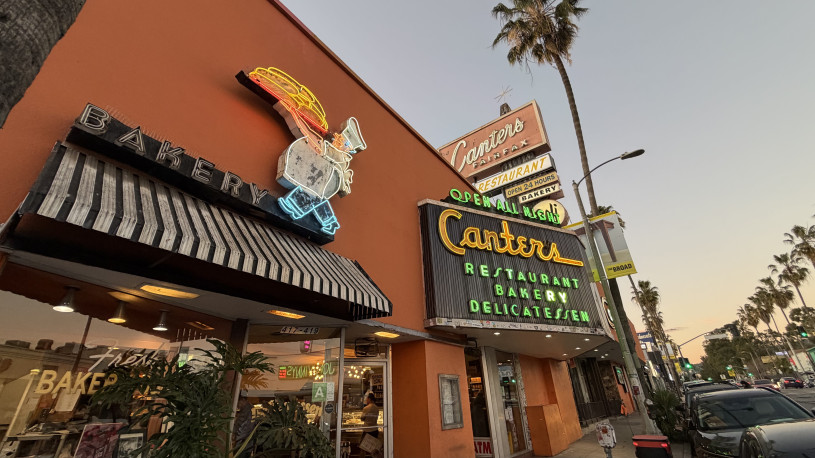
As Marc points out, if you look closely at Canter’s today, you can still see the Esquire Theater "hiding" in the floor plan. The famous neon Canter’s sign is a modified version of the theater’s original marquee structure. The entrance and bakery counter was originally the theater’s lobby and ticket area. Head upstairs to the restrooms and you're stepping inside the original projectionist’s booth and manager's offices.
It came from having a vision for the city’s growth and a dedication to hands-on preservation. In 1965, my father, Alan, had the foresight to buy the building next door and knock it down for a parking lot because he knew families would eventually have multiple cars; that decision is a major reason we survived into the 70s and 80s. I’ve been working here for 44 years, following my grandfather’s 50 years and my father’s 65. A big part of being a landmark is maintaining the original feel; I do all the physical maintenance myself, from the plumbing and refrigeration to fixing our 1948 Marshall oven. People love us because we don't change. We keep the original neon, the original booths, and the same recipes because that consistency is what makes us special.

Photo courtesy of Canter's Deli
While Marc was around the restaurant his entire life, he officially began working at Canter's at 17. Following the family tradition, he didn't start at the top. He was trained across every department to ensure he understood the mechanics of the 24/7 operation.

Natural History Museums of Los Angeles County
Golden hour over a guaranteed parking spot. In the early 1950s, many businesses were still relying on foot traffic. The Canters were ahead of the curve, realizing that as the city expanded, the "drive-in" accessibility would be the key to longevity. To this day, the Fairfax District is notoriously bad street parking in Los Angeles. The Canter’s lot isn't just a convenience; it’s a competitive advantage that has kept them packed for seven decades.

Natural History Museums of Los Angeles County
The retro vinyl booths are the heart of the restaurant. Canter's hasn't changed its layout or style in seven decades. These booths, which Marc sits in, have held everyone from Marilyn Monroe to local families celebrating bar mitzvahs. While the rest of Los Angeles is constantly tearing down the old to make way for the new, Canter’s has remained stubbornly, beautifully as it as always been.

Natural History Museums of Los Angeles
Canter's true staying power lies in its refusal to tamper with the 70-year-old family recipes—from The Pastrami, frequently voted best in L.A., to fresh baked rugelach—ensuring that your favorite dishes are exactly how you remember them each and every time.
People love us because we don't change. We keep the original neon, the original booths, and the same recipes because that consistency is what makes us special.
Marc Canter
My Aunt Selma was very hands-on with taking what was here and converting it. She liked the idea of someone ordering a cocktail with their sandwich. Sure, you can get a beer almost anywhere, but a cocktail was different. The bar opened in the late '50s, but it didn't officially become the Kibitz Room until 1961, after the candy store next door went out of business and we expanded.
It was just a "cocktail lounge" until 1961, when they named it the Kibitz Room. "Kibitz" is a Yiddish term for joking around or talking, and that’s exactly what it became: a living room for the neighborhood. Because we were open 24 hours, the creative people in L.A. leveraged that energy. They didn't just eat here; they used this place as an office, a stage, and a sanctuary. I’ve documented it with photos for years. I met Slash from Guns N’ Roses back in elementary school and started taking photos of him in 1977, years before he even picked up a guitar. We have photos on the walls of everyone from Mick Jagger and The Who to the band Haim—I booked them when Alana was only 7 or 8 years old. We even catered for President John F. Kennedy a couple of times, and Robert Kennedy was at Canter's just a week before he was assassinated. Whether it was Neil Young driving his 1950s hearse to the door or Richard Dreyfus getting career advice from Arthur Miller in a booth, this bar was the backdrop for their stories.

Natural History Museums of Los Angeles County
As the Fairfax District evolved and the 'showbiz' crowd grew, the Canter family decided to add a cocktail lounge. They named it the Kibitz Room—from the Yiddish word kibitz, meaning to chat, joke around, or offer unwanted advice.

Natural History Museums of Los Angeles County
The Kibitz Room is the soul of Canter’s after dark. While the main dining room is a brightly lit sanctuary for families and late-night diners, the Kibitz Room is a dark, wood-paneled club that has served as the unofficial clubhouse for the Sunset Strip’s rock royalty for over sixty years.

Photo courtesy of Marc Canter
The Kibitz Room's most famous chapter involves a group of broke, aspiring musicians who would later become Guns N' Roses. Marc was childhood friends with Slash and the band spent so much time in the Kibitz Room that the deli became their 'headquarters'. Marc would often feed them when they had no money, and the band’s first press photos and early meetings happened in the Kibitz Room.

Photo courtesy of Canter's Deli
The L.A.-based band HAIM played one of their earliest shows in the Kibitz Room. In 2020, the three sisters, pictured here, filmed their Man from the Magazine music video, directed by Paul Thomas Anderson, at Canter's iconic deli counter.

Photo courtesy of Marc Canter
Canter’s isn't just a place that looks like a movie set; for decades, it has been one of the most hardworking locations in Hollywood. Its authentic mid-century aesthetic makes it the "go-to" for directors who need a scene to feel immediately grounded in Los Angeles history—including this scene from Mad Men Season 7. Other recognizable scenes from Canter's can be seen in Curb Your Enthusiasm, Entourage, Be Cool, and Enemy of the State.
It has to be the Canter’s pickle-infused Bloody Mary. What makes it ours is the juice, and you can’t get our juice anywhere else. We aren't buying these in a jar; we make our own pickles right here using my grandfather’s European recipe. Unlike the store-bought ones that use vinegar, ours are water-based. We cure them with salt, pickling spices, and Chinese chili peppers that we grind up to give it that extra kick. The secret is the garlic—we take the whole bulb, skin and all, and grind it up into the brine. It takes five to six days for the pickles to be ready, and that leftover brine is the "gold" we use for the drinks. The people who order it on Sunday mornings love it!

Natural History Museums of Los Angeles County
The ultimate Fairfax 'hair of the dog.' This isn't just a cocktail; it’s a century of history poured over ice. Infused with the legendary pickle brine that Marc Canter calls 'liquid gold'—complete with the kick of ground garlic and salami ends—the Canter’s pickle-infused Bloody Mary has been the unofficial fuel of the Kibitz Room’s rock-and-roll elite since 1961.

Natural History Museums of Los Angeles County
Bartender Pablo Mero (pictured here) has been mixing bloody marys at the Kibitz Room for over 30 years. He's a beloved fixture at Canter's who doesn't just pour drinks. Pablo has been witness to some of the city’s most candid late-night confessions from rock legends blowing off steam to the neighborhood regulars who have seen it all.

Natural History Museums of Los Angeles County
Marc shares a glimpse inside the brining vats where the Canter family legacy is cured. Following a generations-old European recipe, these aren't your average grocery store spears; they are pickled masterpieces that infuse the signature kick to Canter's famous bloody mary cocktail.
I want people to feel that sense of belonging. This is a place where you'll see people coming in after the nightclubs close—everyone from local families to folks leaving the Rainbow bar—just to get a plate of fries, a cake, or a bowl of soup. My father and grandfather taught me that you take care of the people and the building, and the building will take care of the city. When you leave, I want you to feel like you’ve experienced the real soul of L.A. We aren't a museum; we are a living, breathing part of your day. We’re the one place that will always be here, with the lights on, waiting for you.

Natural History Museums of Los Angeles County
From the master slicers at the deli counter to the night-shift servers who have seen it all, the Canter's staff are the keepers of the flame. Many have spent their entire careers within these walls, serving up matzo ball soup with a side of no-nonsense charm.

Natural History Museums of Los Angeles County
At Canter’s, authenticity isn’t a style choice; it’s a commitment to labor. While many modern delis outsource their baking to industrial commissaries to save on space and labor, Canter’s remains one of the few institutions that operates a full-scale traditional bakery on-site.

Natural History Museums of Los Angeles County
For many in L.A.'s Jewish community, walking into the deli and seeing those curved glass cases overflowing with hand-made pastries is a daily ritual. As a 24-hour operation, Canter's bakery cycle never truly stops; you can enjoy a fresh, delicious hamantaschen or black-and-white cookie no matter what time you stop by.
We aren't a museum; we are a living, breathing part of your day. We’re the one place that will always be here, with the lights on, waiting for you.
Marc Canter
Canter's Deli—the landmark that never sleeps—has been a fixture of L.A. culture since 1931. Do you have a memory of a first date, a late-night epiphany, or a family tradition over a bowl of soup or a Bloody Mary at Canter’s? We want to hear how the beverages and vessels of Los Angeles connect you to your community.
Do you know an L.A. beverage crafter who lovingly connects to your community? Join the conversation by tagging @NHMLA with #LACultureinaCup!

