From the David Attenborough of Queens to the First-ever Curator of Community Science, Meet Dr. Christine Wilkinson
Explore some of the common misconceptions about coyotes with our new Curator of Community Science

Above Photo Credit: Gayle Laird, California Academy of Sciences
Published April 1, 2026
Across L.A., evidence of coyotes is everywhere: whether it’s road signs warning us to watch our pets, news stories about attacks, or sightings of the distinctly big-eared canine loping down your block early in the morning.
Coyotes feel like a problem for some Angelenos–a problem to be dealt with through traps, hunting, and poisoning (and sometimes wolf urine). For Dr. Christine Wilkinson, coyotes are an icon of urban wildlife and a chance for people to connect with nature. “Some people just don't want coyotes around because they're misunderstood,” says Wilkinson. “A common theme across many misunderstood animals is that they tend to be behaviorally flexible enough to adapt to what we throw at them and survive or even thrive anyway, and thus upset some people. And so coyotes, obviously, fall in that bucket.”
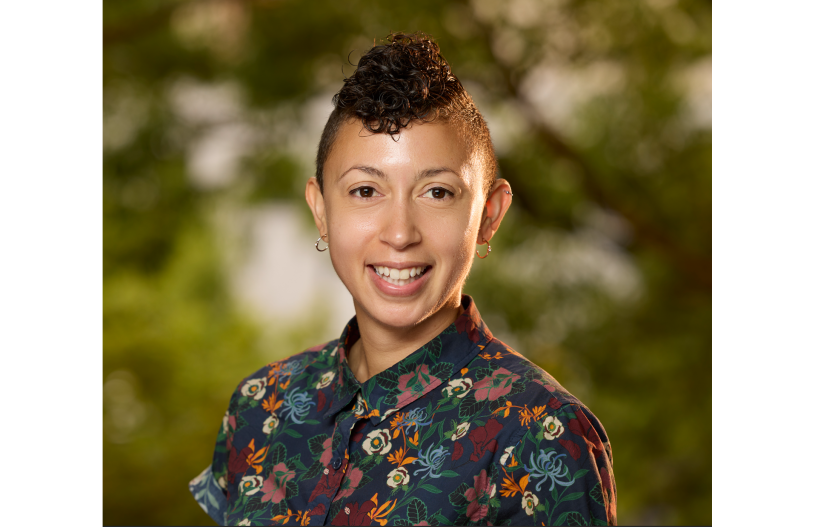
“Museums are uniquely positioned to reach the public, and I'm very excited to be in a place where the community science team has built up just an amazing suite of relationships with community members and community organizations across the Los Angeles area.” Christine Wilkinson, PhD
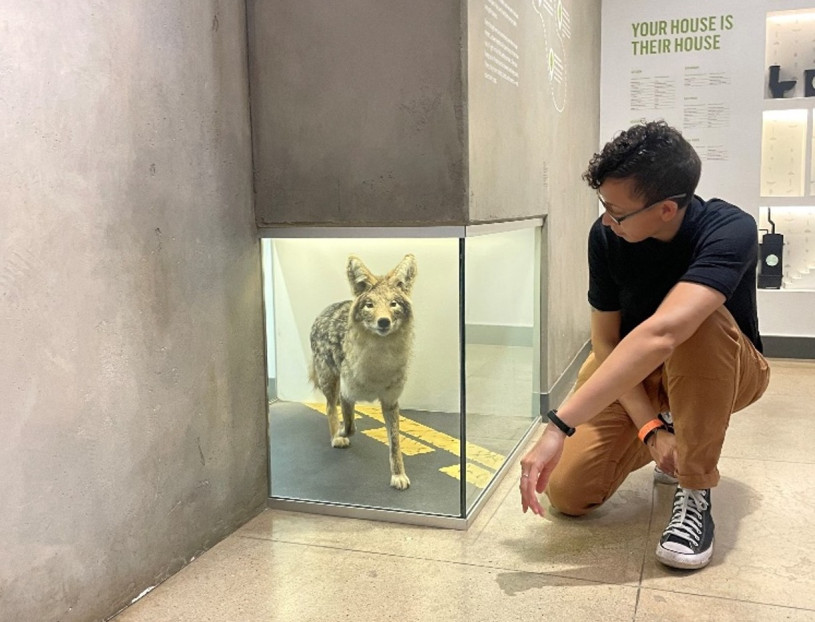
“Many people just don't understand some of the basic behavioral ecology of coyotes,” says Wilkinson. While some people think that coyotes purposely lure dogs into danger, they’re more likely to be curious about your dog as a playmate than as prey. “Coyotes are canids. Your dog's and canid behavior is pretty similar; while they will chase dogs away from their territories—especially if they have puppies—often they might actually be curious about your dog because it's a canid. So, they're doing a play bow, but they also sometimes have a prey drive. Maybe it escalates into something else, and maybe it doesn't, but they’re not actively scheming to get rid of your dog.” Her research focuses on human-wildlife interactions, carnivore ecology, and urban biodiversity through an environmental justice lens, and communicating science just might be her superpower.
You could say that Wilkinson runs public relations for misunderstood animals, the wildlife that we share space with the most. Fittingly, there’s a coyote, a spotted hyena, and a pigeon behind her head at the start of our virtual call (stuffies, not taxidermied animals). Wilkinson is NHM’s—and possibly the planet’s—first-ever Curator of Community Science, and she works at the crossroads of wildlife and humans, where the wellbeing of our communities overlaps. In most of the United States, especially in our cities, coyotes are the big mammal sitting at that intersection.
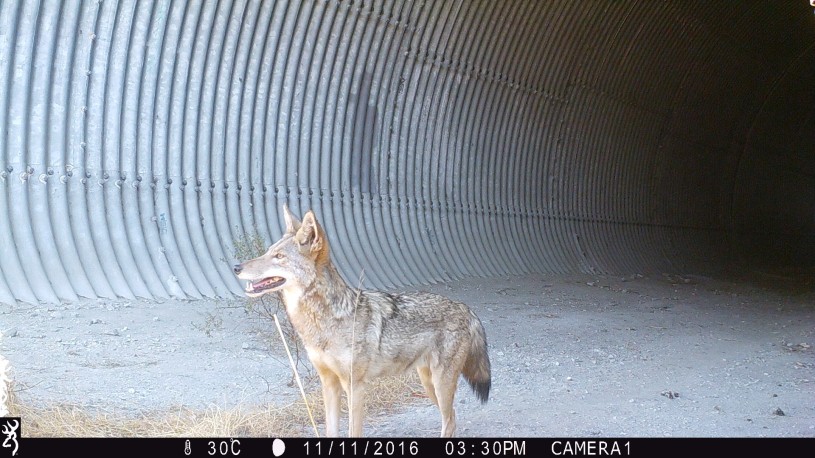
Once relegated to the southwest, coyotes have made themselves at home in cities and suburbs across the country, even as they make their way into South America, despite more than a century of blood-thirsty eradication attempts, including paid bounty hunting, sniping from helicopters, and poisoning with WW 2 chemical munitions—violent efforts that were catastrophically successful in reducing populations of larger predators like gray wolves and grizzly bears. Coyotes survived thanks to their incredible behavioral flexibility.
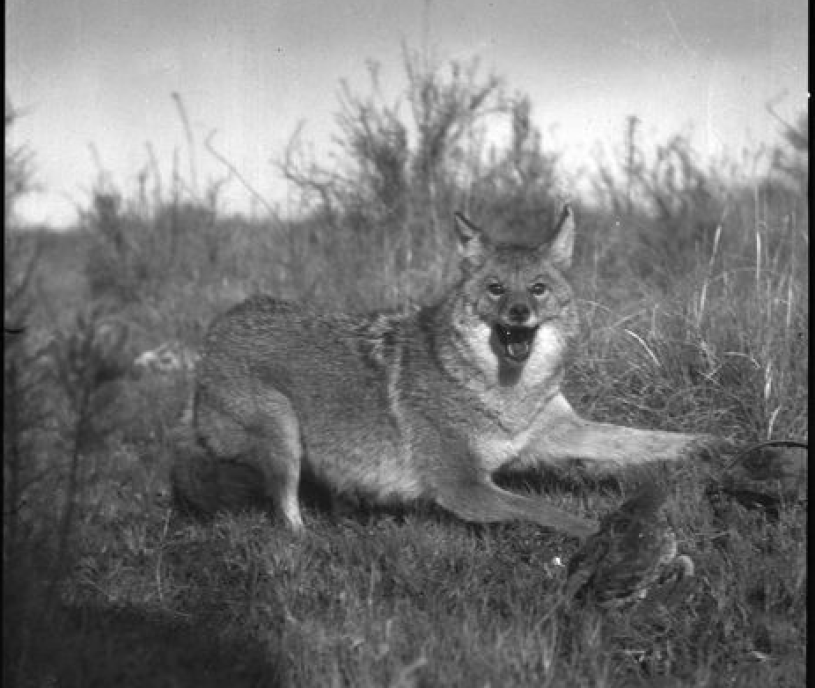
“People are like, ‘Why can't you get rid of them all?” Wilkinson says. “Even if I were the sort of person who wanted to get rid of the coyotes, it just wouldn't work.” Coyotes can hunt in packs, in pairs, or as individuals (what biologists call “fission-fusion”), which gives them flexibility if resources become scarce or they are hunted. Solo coyotes adapt to eat smaller prey like rodents or insects, even fruit. Coyotes manage litter sizes ranging from a single pup to 19 (but the average size is between four and seven)_). If hunters kill more coyotes, there is evidence to show that females increase the size of their litters. Since they’re territorial, they may also decrease litter sizes if a habitat has too many coyotes for comfort. Coyotes’ iconic yips, howls, and barks represent a range of communication between coyotes (and not a celebration of a kill, as one misconception goes). Along with their incredible survival adaptations, coyotes have a long history with human societies. The name coyote comes from ‘coyotl’ in the Nahuatl language, and the phenomenon of urban coyotes is reflected in the name of a suburb of the Aztec capital Tenochtitlan, which became Mexico City, called Coyoacan: ‘place of the coyotes’.
As more and more modern human cities have become places of coyotes, the challenges to their health and safety reflect those of their human neighbors. “Some of my colleagues and I just finished a study here in Southern California, where my colleague Dr. Niamh Quinn of UCANR had led a coyote GPS collaring effort. We were able to see that the patterns of how coyotes move through space and how they select for resources in L.A. is different for coyotes that are in more burdened, more polluted areas than the ones that are in these less burdened areas,” says Wilkinson.
“One of my underlying reasons for looking at what wildlife are going through in relation to pollutants and other environmental issues within and beyond cities is to remind people that people are also going through that.”
“I really was awakened to the fact that conservation needs people, and without people, we won't have any sort of resilient approach to conservation.” Christine Wilkinson, PhD
Wilkinson is loquacious, and a chat about her work feels like sitting down with the seasoned host of a nature TV show, producing laughs and wide-eyed wonder in equal measure. Before becoming Curator of Community Science, earning a PhD at Berkeley, doing fieldwork in East Africa, working with the Bay Area Coyote initiative, or co-founding Black Mammalogists Week, Wilkinson was a very shy kid living in New York City, looking for animals between visits to the American Museum of Natural History and the Bronx Zoo, and dreaming of connecting people with the wildlife closest to them.
David Attenborough of Queens
“I was obsessed with animals from the very beginning,” says Wilkinson. “I was always going out, actually pretending I was the David Attenborough of Queens with my own nature show, and I would be like, 'Here are the cockroaches.’”
If Wilkinson easily recognized natural wonders on her city block, she had more trouble picturing herself in the world of wildlife research. “I didn't really know how to get into the field of wildlife science because I was always watching the people on TV doing wildlife work in faraway places. Plus, they were always white dudes! There was nobody who looked like me.”
College brought her closer to those faraway places. At Cornell, Wilkinson joined a National Science Foundation-funded program for systemically minoritized and underrepresented students, landing in Maine’s Isles of Shoals, under the guidance of a mentor, Dr. Myra Shulman. “If I hadn't had her as a mentor, I'm really not sure what field I would have ended up in,” said Wilkinson. Her next round of field work would take her even further.
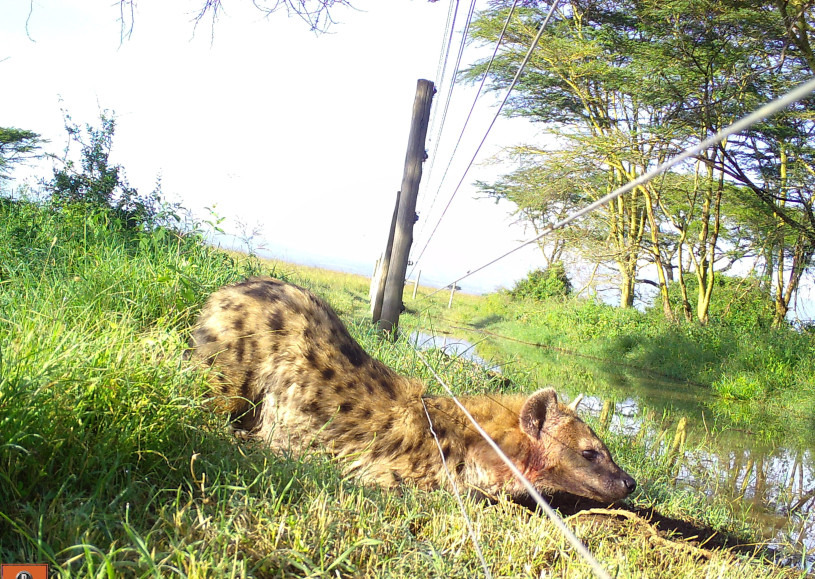
“As a half-Black person, I wanted to be in a place where people who are Black are living alongside wildlife, and they're not exoticized, and they're not exoticizing this relationship with wildlife,” said Wilkinson. In Kenya and Tanzania (and eventually Uganda), she studied in a wildlife management program. She’d expected to immerse herself in wildlife, but instead discovered how important humans were to any conservation efforts. “Everything that I thought about conservation was turned on its head within the first couple of weeks that I was there, and it completely revolutionized everything that I do. This realization about the key roles of communities as decision makers was basically the beginning of the path to where I am now as the Assistant Curator of Community Science.”
Wilkinson found that one of the biggest challenges for wildlife conservation was addressing the real concerns of local people. “I met someone who said to me, ‘If a lion kills a person, the government may never come here to compensate or address that. If a person kills a lion, the government's going to be here in two days to arrest that person’,” says Wilkinson. Conservation unrooted in human concerns and justice leads to resentment from the folks living with the very wildlife she and her colleagues wanted to protect.
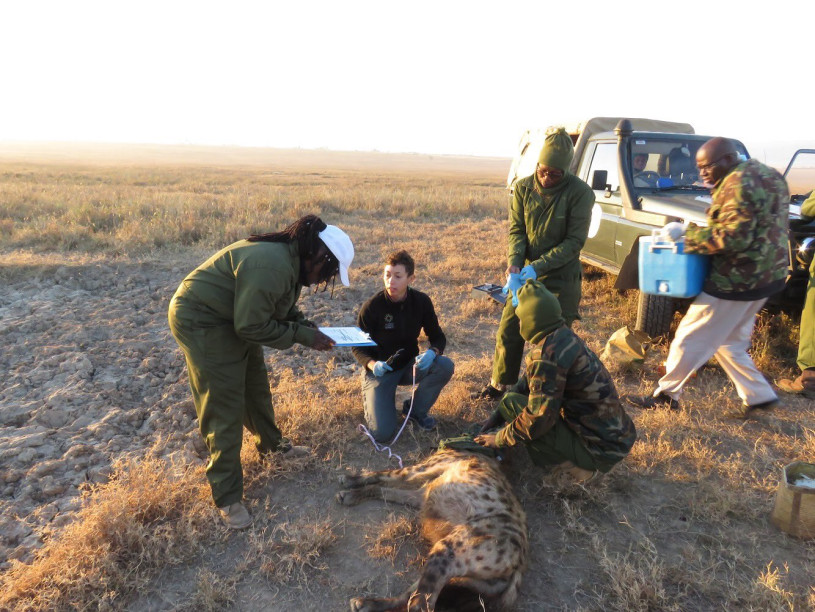
“I really was awakened to the fact that conservation needs people, and without people, we won't have any sort of resilient approach to conservation. People who are living in these communities should be the ones that are coming up with and maintaining these conservation solutions that work for them and their livelihoods, as well as their safety and their wellbeing,” says Wilkinson. The problems of conservation are rooted in real challenges that come with sharing space with big wild animals. Communicating with the locals to understand those challenges would be crucial to any solutions. “I realized I couldn't be a shy kid anymore.”

To better approach the community side of the equation, Wilkinson earned a PhD at Berkeley. She also worked–and volunteered– at the California Academy of Sciences to overcome that shyness and hone her communication skills (it really worked). During her PhD studies in Kenya, she integrated participatory mapping, carnivore behavior, and wildlife ecology to understand human-wildlife interactions and ideate coexistence solutions in a rural, livestock-heavy landscape that is rapidly urbanizing. As a Schmidt Science Fellow, she integrated data science and One Health, a lens that recognizes the deeply intertwined nature of ecosystem, animal, and human health. It’s a framework that still guides both her research and vision for community science.
In the same way that threats to charismatic animals can spark environmental interest and action, Wilkinson hopes that research like her recent coyote study can help urban residents connect with their wild neighbors.
“How do we get people to look around them and be involved and in that sense of place around them too, in saying, ‘wait, I saw this type of animal for the past x years because I'm paying attention, and now it's gone. What does that mean for my community? What does that mean for what I want to advocate for?’ And then the data itself provides even more fuel for policy and power for those folks. There are all of these elements that are related to environmental justice and One Health that underpin this kind of work.”
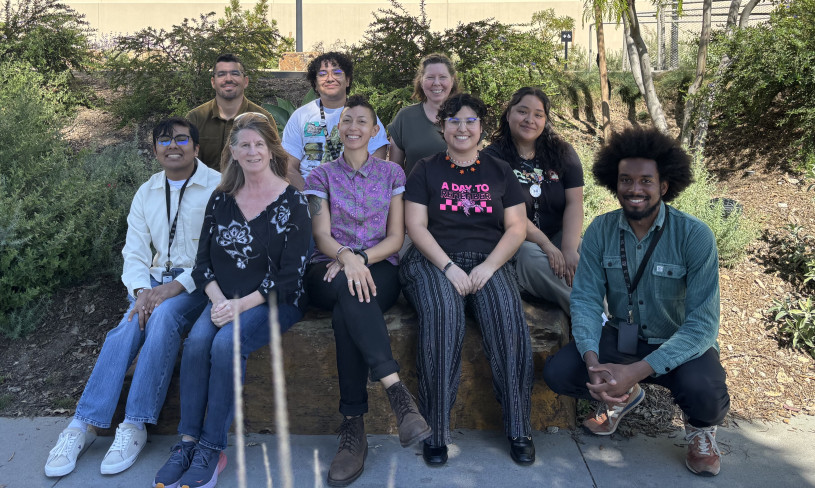
Community science as a practice is crucial for doing better-informed and more equitable conservation and science. Wilkinson is looking to expand NHM’s already world-class community science work, with co-created, social-ecological research centered around more belonging and access. She’s hoping to create datasets that are particularly useful for locals and inspire more environmental stewardship and action through the team’s work. Wilkinson is also continuing her work as a co-founder of Black Mammalogists Week, an annual event that brings together Black mammalogists across the Diaspora that she’s bringing to NHM this fall. The program dovetails with a desire to more thoughtfully engage L.A. County’s Black community in the Museum’s community science.
As Los Angeles and the world continue to reckon with global change and a warming climate, Wilkinson hopes to continue her work in California and internationally, exploring how animals navigate our human-dominated landscapes, the societal factors shaping human-wildlife interactions, and how those interactions play out in terms of ecosystem health, biodiversity, and human wellbeing—as well as solutions that can help Angelenos and our wild neighbors coexist.
“Museums are uniquely positioned to reach the public, and I'm very excited to be in a place where the Community Science team has built up just an amazing suite of relationships with community members and community organizations across the Los Angeles area,” says Wilkinson. “So the community science game is quite strong, and I'm excited to boost what that team is doing, and see how I can help them expand that work, get more funding toward our vision, increase longevity of the work, and engage meaningfully with more and more communities.”

