Excavating 20 Years of Triassic Discovery at Ghost Ranch, New Mexico
Dig into the 20th year of excavations at the famed site and discover how the project continues to fuel fossil researchers

Published September 2, 2026
Georgia O’Keeffe captured the painted cliffs and mesas of New Mexico from a dude ranch fifteen miles or so north of the village of Abiquiú. The Spanish called it ‘Ranchos de los Brujos’, and the area certainly bewitched O’Keeffe, inspiring some of her most iconic landscape paintings. Across the street is one of the most important and celebrated fossil sites from the Late Triassic Period, the dawn of the Age of Dinosaurs.
This year marks a milestone at Ghost Ranch’s Hayden Quarry: two decades of ongoing exploration, which Dr. Nate Smith, Gretchen Augustyn Director & Curator of NHM’s Dinosaur Institute, along with Drs. Randy Irmis, Sterling Nesbitt, Michelle Stocker, and Alan Turner began when they were just graduate students. Over the years, the team has dug deep into the origins of dinosaurs and their close relatives, and discovered the stranger things that called the Triassic home, all while equipping the next generation of paleontologists for even more discovery.
“Twenty years ago, we had no idea the amount of new discoveries the Hayden Quarry would hold for us,” says Smith. “Even more impressive than the fossil cornucopia is the fruit this site has borne for paleontological mentorship and training. At the time, we were just plucky grad students hoping to one day land a job, and now we’re all in senior roles bringing our own students (and in some cases, our “grand-students”) out to Ghost Ranch.
“There are few other sites in the world where students can be trained in fossil collection, conservation, research, and public engagement—often all in the same day,” Smith adds.
The 20-year odyssey began when Alex Downs, now-retired Curator of the Ghost Ranch Ruth Hall Museum of Paleontology, brought a partial skeleton from the site to the Society of Vertebrate Paleontology conference in Denver in 2004.
“We recognized it as an early dinosaur, which is quite rare from the Chinle Formation, the rock layer that we’re working in,” says Irmis, now Curator of Paleontology at the Natural History Museum of Utah. Besides Ghost Ranch, the Chinle Formation runs through the Southwest, with recognized fossil deposits in western Colorado, northern Arizona’s Petrified Forest, Nevada, Utah, and western New Mexico.
“We could tell from the hip structure that it looked different from other early dinosaurs we knew from the same layers.” Irmis recounts the project’s origins in a copse by a dried riverbed, the crew's designated lunch spot. It’s over 100 degrees outside, but surprisingly green despite the heat.
The finding excited Irmis and Nesbitt, who first visited the site in 2005.
“In like an afternoon, we collected half a dozen early dinosaur bones from the quarry. We saw just in those bones, there was a bunch more diversity of other types of animals preserved. So the four of us cooked up the project, the idea of coming out here and doing field work and really understanding what's going on here and using it as a springboard for understanding early dinosaur evolution in the Western U.S.”
That springboard took them into the deep end of the Late Triassic, approximately 212 million years ago, when Ghost Ranch was part of the southern supercontinent Pangea, and much closer to the equator.
That remarkable skeleton turned out to be Tawa hallae, one of the earliest species of theropod dinosaur—the bipedal meat-eaters that include T. rex. Described by the team in 2009, the early theropod shared characteristics with modern birds and was more closely related to dinosaurs from South America, suggesting that Tawa and two other meat-eating dinosaurs from Ghost Ranch were only distantly related to each other, with close relatives in what is now South America, implying that each carnivorous dinosaur species descended from a separate lineage, traversing the supercontinent with apparent ease, along with the other stranger animals of the Triassic. Tawa would prove to be just one of many high-profile discoveries from Ghost Ranch, rewriting the story of dinosaurs’ origins.
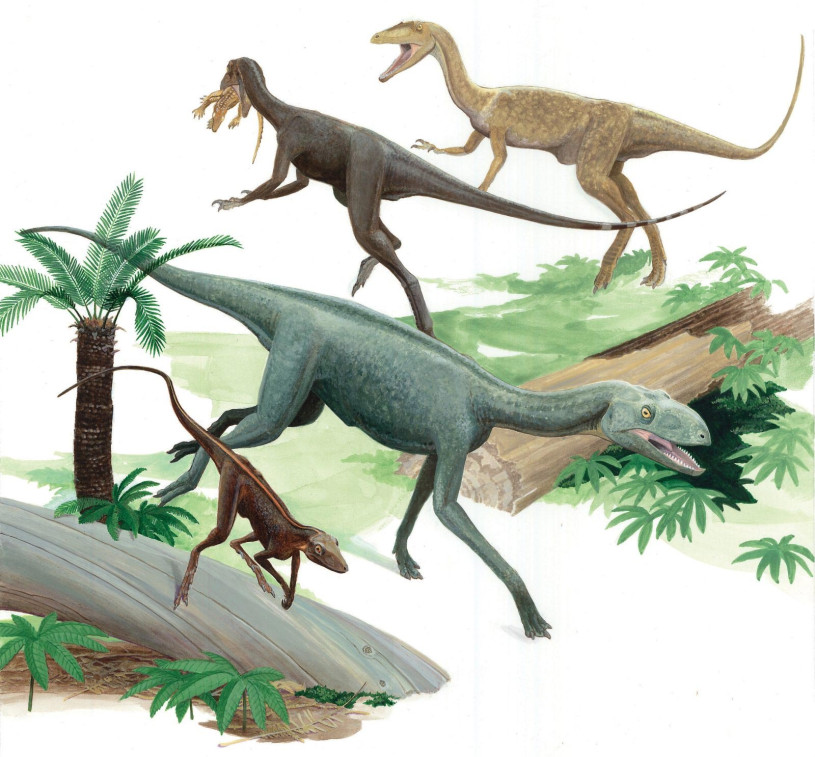
Ghost Ranch was already a renowned fossil site when the team met Tawa in the early 2000s. The earliest fossils were found by Edward Dinker Cope in 1875, followed by a University of California, Berkeley, in the 1920s, which led to possibly one of the most famous bone bed discoveries of all time, led by the American Museum of Natural History. In the 1940s, the painted mesas and canyons coughed up a graveyard of Coelophysis bauri, another early dinosaur. Researchers estimate that more than 1,000 well-preserved Coelophysis skeletons are packed into the quarry that bears its name, helping make the small theropod one of the most well-represented dinosaurs of all time. Finding such an old, well-preserved, and previously unknown dinosaur species from the Late Triassic was especially surprising.
“Late Triassic fossils have been collected from Ghost Ranch for over 100 years,” says Smith, “but more recently, discoveries of lagerpetids like Dromomeron and early dinosaurs such as Tawa have ignited a mini-renaissance in our understanding of dinosaur and pterosaur origins and early evolution. In terms of dinosaur research, the Triassic is the new black.”
While Tawa grabbed headlines, the team’s first big paper described the weird little dinosaur relative they named Dromomeron in a 2007 paper in Science. Dromomeron was part of a poorly known group of ‘dinosaur precursors’ called lagerpetids. Further investigation led the Ghost Ranchers and an international team of researchers to argue in a 2020 paper in Nature that these small, wingless reptiles were the closest known ancestor of the flying pterosaurs, based in part on the complexities of their inner ears, revealed by CT scans. It’s a great example of how Ghost Ranch specimens and research help us get to the origins of these iconic animals.
“The project is amazing for understanding early dinosaurs and all of the other animals that lived with them,” Stocker, now an Associate Professor at Virginia Tech, says. “It sets the tone for knowing what we should look for and the kinds of data that we can collect at other locations.”
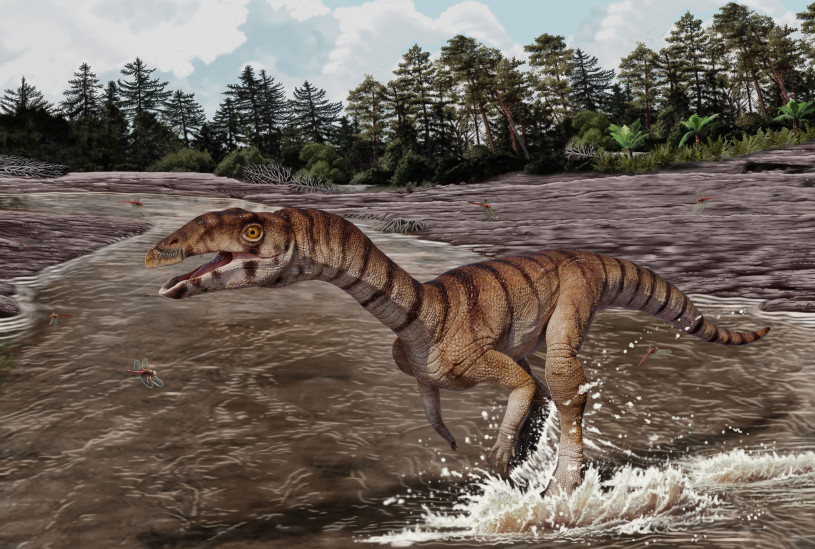
A 2026 publication described Labrujasuchus, a toothless, bipedal, tiny-armed shuvosaur—think of a scaly ostrich, but weirder—from the branch of archosaurs that led to crocodiles (famously four-legged and full of teeth). Labrujascuchus is a great example of how strange the Triassic was. The modern animals we know were just beginning to diversify into a menagerie of forms and body plans that rhyme with the lifestyles of extinct and living animals better known to the public, but nested in groups that ended up taking wildly divergent paths.
Members of the original team have authored or co-authored dozens of papers detailing new discoveries from the site, while the fossil material they’ve unearthed has helped fuel hundreds of papers from other researchers. “This whole area is just chock full of really important Triassic material,” Stocker tells me. “So, we're never gonna run out of things to excavate.”
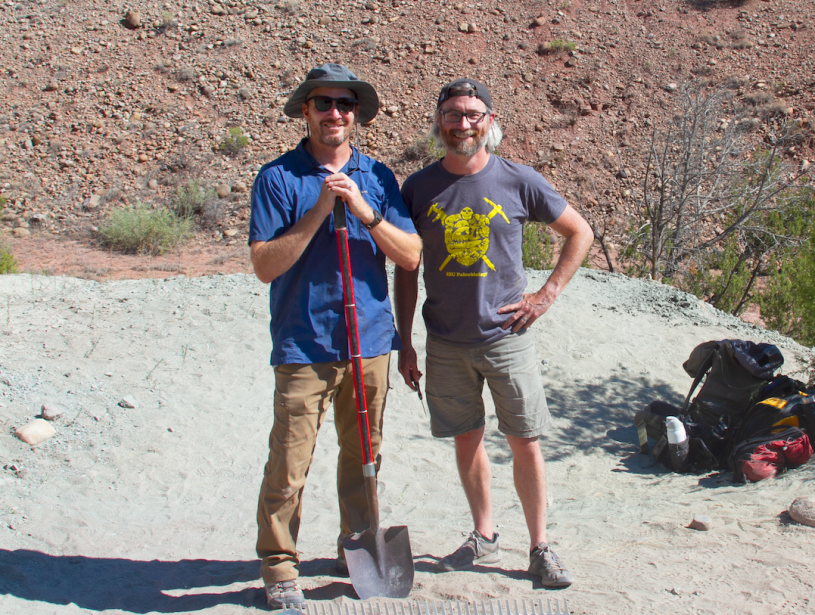
“I tell everyone this, but what I've learned here I've carried to many other sites,” says Nesbitt, also a Professor at Virginia Tech. “People just don't dig a big enough hole.” It’s a sentiment that echoes throughout my conversations at the site: there are more Triassic fossils all over these mesas. On this trip, we’re focused on two sites in the Hayden Quarry: H2 and H3.
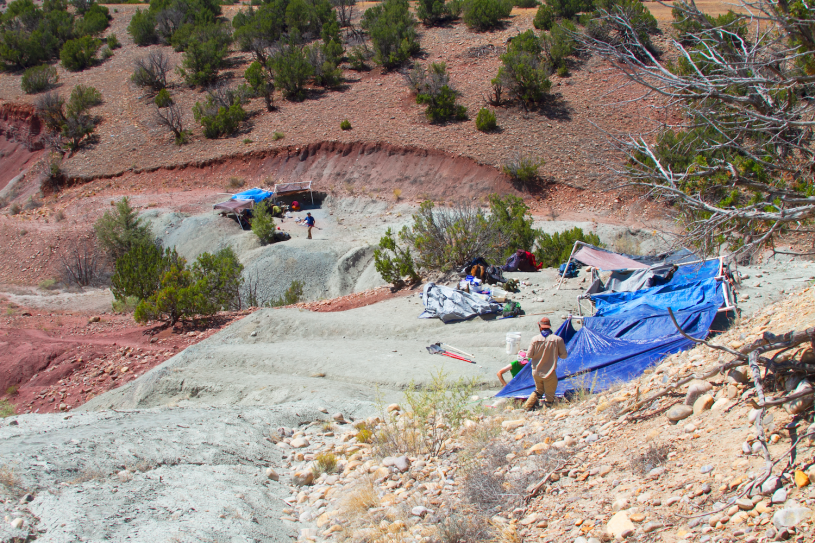
Scratching the Chinle
“Sometimes you plant seeds for trees whose shade you’ll never know,” Smith says before dumping another shovel-full of dirt down the hill. He’s evening out the sediment for next season’s excavations, ‘building a bench’. Next to the bench, two shade structures—PVC pipe skeletons with tarps tied overhead (a design the team developed themselves early on in the project)
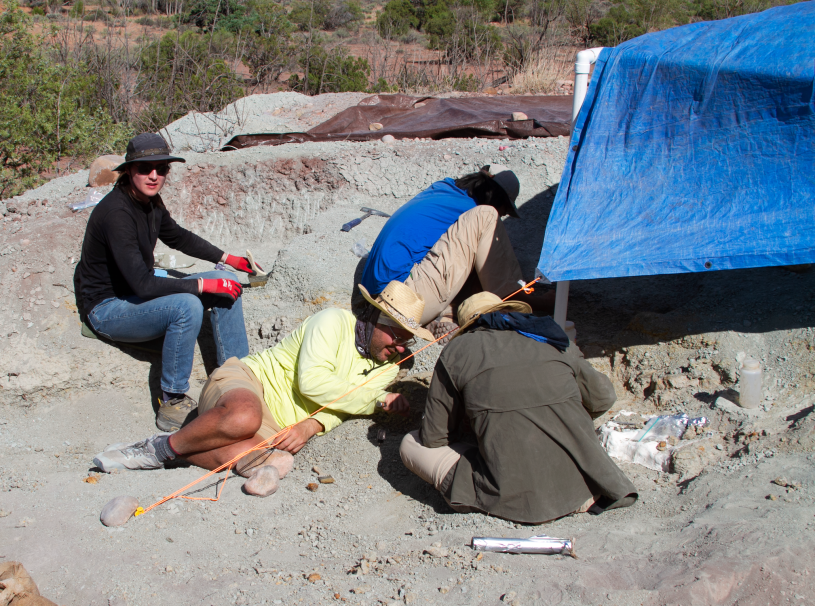
Above the hill at Hayden 3, a line of a dozen or so of us carefully pick and scratch at the fossils sticking out of the exposed sediment beneath a line of shade structures. Our tools? Dental picks, awls, paint brushes, and, if we find something delicate, toilet paper, tinfoil, and consolidant. One of the things that makes Ghost Ranch so special is the sheer volume of fossils. Whether you’re a veteran fossil hound or a greenhorn, you’re going to find something. Picking through the sediment at H3, there are hundreds of tiny fishscales—tiny shiny black flecks—along with vertebrae, claws, toes, teeth, armor plates called osteoderms, fossilized poop, seed pods, and on and on, all down the line.
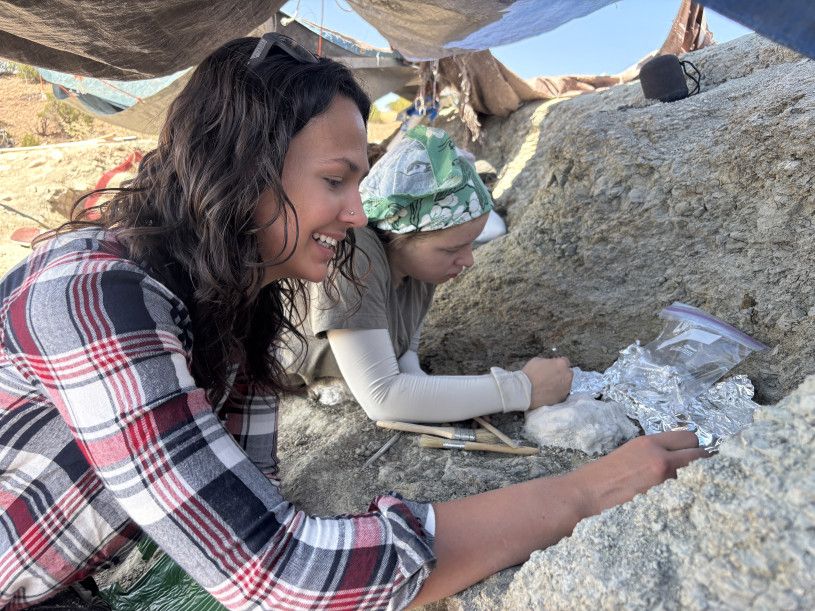
I’m posted between Denycè Jasicki, an undergrad from Virginia Tech, and Trinidad Cruz, a graduate student from California State-East Bay, both volunteering with the Natural History Museum of Utah. It’s meditative work that overcomes the discomfort of the heat and bodies contorted to access the exposed fossils as carefully as possible, until a dust devil whips the tarp off our structures and the grit into our faces.
“I’m exfoliating my corneas,” quips University of Utah graduate student and Virginia Tech Alumnus Sofia Kryder. In the field, you have to roll with the punches.

Photo by Tyler Hayden
Sofia Kryder, University of Utah graduate student, holds down the fort (literally), letting UofU intern Nikki Krivka and Caitlin Coe continue excavation

Photo by Tyler Hayden
An osteoderm, a bony deposit that acted like armor in Triassic reptiles

Photo by Tyler Hayden
NHM Trustee Jenna Perlstein on her first dig

Photo by Tyler Hayden
A seed pod from 212 million years ago exhibits how difficult it can be to pick out fossils from pebbles

Photo by Tyler Hayden
Newly minted PhD Dr. Tori Cassady protecting herself from the sun while keeping the digsite clean
Identifying a fossil in a sea of rock can be challenging. The shape and shade of fossils at the site are one clue. Smith points out that they should be a sort of dark purple, almost black, think faded wine. But charcoal and even just shapely rocks can fool the eye. If you’re still not sure, lick it.
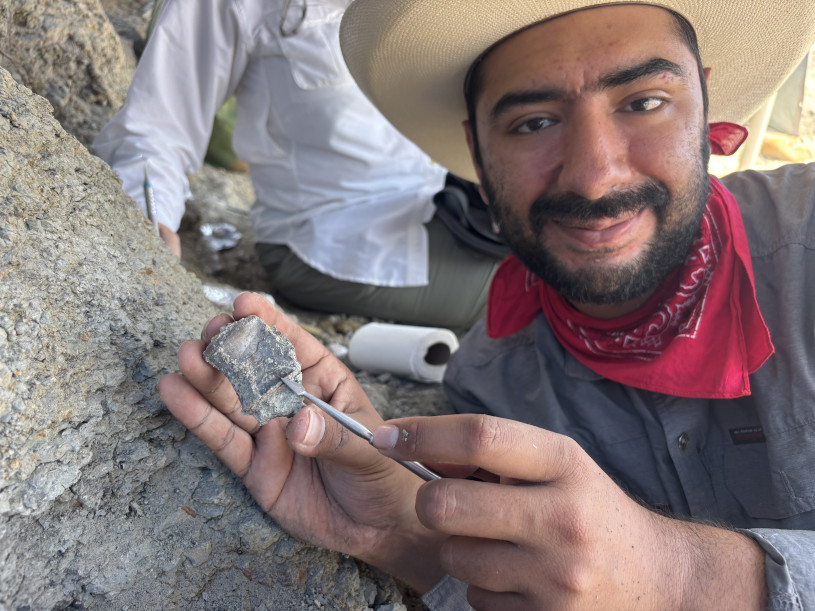
“If it’s a fossil, it’ll stick to your tongue,” Denycè tells me. The holes in the bone from the nerve endings and blood vessels make fossils into delicate little sponges. The charcoal, in contrast, comes off on your tongue in a tasteless powder. If you’re still not sure, or if the possible fossil is in a delicate position, you call in Dr. Zach Morris, Postdoctoral Fellow at the Dinosaur Institute.
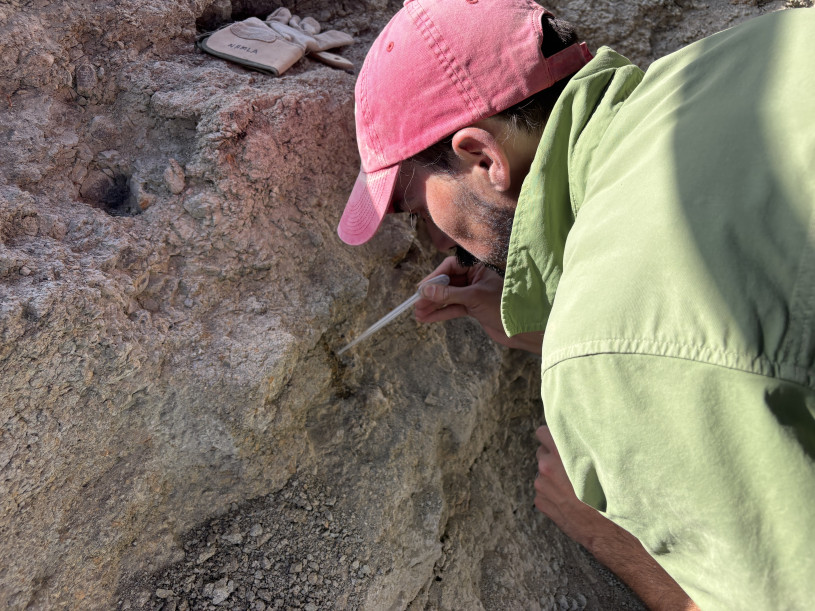
He’s one of many paleontologists who cut their teeth on the bones of Ghost Ranch. Like a lot of Ghost Ranch alums (inlcuding Stocker and Irmis), Morris interned at Petrified Forest National Park in Arizona (PEFO). He’s been coming to Ghost Ranch for some time: 15 years from his first field season at Ghost Ranch when Morris was just an undergrad at UC Berkeley working alongside his colleagues. He’s now a seasoned veteran of the site, a relationship common among the hammering-and-picking researchers all over the Hayden Quarry, and it makes working at Ghost Ranch feel something like a paleontological family reunion.
“I think it's rare to have a project that can span so many academic generations. And so from my own experience, it was really formative because it started when I was a grad student. There was the excitement of the discovery, and the fact that I could share the experience with people who were my friends was really amazing,” says Turner, now a Professor and Chair of the Anatomical Sciences Department at Stony Brook University. “It was important for us academically and career-wise because we were all just in the early phases of our own professional development. And the important discoveries that came out of the Hayden Quarry really shaped our career trajectories?”
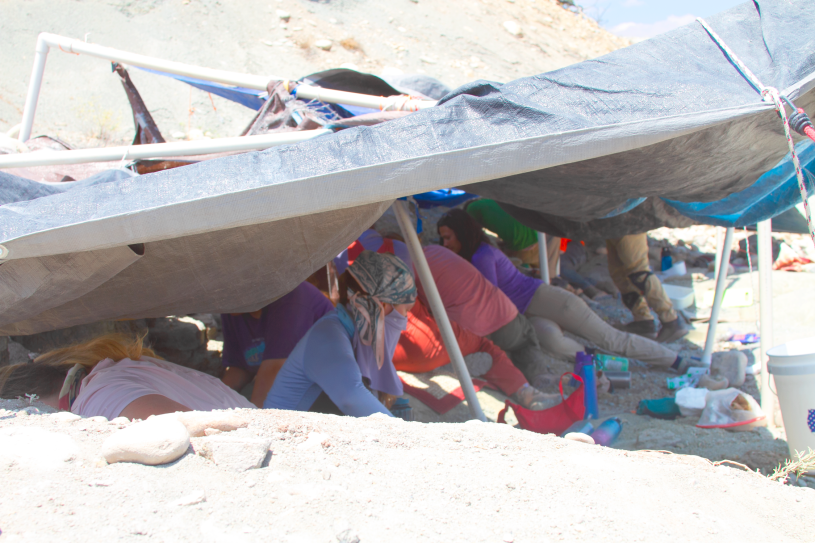
Morris is just one of the many scholars who find their way to and from NHM’s Dinosaur Institute to Ghost Ranch to ascend into paleontology careers. Dr. Kiersten Formoso was a Dinosaur Institute graduate student and is now an Assistant Professor at Rutgers University; Dr. Keegan Melstrom was a graduate student with Dr. Irmis before joining the Dinosaur Institute as a Postdoctoral Fellow, and is now an Assistant Professor at the University of Central Oklahoma; and Isaac Magallanes, who is finishing up a PhD at the University of Chicago, will join the Dinosaur Institute as a Postdoctoral Fellow in 2027. These early-career researchers all honed their skills at Ghost Ranch. Many of them have roots as interns with Petrified Forest National Park in Arizona. All of them evolved professionally at the Dinosaur Institute.
“With the material we've already collected, there's no doubt dozens of master's and PhD theses and other student research projects,” says Irmis. “From a field perspective, this is such an amazing place to bring out students and volunteers for field training, and I think it's also unique because it's a chance to bring together teams from different institutions.”
“The reason we keep coming back is for sampling. And we know every animal grows up, but we know less about their earlier stages,” Nesbitt tells me. “We happen to find a lot of those stages here. So it helps us understand how an animal changes its shape or the bones change their shape as the animal gets bigger. And that's been really helpful for understanding the origin of dinosaurs and their closest relatives.”
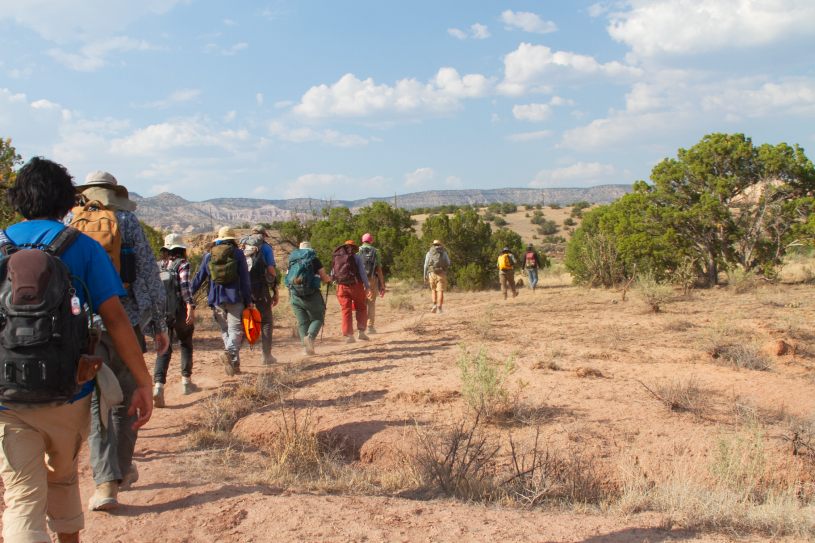
Beyond the data and discoveries, there is something profound about communing with life on Earth from hundreds of millions of years ago.“Being the first person to see something in over 212 million years creates a sort of emotional connection,” says graduate student Adam Lindholm. He came all the way from the University of Oxford in England to work on the site.
Chonky Phalanx
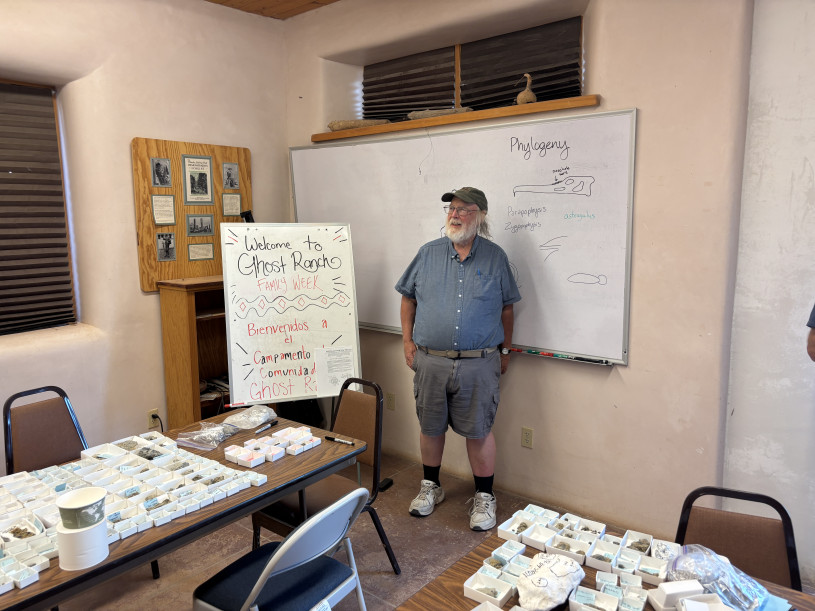
Unpacking the day’s finds and logging them with field identifications is the last step in the long day’s work. The crew shuffles in from the dark, after dinner, into the classroom at the Ruth Hall Paleontology Museum, where the OG team has been coming to review the day’s finds since the beginning.
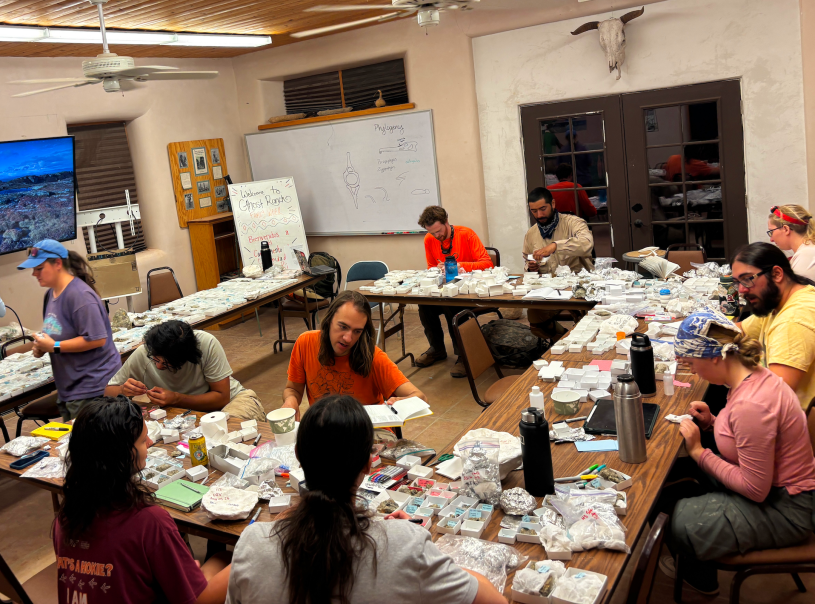
“I remember sitting in the classroom and charting out on the blackboard the various new taxa we were finding, like, reptile A, reptile B, " says Turner. “That's the moment I think it began to sink in for all of us, just the scale of what we had at our hands.”
The tables are covered with rows and rows of mostly tiny boxes adorned with Post-it notes that signify field IDs. The team shuffles in and opens up their ziplock bags full of the foil-wrapped oddities collected during the day.
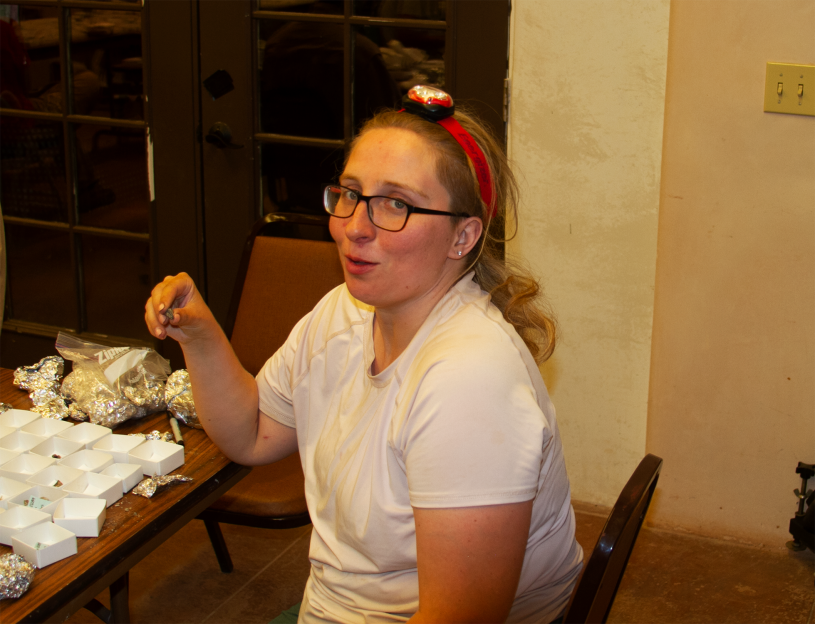
“I say it’s a little present that you wrap for yourself,’ Emily Patellos, a PhD student of Smith’s in NHM’s Dinosaur Institute, 6th year Ghost Rancher, and Virginia Tech and PEFO alum. “You forget about it, and when you open it, you’re surprised.”
As more folks make their way into the classroom, it feels somehow hotter than the dig site. The atmosphere is muggy, but it’s a friendly muggy, with crewmembers debating what the stranger bones could be. Morris takes a long look at a particularly odd fossil. “I’d go chonky phalanx.”
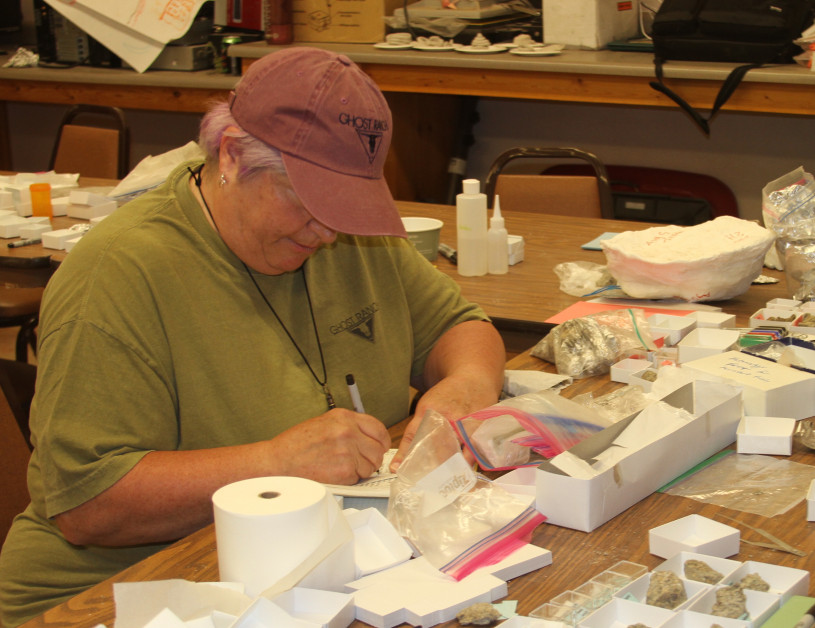
Once the disagreements are settled, each crew member logs their findings, and it’s only then that the day’s work is done. These field identifications will help future researchers know what to look for as they take the winding paths down their own investigations into the strange, ancient world that gave rise to dinosaurs.
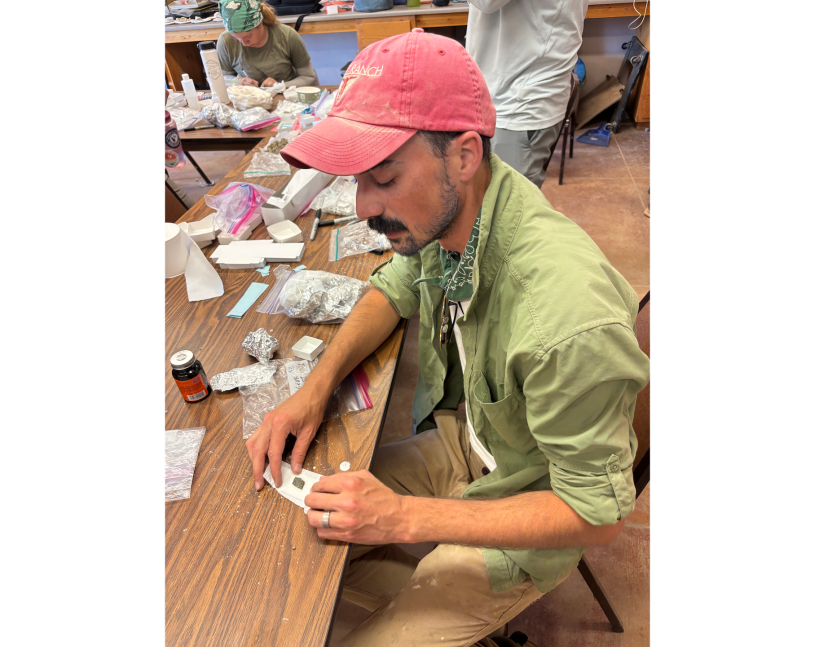
“That’s why collecting fossils is so important,” says Irmis. “Many of the ideas we publish will eventually be proven wrong, but the fossils will be a permanent contribution to science.”
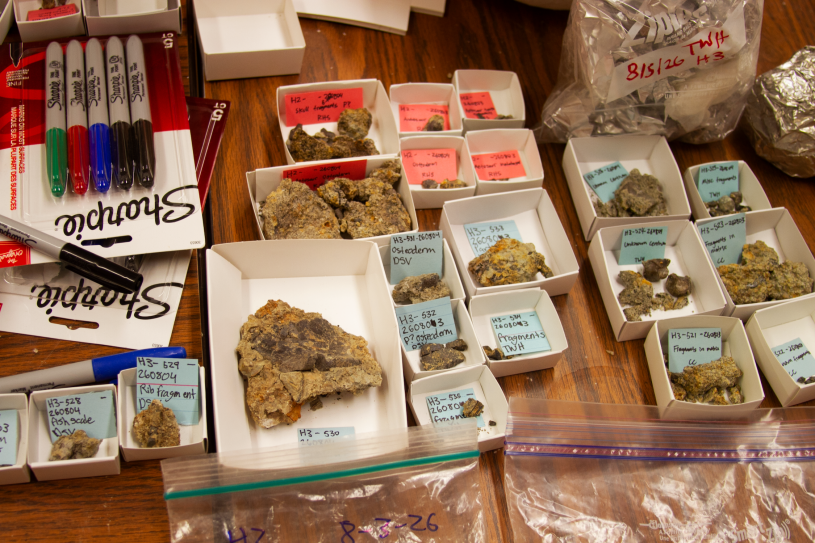
“Without a doubt, the experience of digging into the matrix and unearthing remains that haven't been seen since Triassic times can only be described as an adventure of a lifetime,” says Dinosaur Institute volunteer Anne Baker-Hayes. “How many of us can claim to have worked side-by-side with a paleontological team bringing out these rare and precious finds?” Hayes and her husband Richard (also a volunteer) joined the dig for the first time at H2, and added their names and finds to the little yellow field notebook where every fossil officially joins the season’s official tally, over 1,000 vertebrate fossils collected, with many of them traveling on to the Natural History Museums at Los Angeles and Utah for further preparation and research.
Getting Close to the Faraway
The campsites and casitas of Ghost Ranch house more than just weary paleontologists.
“Whether visitors are seeking its iconic landscape and spiritual healing or digging into ancient history, Ghost Ranch is a place like nowhere else on the planet. We’re so proud to play a central role in making that incredible research possible,” says Joanne Lefrak, Director of Experience and Social Impact at the Ghost Ranch Education and Retreat Center, where the team of paleontologists and volunteers are hosted each summer. “We’re looking forward to collaborating with Dr. Smith and colleagues to continue sharing this extraordinary place for years to come.”
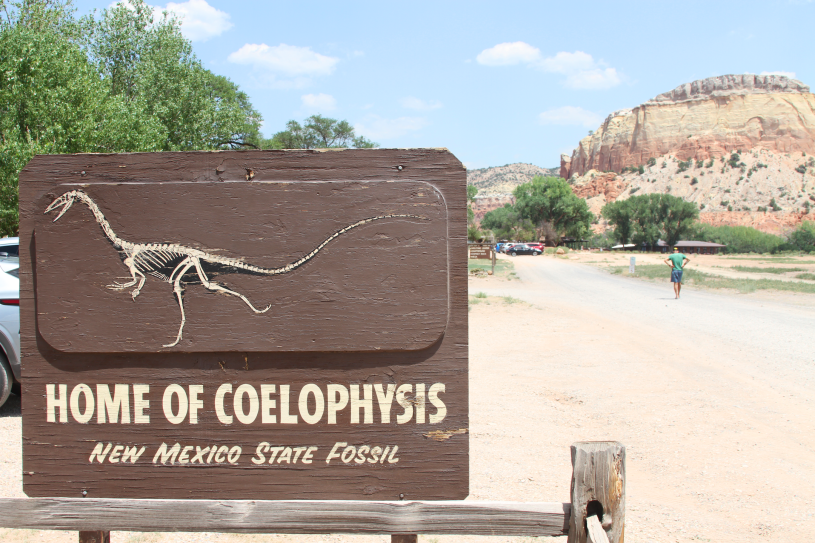
The closeness of the ranch and its campsites makes Ghost Ranch ideal for introducing folks to fieldwork. At dinner, crewmates describe other digs with miles-long hikes in even higher temperatures, carrying heavy equipment on their back, or lugging heavy specimens across protected lands that don’t allow destructive transportation—like wheels. Ghost Ranchers break their fast under the stars with access to showers, ice machines, and micheladas. You can dive into the Triassic while you’re still getting your feet wet. The views don’t hurt either.
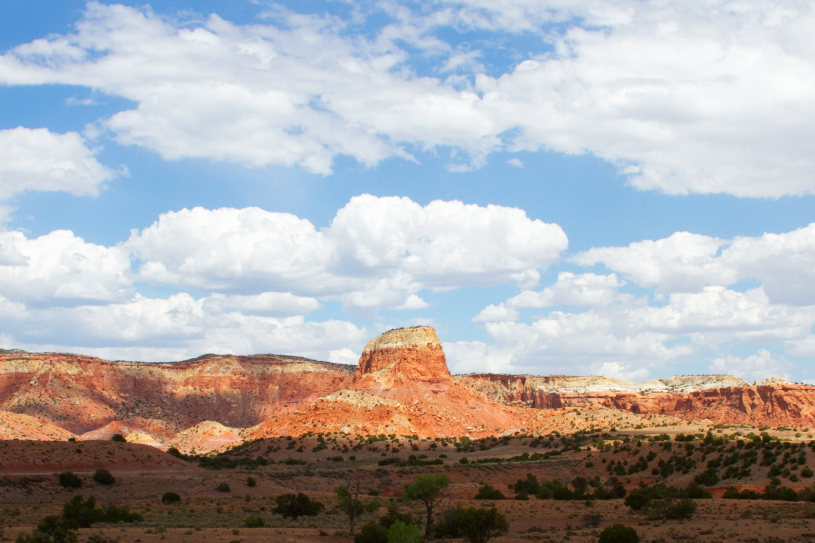
O’Keeffe had a poetic concept for Ghost Ranch that vibes perfectly with the Triassic spirits at the quarry. She called it the 'Faraway’, a term of endearment for the enchanting landscape of northern New Mexico and the beautiful desolation of the badlands. Ghost Ranch and the Hayden Quarry are full of the Faraway. Every fossil is a little portal to the primeval. The impossibly distant Triassic becomes so close you can touch it.


