Keiko’s Tooth: A Killer Whale, a Movie Star, and the Hidden Power of Museum Collections
Assistant Mammalogy Collections Manager Amanda Killian on finding the Free Willy star's tooth and the ever-growing value of natural history museum collections

Published July 7, 2026
“Hey, Amanda, what is this?”
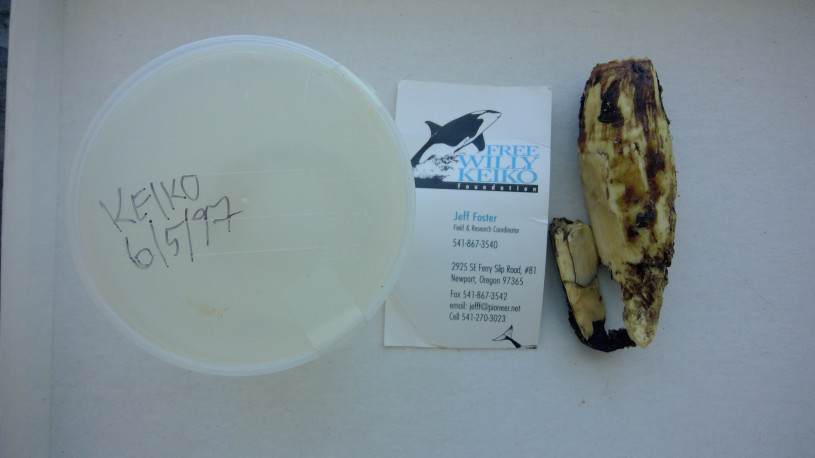
Dr. Priscilla San Juan had opened the dark grey metal cabinet labeled with a small sticker of a dolphin during a tour of the mammalogy collection. This holds the only marine mammal specimens at the Museum, and the top drawer is one of my favorites. I am always excited to show visitors the killer whale jaw and the box of its teeth. But something in the back caught my eye: a small plastic jar with a taped-on lid. Written on top in black marker were two words that made me freeze:
“KEIKO 6/5/97.”
Could it really be that Keiko? The killer whale who starred in the 1993 film Free Willy? The same whale who inspired a global movement, driven by children, and the first-ever attempt to return a captive orca to the wild?
I carefully peeled back the yellowed tape. A pungent odor escaped. Inside was a rotting tooth, darkened with age, its base still clinging to dried tissue. Next to it sat a business card from the Free Willy Keiko Foundation. Wow. It’s really that Keiko.
You might think that a decaying whale tooth is gross and should be thrown away. But this specimen, tucked away in the back of a drawer, reveals exactly why museum collections matter.
Museums like NHM don’t just display fossils and skeletons; they are libraries of science and nature. Each item in the collections holds the potential to answer questions we haven’t asked yet, to tell stories we’ve forgotten, and to remind us of our impact on the natural world.
Keiko’s tooth, for instance, offers insight into his life in captivity. Many captive orcas, including Keiko, develop dental issues from chewing on enclosure walls or metal gates—a possible sign of boredom, frustration, or stress. Collections Manager Dr. Shannen Robson contacted the person on the business card. This tooth had to be pulled to make Keiko healthy enough to hunt in the wild. That decaying tooth is more than an artifact; it’s a biological record of human-animal interaction.
Specimens like this are used long after the moment they’re collected. With today’s technology, researchers can analyze teeth and tissues for stress hormones, contaminants, isotopes, or even DNA. A sample gathered in 1996 can provide new answers in 2026. That’s the magic of museum collections—they grow more valuable over time.
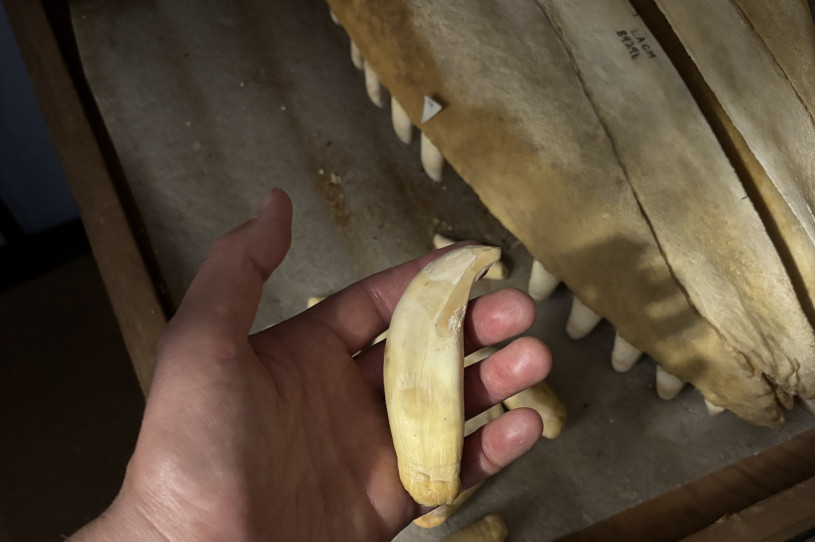
But collections also have a human side. Finding Keiko’s tooth reminded me how specimens connect people to nature through stories. For many who grew up watching Free Willy, Keiko was their first emotional connection to a whale. His story sparked conversations about captivity, animal welfare, and conservation. Seeing that tooth—smelling it, even—made those issues feel real again, grounded in something tangible.
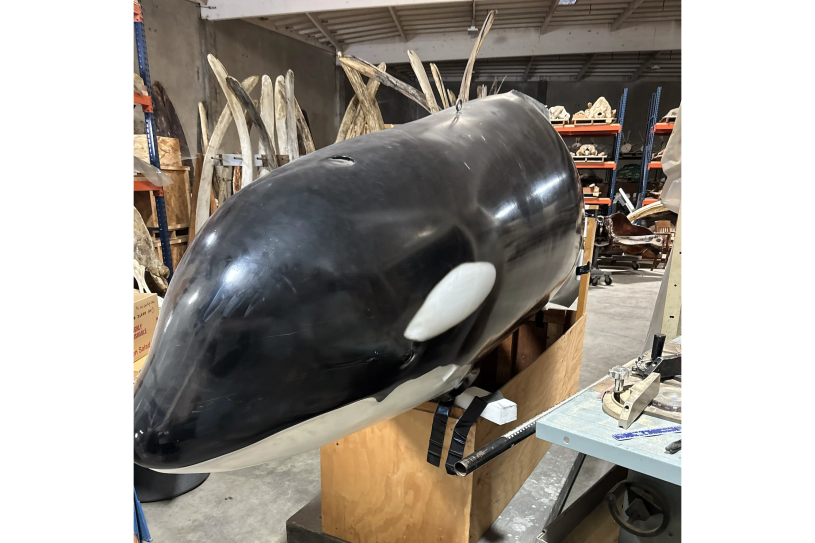
At NHM, our collections hold more than 35 million objects. Most are never on public display, but each one has a role to play. Some help identify new species. Others document environmental change. And some, like this tooth, offer a window into cultural moments. They remind us of how animals, media, and people intersect in unexpected ways.
So, the next time you visit the museum, remember what you see in the exhibition halls is just the tip of the iceberg. Behind the scenes are thousands of specimens, each with its own hidden story, waiting for a curious eye to find it.
And sometimes, what you find isn’t just a specimen. Sometimes it’s a movie star.

