Orcas: Culture Beneath the Surface
Dive into the matriarchal culture of orcas

More Than Killers. More Than Whales.
Orcas are anything but black-and-white. They swim through our imagination as apex predators and beleaguered performers, but our descriptors fall short. Contrary to their common name, “killer whales” have never killed a person in the wild (that we know of), and they’re technically really big dolphins, the largest members of the superfamily Delphinidae (the group of toothed whales known as oceanic dolphins). Even their scientific name, Orcinus orca, fails to capture their true nature, which researchers believe contains multiple subspecies and may even likely include different species: Orcinus tbd.
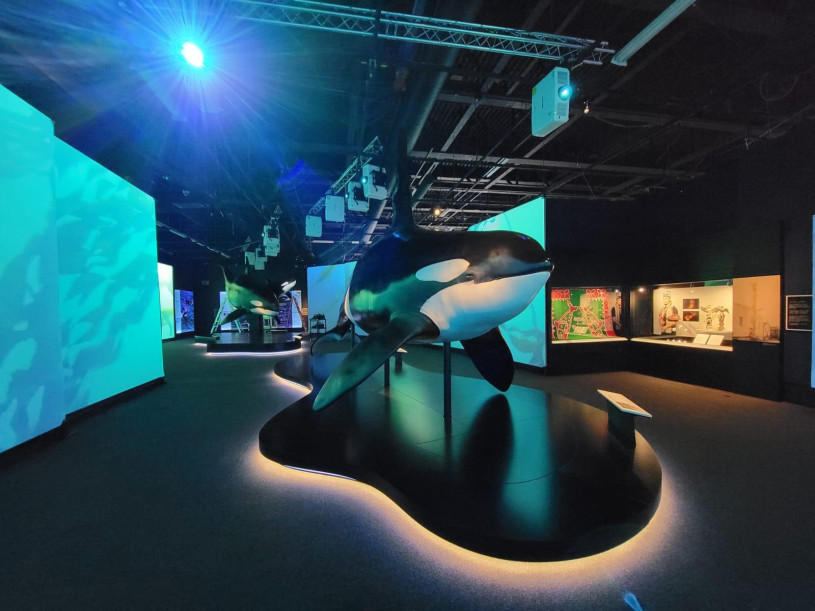
NHM’s new exhibition, Orcas: Our Shared Future, explores the fascinating contradictions and human connections of these iconic and mysterious animals who have so deeply impacted our culture, and whose survival is interwoven with our own. To celebrate, we’re diving into their complex culture, the surprising and extraordinary learned behaviors that define orcas.
“Most orcas navigate the world in tightly-knit family groups called pods. The social interaction part of their brain is bigger than ours,” says Amanda Killian, orca fanatic and Assistant Mammalogy Collections Manager. She adds with a smile, “They’re better than us.”
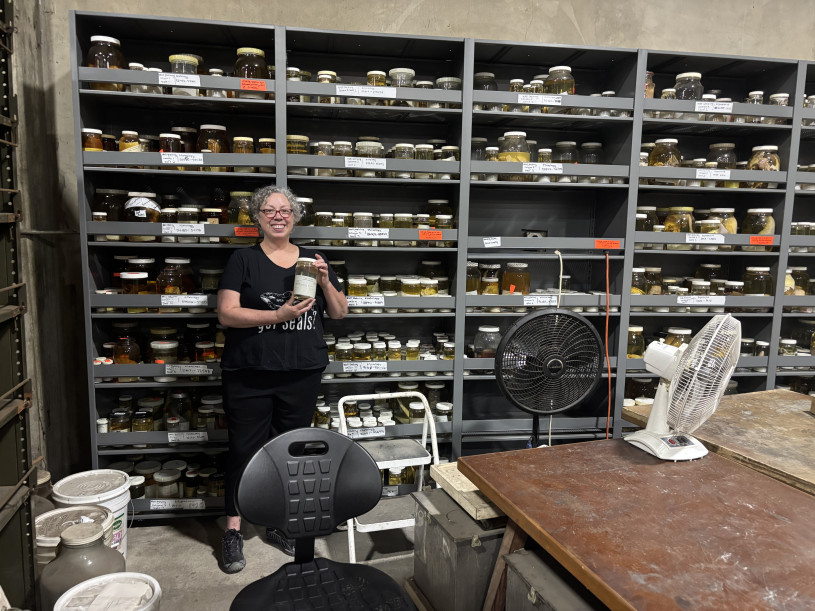
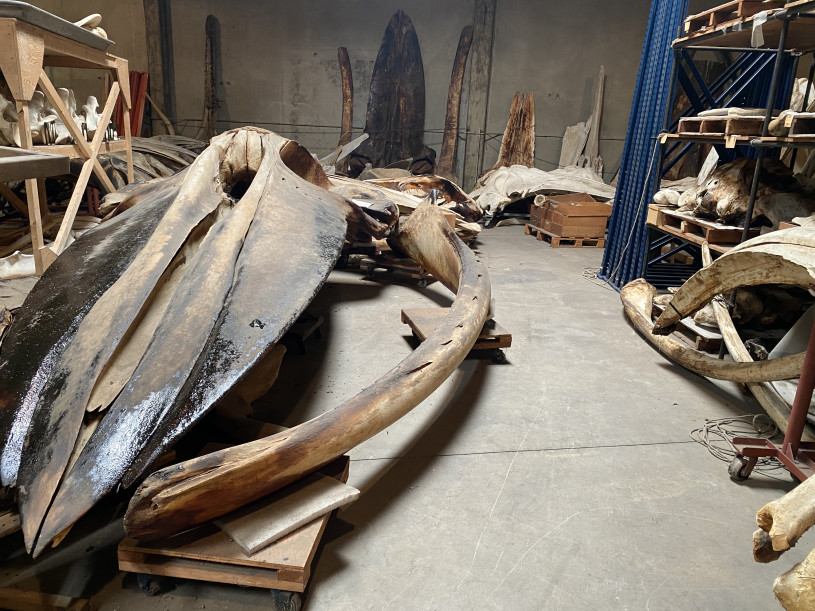
We’re talking in the Mammal Collection Center, where NHM collection managers prepare and care for the bones of orcas and true whales for future research. Since collections are made up of stranded animals that need to be mascerated, a process that involves the removal of decaying flesh, the awe-inspiring sight of whale bones lining the walls is suffused with a similarly outsized, evolving, ever-present odor of rot. Despite the smell, Killian’s enthusiasm for orcas is infectious, punctuated with anecdotes of orca behavior, especially the variety of their diets and their sophisticated hunting techniques.
Global Gourmands
On the shores of South Africa in late 2009, great white sharks kept washing up—just without livers. The culprits were a pair of male orcas given the names Starboard and Port to reflect the fold of their dorsal fins. The pair were flipping over great whites and other sharks to get at those fatty livers (and nothing else). Being upside down temporarily dazes sharks, an effect called tonic immobilization.
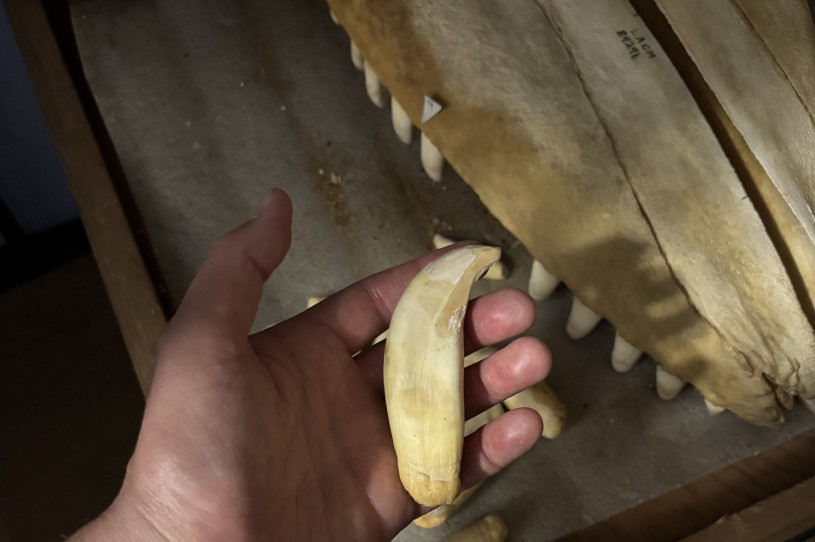
Starboard and Port were turning sharks upside down to stun them and take their livers off the coast of South Africa. In addition to Starboard and Port, there are orcas that flip stingrays into the air off the coast of Baja; they feast on chinook salmon near Seattle; they coordinate breaking ice flows to reach Antarctic seals; and orcas strand themselves to catch seal pups on the shores of Argentina, a practice called beach hunting. Across the Earth’s oceans, orcas tailor their diets to local delicacies. These distinct geographic groups, called ecotypes, may be subspecies or even different species altogether. For a long time, scientists thought that mammal-eating orcas in one region would be closely related to mammal eaters in another region, but genetic testing revealed that this was not the case.
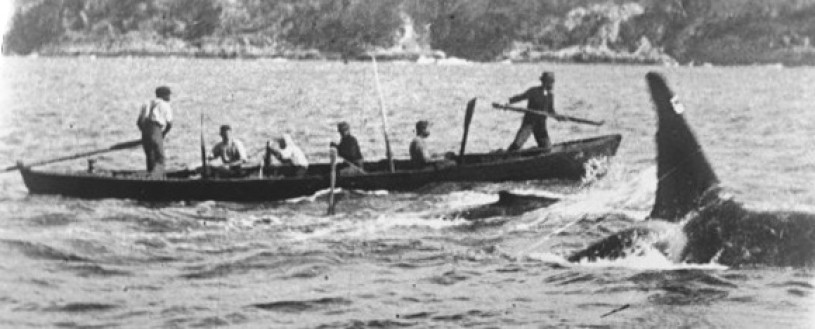
Detail of still from early documentary film, first shown publicly in 1912. In the foreground is a killer whale (Orcinus orca) named Old Tom, swimming alongside a whaling boat that is being towed by a harpooned whale (out of frame to the right). A whale calf can be seen between Old Tom and the boat. The whalers were based in Eden, New South Wales, Australia.
The diversity and complexity of orcas’ hunting techniques underscore the vital role that learning and teaching play in their culture. They exhibit forethought, coordination, and innovation to an incredible degree. Maybe one of their most dramatic techniques brings orcas onto land, a learned behavior that contradicts an essential survival instinct.
“Peninsula Valdés. That's where the whales beach themselves to catch the baby seals,” says Killian. “And the way they do that is by teaching the young ones the behavior. So, the matriarch will take the young orca progressively closer to being stranded, and then block the way so they can't escape, to get them used to being partially out of water. And then they increase that time and that distance to the point where they feel confident with beaching themselves to do the hunting behavior.”
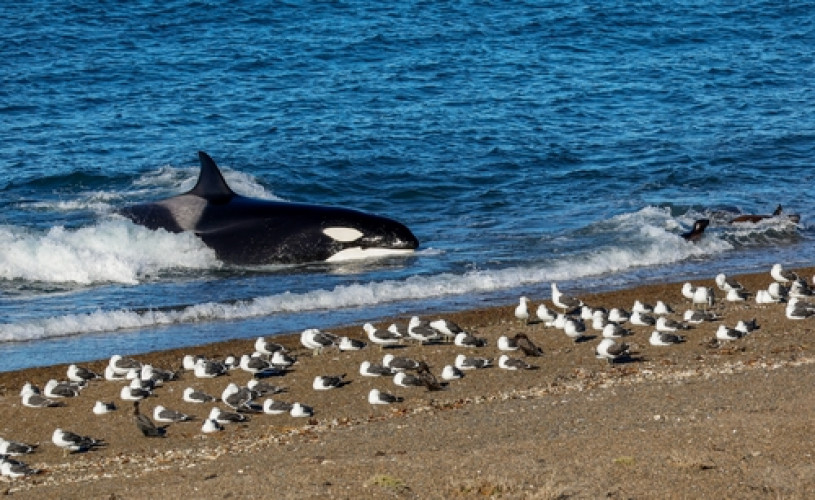
“So they have to learn that, because just humans are afraid of heights because it's not good for us to fall down, killer whales are afraid of being beached because they know they will die,” adds Killian. Overcoming their fear through learning helps orcas survive, and in orca society, matriarchs are responsible for passing down these skills.
Cultural Motherload
Orcas are matriarchal, with males and females staying with their mothers’ pod for their entire lives (at least in the resident populations that stay in one place, and so are easier to observe). A recent study even shows that mother orcas will care for their male offspring long after the males have reached adulthood, a behavior that is not fully understood but is familiar to human mothers.
Learning and communication are central to orca behavior, and the older females that lead each pod also educate juveniles in hunting and navigation techniques using the pod’s particular calls.
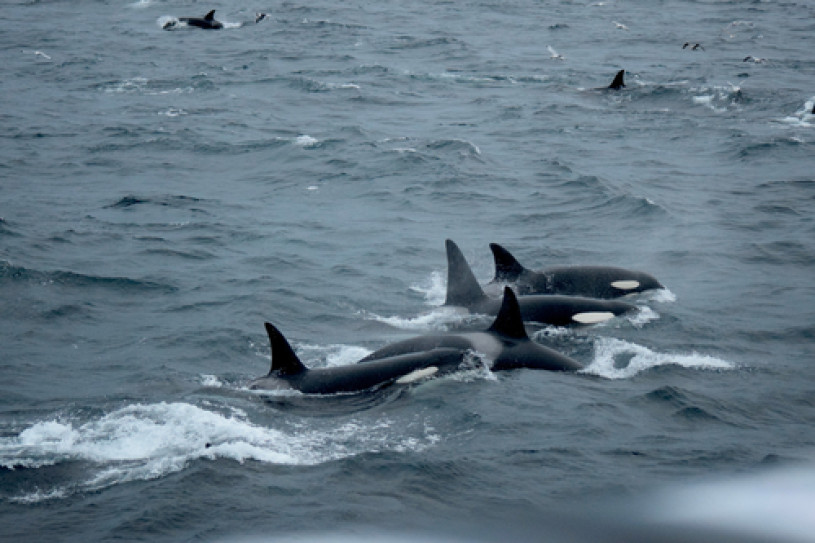
Orcas make three types of sounds: pulsed calls, clicks, and whistles. While clicks are thought to be primarily for identifying prey and navigation, they also play a role in communication between orcas, and each pod has its own unique vocalization patterns, which researchers call dialects. “You can tell one pod of killer whales from another based on their calls,” says Killian, and notes that there are larger differences as well.
“The communication style differs between the fish-eating ecotypes and the mammal-eating ecotypes,” says Killian. “So, the ones that eat fish communicate the entire time that they're hunting. They're making constant vocalizations that humans can hear. The ones that hunt mammals, maybe they're making some kind of sound that humans cannot hear, but they are quiet when they're hunting.”
Given how well-coordinated the mammal eaters' hunts are, their silence raises even more questions. Are there planning meetings? Are there orca attack plans practiced through play behavior? So much of orca behavior is murky, developed below the surface.
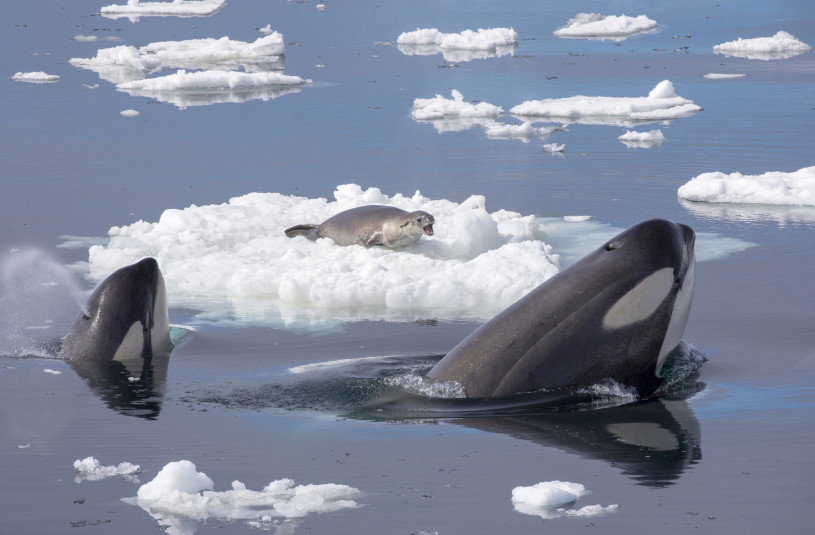
Photograph by Callan Carpenter used under the Creative Commons Attribution-Share Alike 4.0 International license.
Take salmon hats. An orca swam around with a salmon on their head, a retro behavior not observed since the 1980s. “It's kind of inferred that it was a fashion trend because one orca started doing it, and a few days later, others started. I think the whole event was only a couple of weeks, and it popped back up into cultural relevance last summer because another orca had suddenly shown up with a salmon hat,” says Killian. “But it didn't take off like it did last time.” Other orca trends seem to be spreading.
Starting in 2020, 15 orcas in a group designated Gladis (a nod to an earlier scientific name Orcinus gladiator) began attacking the rudders of boats. Some people think a boat struck the individual White Gladis, sparking a cycle of revenge against boats in the busy waterway, but researchers suspect the orcas might just have found a new play behavior. The Gladises have had some 700 interactions with boats, likely spread through social learning, adopting new behaviors orcas find useful or just interesting. White Gladis has been observed leading her offspring into ramming the boats.
Other behavior is more somber. “It's happened a couple of times in different pods where a baby has died, and the mother will carry it on top of her rostrum on her nose for weeks, and of course, they have to breathe,” says Killian. “So underwater they can balance it, and then when they go up to breathe, it will fall off, and then they go down and pick it up again and swim with it until they have to breathe again.”
Just like us, orcas gather to celebrate milestones. “Every once in a while, and it may be around births and deaths, a bunch of pods will get together and just do a bunch of jumping displays and lots of vocalizations,” says Killian. While technological advancements like hydrophones and drones have opened the door to a greater understanding of orca behavior, there is so much more to discover, and the mysteries hidden in the deep only underscore the urgency of protecting orcas and the oceans we share. Orcas are found in every ocean, and at first glance seem to be relatively healthy, but each population faces different threats. Without research into each population, we could be on the precipice of an extinction without knowing it, and risking its culture vanishing from the seas.
Learn more about these incredible creatures and how we can protect them at NHM’s Orcas: Our Shared Future.

