Possible T. rex Poo Reveals a New Source of Investigating How Dinosaurs Evolved
Scientists discover an exceptionally well-preserved bird feather from the Age of Dinosaurs in prehistoric poop

Translucent, syrupy gold, amber can preserve little bits of the Age of Dinosaurs across tens of millions of years—so can poop. For the first time ever, scientists found a bird feather in some fossilized dinosaur excrement.
The feather is exceptionally well preserved, and studying its internal structure could advance scientific inquiry into how these unique structures evolved over millions of years.
Feathers and Feces
Sometimes, it takes an expert eye to pick the fossil out from its surroundings, but this feather is unmistakable.
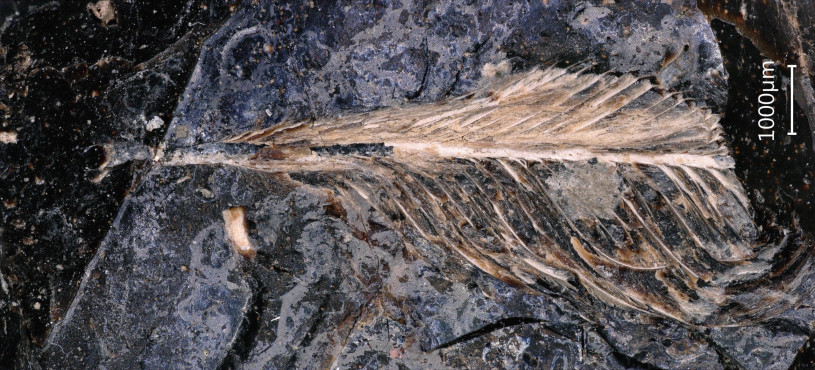
“It’s such a beautiful, well-preserved feather, from such an unexpected source,” said Dr. Jingmai O’Connor, Associate Curator of Fossil Reptiles at the Field Museum and Research Associate at NHM’s Dinosaur Institute and the lead author of the paper, published in Current Biology.
NHM’s Dr. Aaron Celestian, Curator of Mineral Sciences, and Dr. Luis Chiappe, Senior Vice President of Research & Collections and Curator of the Dinosaur Institute, are co-authors on the paper.
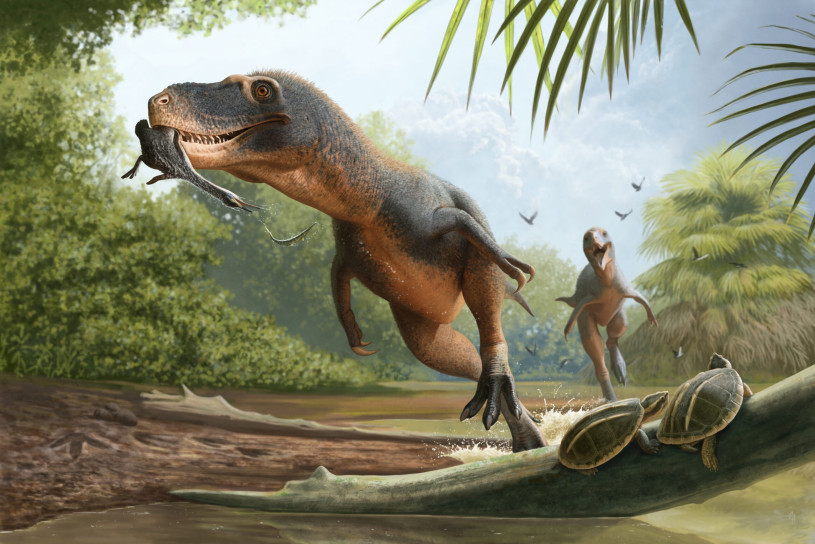
Researchers think the scat came from either a juvenile T. rex or a Nanotyrannus, both common predators recovered from eastern Montana’s Hell Creek Formation, a large series of badlands containing a treasure trove of dinosaur fossils including the celebrated T. rex (including Thomas) and Triceratops. The coprolite was found in these rock layers in 2016.
The researchers studying this ancient poop uncovered multiple feathers, along with small fragments of leg bones and tiny fish scales by using computer tomographic imaging. The birdy parts may come from Hesperornithiformes, although the bone remains preserved in the coprolite are too fragmentary to be sure. Hesperornithiformes are an extinct group of foot-propelled, diving birds that lived towards the end of the Age of Dinosaurs. These ancient birds are a Mesozoic parallel of modern grebes, but generally much bigger, toothed, and virtually flightless.
This uncertainty notwithstanding, “what matters here is the structure of the feathers contained in the coprolite; this discovery constitutes the oldest known true modern feather and you can only tell that by looking at its construction under a microscope," said Chiappe.
Passing Through the Millennia
A combination of the Greek words kópros “dung” and líthos "stone", coprolites could be treasure troves of data on birds from the Mesozoic as well as the animals that fed on them.
This particular coprolite captured a pair of meals—the scales likely represent the bird’s fish dinner, and the bird itself was the feast for a T. rex or Nanotyrannus. Where feathers are unlikely to survive the mineralization process that creates fossils, most animals can’t usually digest the keratin that makes up things like feathers.
And the role that feathers play in the evolution of birds is huge, said Chiappe. Beyond supporting their flight and being integral to mating courtships, feathers are also used for insulation. Understanding feather structure can also help us understand the evolution of these functions.
“We only knew to look at this one because of how it happened to be split open, with the feather exposed—it was literally a lucky break. I hope more scientists start CT scanning coprolites and taking a closer look at them to see what might be inside,” said O’Connor.
Coprolites in the bowels of fossil collections like NHM’s could house even more surprises.
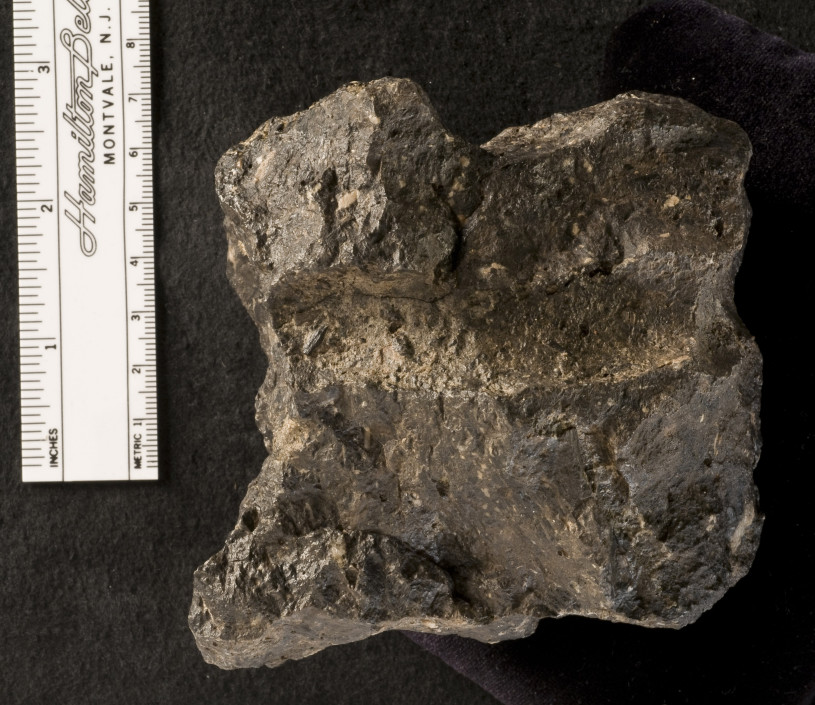
“Now fossilized poop has become a primary source of evidence for understanding the evolution of feathers across 160 million years of evolution,” said Chiappe, “I think that’s very exciting. We have other ancient poop in our collections that now need to be looked at more carefully to see whether they also preserve evidence of feathers,” he said.
That includes the coprolites on view in the Dinosaur Hall. Other number two specimens could be first-rate avenues of discovery.

