Fossils Under San Pedro High School Reveal a Pleistocene Beach in a Miocene Sea
Discover some of the last fossils and the lasting impact of the bone beds beneath San Pedro High School

Published June 3, 2026
Key Takeaways
- In 2022, researchers discovered an incredible trove of marine fossils under San Pedro High School during the building's renovation.
- Alongside 120,000-year-old invertebrate fossils from the Pleistocene, researchers discovered 9-million-year-old vertebrate fossils from the Miocene.
- The San Pedro High School bone bed is the largest collection of marine fossils ever found in Los Angeles County.
- NHM researchers are using invertebrate fossils from the site to investigate how past climate change impacted ocean life and understand how the current climate crisis will impact modern marine life
Dr. Austin Hendy knew they were somewhere close.
“I would walk my dog by there and always be thinking about, where the heck did those fossils come from?” As the Curator of Invertebrate Paleontology at the Natural History Museum of Los Angeles County, Hendy had read reports of marine fossil from the Pleistocene, the epoch most closely associated with the Ice Age in popular imagination thanks to sites like La Brea Tar Pits, a site representing the last 50,000 or so years of the two and a half million year epoch.
“It doesn’t get better than a discovery on the grounds of a school, involving students in their curation and care, and then sharing those finds with the young scientists of tomorrow.” Dr. Austin Hendy
In 1936, paleontologist Emery Chace collected Pleistocene fossils from the site of the newly constructed San Pedro High School. In 2022, new construction at the high school unearthed this treasure trove of invertebrate fossils once again. While Hendy (and the paleontological community) knew they might find fossils from 120,000 or so years ago in this neighborhood, no one expected to find thousands of Miocene fossils dating back nearly 9 million years (especially under a high school). The San Pedro High School bone bed is the largest collection of marine fossils ever found in Los Angeles County.
“I mean, there is no record of that kind of deposit, really, anywhere in California,” said Hendy. “Just the quantity of fossils was truly unique.”
Hendy and Dr. Wayne Bischoff, the director of cultural resources at Envicom managing fossil salvage at the site, were kind enough to walk me through the construction site/hidden fossil treasure trove before it submerged once again beneath the school. The visit illustrated how the distant past is closer, more alive, and impactful than it seems.
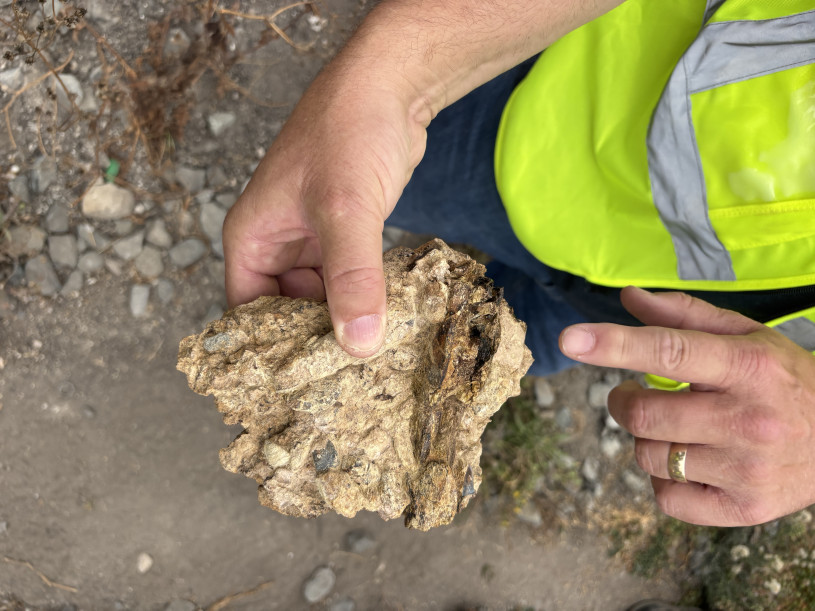
As the team gathered for the day’s activities, Bischoff shared a skull fragment from an ancient toothed whale. On the day of my visit, a preparator from NHM’s Dinosaur Institute would be working to help extricate the rest of the skull.
The Topography of an Extinct Channel Island
As we walked through the construction site, Bischoff broke down the site’s formation.
“We've got now five different bone beds, all separated and stacked on top of each other, that probably formed at the outflow of a submarine canyon with an offshore island that was raised by continental movement along the Pacific and North American plates. Our geology team has confirmed that we were dealing with a previously unknown Channel Island from the Miocene time period,” Bischoff explained.
“The currents down the canyon would periodically scour new shallow channels, especially during storms, that would then slowly fill up with material sliding down from shallower water near the island. Later, the channel material would get capped; a process that perhaps repeated itself every 100,000 years or so.”
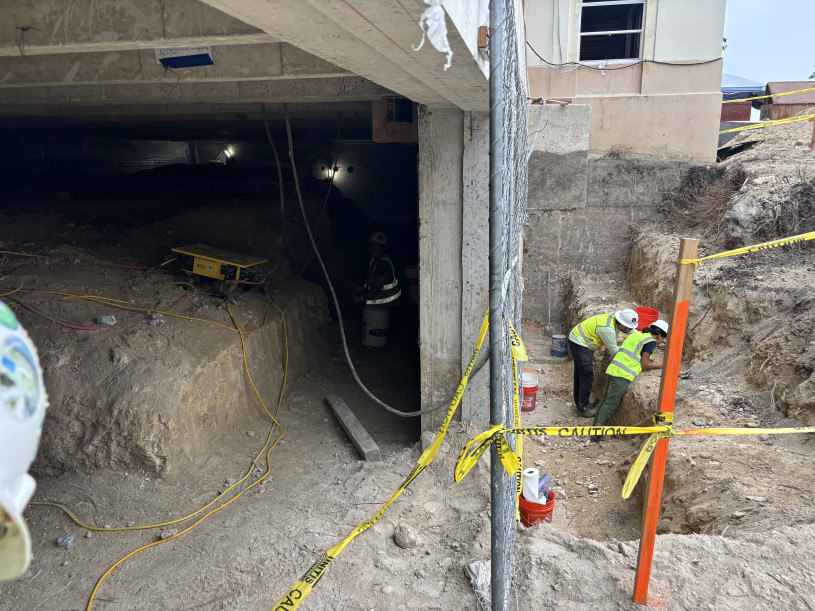
After safety training, the first thing Bischoff wanted to show me was a line in the sand. He pointed to a trench skirting the outside of the building. A chainlink fence bordered the outside and the excavated ground beneath the school building proper. Under the building, it’s the Miocene. On the outside, it’s the Pleistocene. Just a couple of feet separated millions of years of fossil history.
Collecting Shells on the Pleistocene Shore
On the Pleistocene side, Priyanka Soni is looking for shells at this ancient beach. The University of Southern California doctoral candidate and Graduate-in-Residence in the Invertebrate Paleontology Department of NHM stands in the head-high trench, scanning the packed dirt for ancient marine invertebrates. Soni studies Southern California marine fossils, investigating how these ancient marine communities responded to warming to predict how modern marine life might deal with a warming climate in our time.
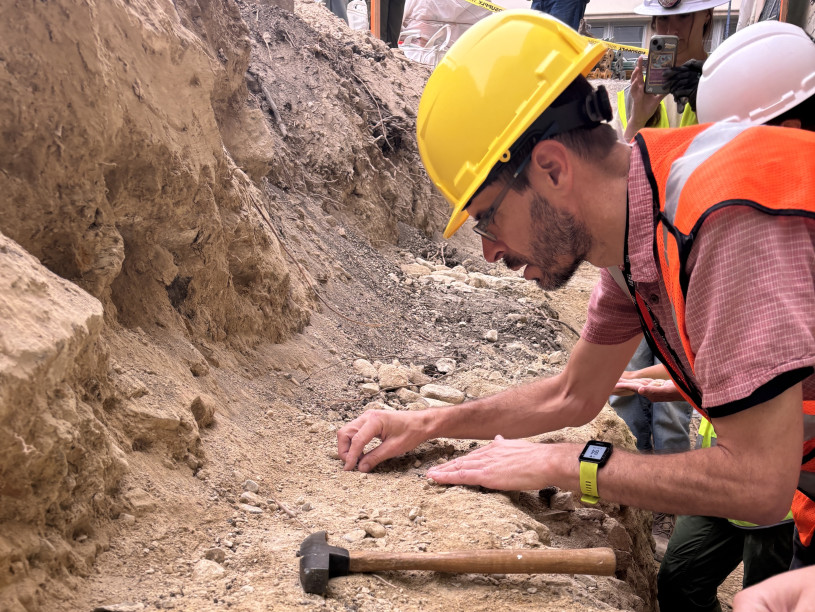
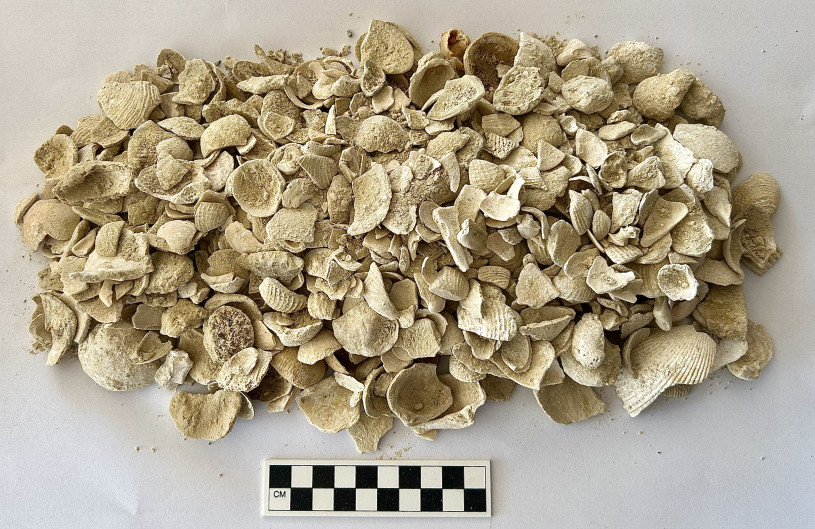
Knocking away clumps of dirt, Soni and Hendy dig out the particular shells of target species, producing buckets of fossils. Collectively, these tiny shells help paleontologists tell a story about how Earth’s changing climate affects marine life.
With its glacial and non-glacial periods, the Pleistocene experienced similarly drastic changes in temperature, paralleling our current climate precipice. The fossil shells she’s collecting at San Pedro High can tell researchers like Soni how life survived those rising temperatures—and may do so again.
“It's like conserving the future with the past,” said Soni. “We have these records of species no longer living around San Pedro during the Pleistocene, so we know where species lived in the past. We know where they live today, but where will they go in the future? There's something going on. We can do modeling on that. It's really a very practical application of paleontology.”
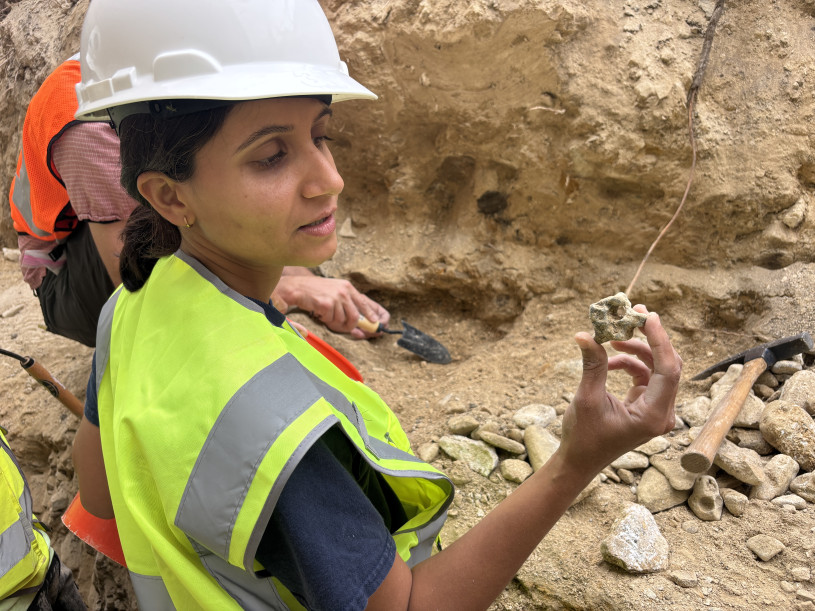
Thousands of shells, buckets and buckets of them, were already in the collections at NHM. Processing those buckets will take time, but the data they produce will inform how best to conserve life in our oceans. The rich diversity of the site’s marine invertebrate fossils provides a more granular view of how best to prepare for the warming future. “This is called conservation paleobiology,” Soni added.
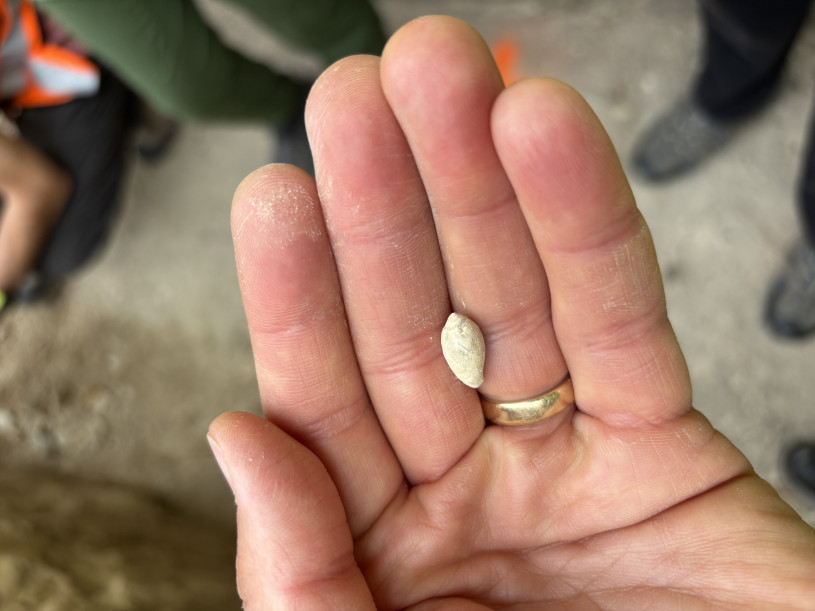
“I was fascinated to see such remarkable fossils exposed beneath the school campus,” Soni says later. “The huge quantity and also amazing preservation were truly a wow moment. What makes me more excited is that these fossil shells tell a story of a warmer Southern California, a survival success by migration instead of accepting an extinction.”
Marine invertebrates often swim unnoticed in our conception of ocean life, but they make up more than 90% of ocean life. By mapping the Pleistocene migrations of marine invertebrates, researchers like Soni can infer how a heating ocean will impact those species into the future.
Plumbing the Miocene Depths
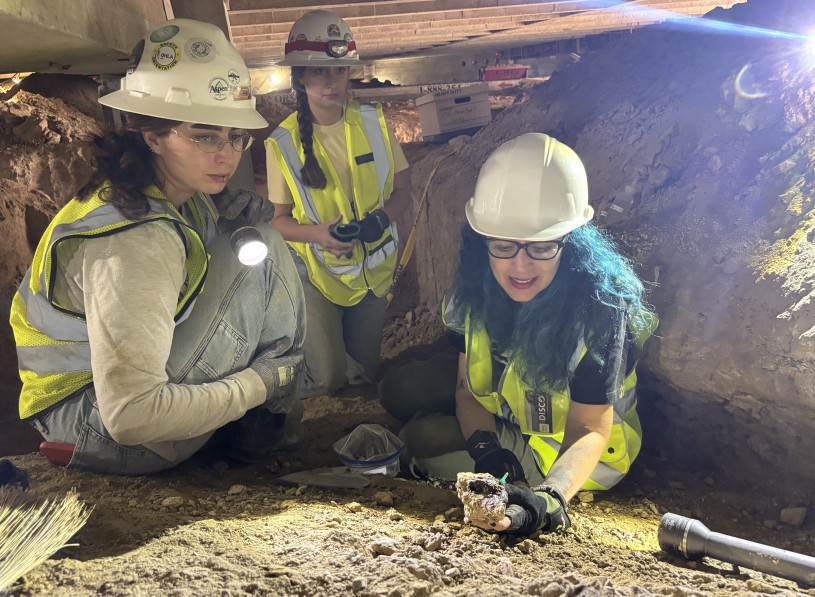
We just had to duck our heads slightly to walk into a record of much more ancient waters. We navigated the underground maze of trenches Bischoff and his team dug to expose the Miocene fossils beneath, along with low-hanging concrete, strung lights, and ventilation tubes. After several twists, turns, and bumps that made me grateful for the helmet, we landed at the toothed whale.
Corinna Bechko and a team of Envicom excavators crouched and squeezed around the fossil skull between the dirt trenches and the concrete overhead. With a mag light in the dirt for extra illumination, Bechko undertook the delicate work of extracting the permineralized bone—where minerals have replaced organic material of a bone—from the sediment that’s kept it safe for so many millions of years. Drip by drip, Bechko added adhesive to the skull. It’s painstaking work, but necessary. If not properly stabilized, the fossil could crumble when it’s finally time to remove it.
“I found the first whale teeth when I was cleaning samples in my backyard,” Bischoff explained, “ I thought we were slowing down on discoveries, then we found another bonebed layer with the toothed whale fossils. We have a good portion of the skull, and hope to describe a new whale species with NHMLAC help.”
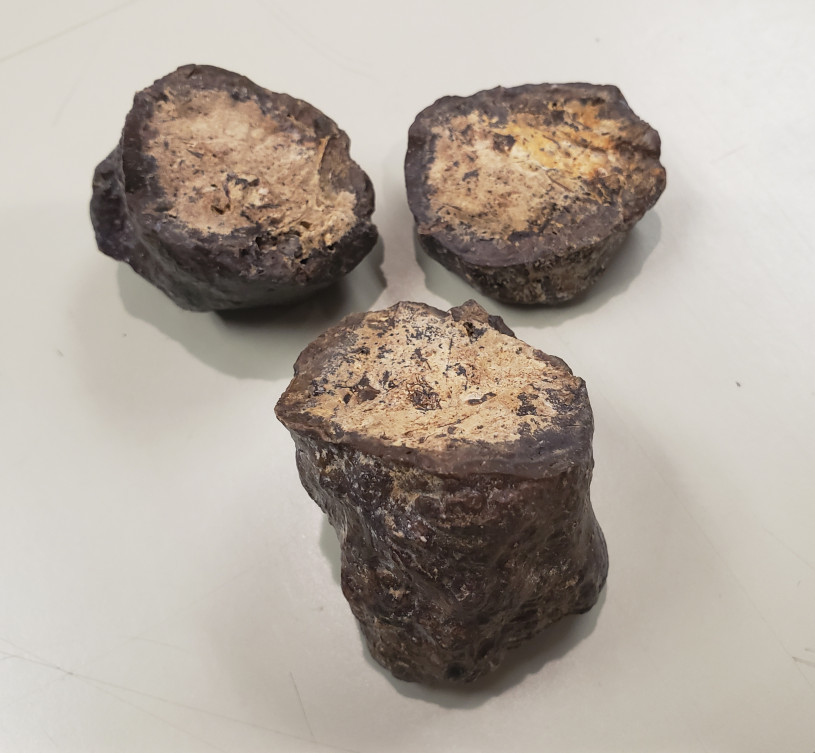
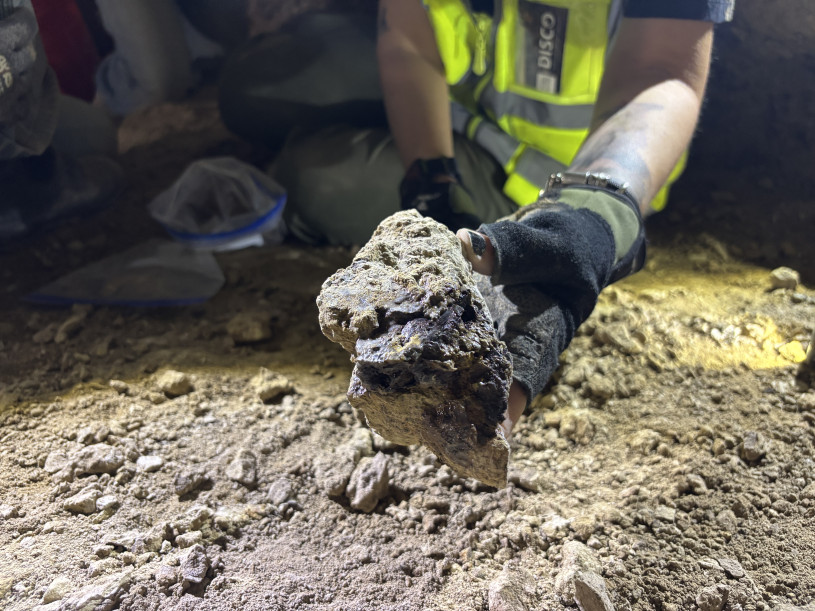
Closer to the entrance, we stopped by another excavation. It was still too early to tell, but Bischoff thought it might be a toothless walrus. Along with the unknown pinniped, the team has been uncovering quite a bit of poo. Coprolites, or fossil poop, are just as valuable as the bones. They can help researchers understand the diets of these extinct marine creatures and reconstruct food webs to get a better picture of the ancient past through the lens of poo.
Bischoff laughed. “I’m pretty sure we now have the largest fossil poop collection in the United States!”
The sediment encasing the fossils tells its own story about the ancient ecosystem. Diatomaceous earth, a material composed of tiny fossilized algae called diatoms, surrounded the Miocene fossils, evidence of an environment rich with nutrients that attracted a staggering variety of life: the whales, fish, walruses, turtles, sea birds, and other marine life, a fraction of which would ultimately become this unprecedented fossil site.
“Marine mammals in the Miocene were incredibly diverse, and they would be both familiar and strange compared to what we see today,” says Dr. Jorge Velez-Juarbe, Curator of Marine Mammals at NHM. “Think of walruses, raptorial sperm whales, and creatures unlike anything swimming in today’s seas. The discovery of marine mammals at San Pedro High School further illuminates that menagerie, and no doubt we’ll be studying these specimens.”
Many of the Miocene vertebrates will ultimately be cared for by Dr. Velez-Juarbe and his colleagues at NHM. In the Museum’s collections, they will fuel research into the bizarre world of the Miocene. Studying them may reveal additional details on the evolutionary history of the marine mammals we know today, along with surprises from L.A.’s deep history. “There’s a possibility that some of these fossils represent new records for the region.”
Excavating Inspiration
Unlike fossil beds without high schools on top of them, the discoveries under San Pedro High had a limited window for excavation. Bischoff, Hendy, and their colleagues had to excavate the fossil material before the school bells rang, welcoming students returned to their refurbished campus.
While the Pleistocene shore and Miocene sea have receded once again into the ocean of time, they will continue to ripple out into new discoveries.
Many of the Miocene vertebrates will ultimately be cared for by Dr. Velez-Juarbe and his colleagues at NHM. In the Museum’s collections, they will fuel research into the bizarre world of the Miocene. Studying them will reveal the evolutionary history of the marine mammals we know today, along with surprises from L.A.’s deep history. “There’s a possibility that some of these fossils represent new species.”
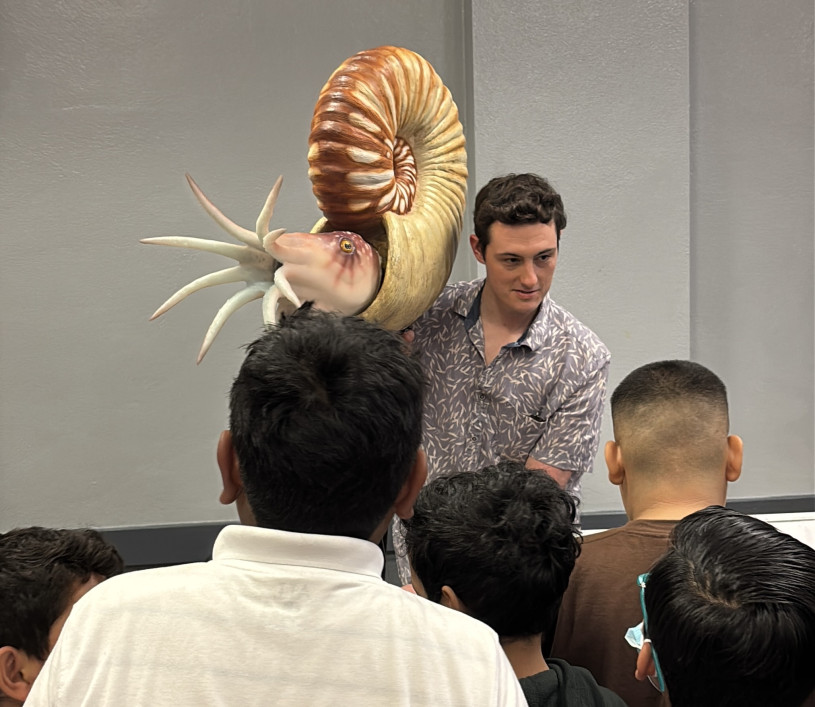
Beyond scientific discoveries, the fossil site is connecting Angelenos to L.A.’s underwater history. Led by Hendy, NHM and Envicom staff have taken the show on the road to a local school in Wilmington Park Elementary, providing students there with access to the fossils, research staff, and a very special ammonite puppet in a unique classroom experience that brings the breadth of the discovery to life for young people.
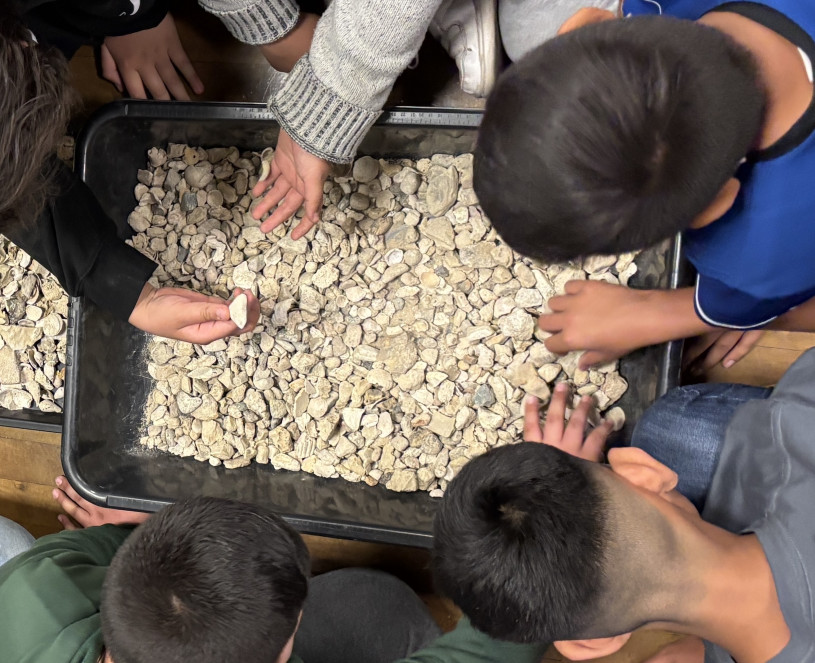
Many of the researchers from the San Pedro High School excavation joined, including Bechko and Bischoff, as well as artist Cullen Townsend, a scientific illustrator and puppet maker responsible for some of the most arresting imagery documenting Los Angele’s ancient past/ The team set up four tables where students could explore the site’s discoveries and be inspired by paleontology, from hands on fossil sorting to a poop cam.
“There were maybe 100 students there,” says Hendy. “And I thought, how can I possibly entertain 100 students? So that's where we had this idea of having different tables and a mixture of hands-on activities and, of course, Romeo the ammonite puppet.”
Much like the immersive L.A. Underwater exhibition at NHM, Hendy and his colleagues hope the fossils unearthed beneath San Pedro High will ignite young minds to the region’s submerged prehistory, making a local scientific discovery more accessible to L.A.’s communities. If the hundred or so extremely stoked students were any indication, its first outing as a lesson plan was wildly successful.
For Hendy, this whole experience epitomizes one of the central tenets of L.A. Underwater: any neighborhood of our city can hold fossil treasures, and everyone can participate in the scientific process. “It doesn’t get better than a discovery on the grounds of a school, involving students in their curation and care, and then sharing those finds with the young scientists of tomorrow.”

