Meet Masripithecus: Newly Described Ancient Ape Fills a Gap in Evolutionary History of Primates
An international team of researchers add a new chapter in the story of apes—including us humans—starting around 18 million years ago in North Africa

Published March 26, 2026
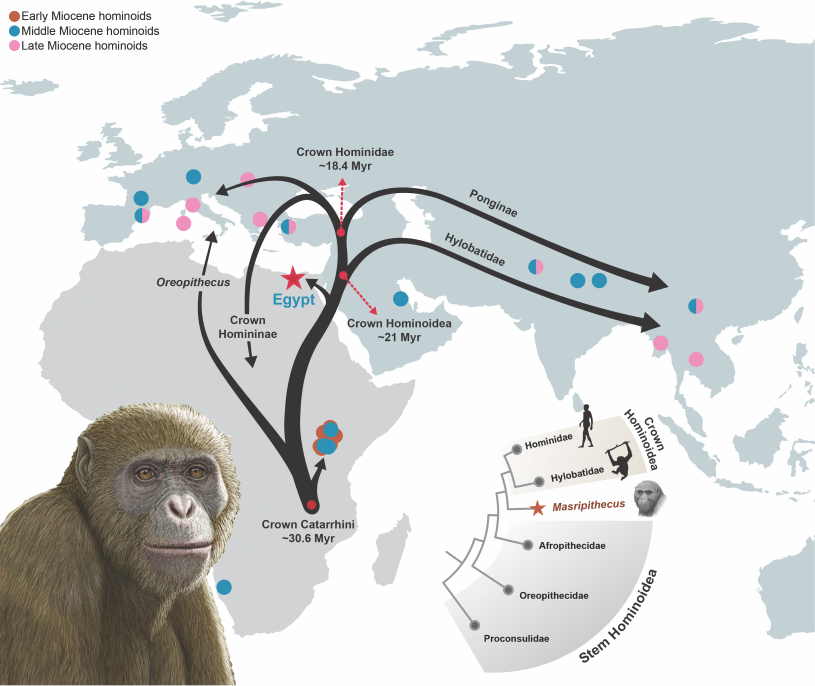
Published in the journal Science, a new study by an international team of researchers, including NHM Mammalogy Research Associate Dr. Erik R. Seiffert, describes a new genus of fossil ape from 17 to 18 million-year-old rocks of northern Egypt during the Early Miocene: Masripithecus. Based on the fossil remains of its jaw, the researchers' molecular and morphological analyses put the newly described ape closer to the base of the hominid evolutionary tree.
The name Masripithecus comes from the Arabic word for Egypt, ‘masr’, and the Greek word for monkey, ‘pithekos’. The discovery marks the first time an ape from the Early Miocene has been described from the region, and suggests that crown Hominoidea—the group including hominoid’s most recent common ancestor along with its extinct and living descendants (like gorillas, chimpanzees, orangutans, and us)—might have got their start in the northeastern part of Afro-Arabia—and not Eurasia or eastern Africa as had previously been thought.
“The discovery of Masripithecus, combined with our analyses of relationships among both living and extinct apes, and their ancient biogeography, has really challenged my previous assumptions about where the last common ancestor of the living apes lived,” says Seiffert, who is also a researcher in USC’s Keck School of Medicine’s Division of Integrative Anatomical Sciences and the Duke Lemur Center Museum of Natural History, Durham, North Carolina. “This new evidence suggests that northern Africa and the Middle East might have been more central to the origin of the living apes than were more southern parts of Africa. Our study is sure to reignite debate about the ancient geography of early hominoids.”
Read the article in Science here.