Not Deformed, Just Weird: Ancient Pygmy Sperm Whale Species Is the Most Asymmetrical Mammal of All Time
New species of prehistoric sperm whale Scaphokogia huachafo had a Picasso-like face and fed on the Miocene seafloor more than five million years ago

Published November 9, 2026
Out of all mammals, toothed whales have the most asymmetrical skulls.
But the newly described pygmy sperm whale Scaphokogia huachafo has the most lop-sided skull ever found in whales—and possibly among all tetrapods (basically every animal with a backbone and limbs). Described by an international team of scientists in the journal Communications Biology, the 6.3 to 5.6 million-year-old skull of S. huachafo pushes the strangeness of whale skulls to modern art levels.
“Sperm whales as a general rule are kind of weird,” says Dr. Jorge Velez-Juarbe, co-author and Curator of Marine Mammals at the Natural History Museum of Los Angeles County. “Their skulls are very asymmetric, characterized by having an almost bowl-shaped posterior part of the cranium with a crest that runs along the midline, and that holds structures related to echolocation, like the spermaceti organ that gives the whales their name.”
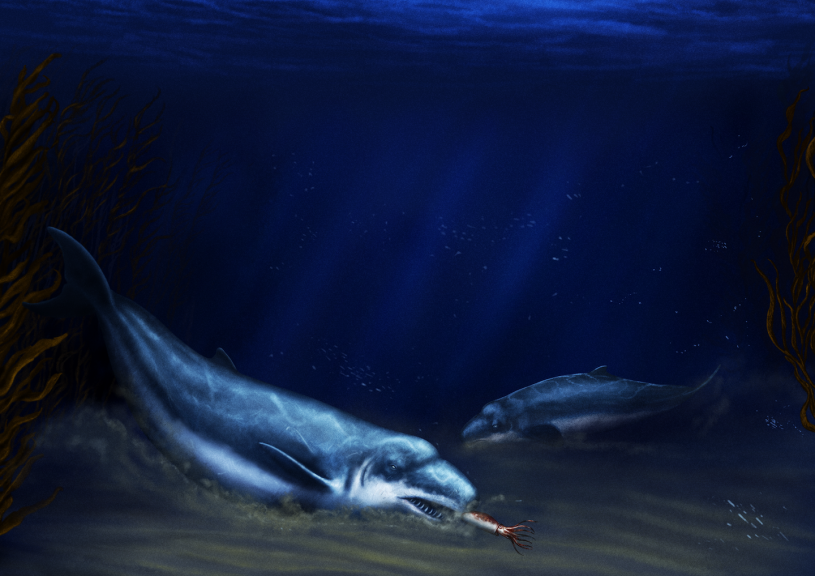
The modern sperm whale gets its distinct rectangular head-shape from this peculiar skull plan, but S. Huachafo takes the strangeness much further. “They were taking some of these adaptations to an extreme,” adds Velez-Juarbe, who describes a tubular snout and a spoon-shaped concavity to hold its ‘melon’, another structure that helped it echolocate.
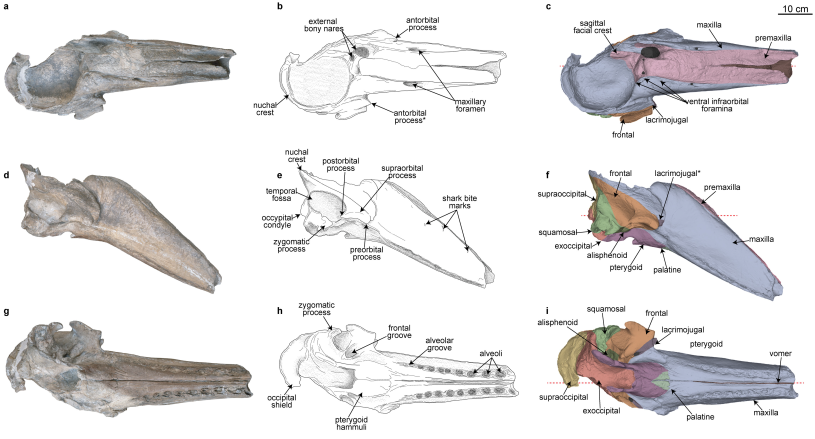
“They maximize skull adaptations to accommodate all these soft tissue structures for echolocating,” says Velez-Juarbe. “It's the way they find their way in the ocean.” It’s those echolocation tools that Velez-Juarbe and his team think warped the bizarre pygmy sperm whale’s skull. Echolocation helps sperm whales ‘see’ in the dark, and S. huachafo fed on the sea floor—a darker world that probably required more powerful tools to ‘see’. Bigger structures for echolocation mean bigger asymmetry.
Velez-Juarbe and his colleagues think the bizarre shape helped S. Huachafo scour the seafloor for squid, bottom-feeding like dugongs do today. It can be difficult to imagine a sperm whale hoovering up invertebrates on the bottom of the ocean, but a more powerful echolocation would have been crucial to finding those morsels in the murky sea.
Weird Whales
“The eyes are offset,” adds Velez-Juarbe. “I think of it like Sloth from The Goonies.” Instead of that familiar sperm whale head-shape, the tubular snouts and large melons pushed the eyes askew. “Alongside this asymmetry, the angle at which the neck and the first vertebrae align is a little bit off. So maybe they're moving their head at a particular angle that helps them find food better. It's a very puzzling animal, and we know it's not because of deformation.”
Fossils are delicate things, and the same geologic processes that preserve ancient bones can warp their shapes. To ensure they weren’t looking at a distorted specimen, Velez-Juarbe and his co-authors examined asymmetry in sperm whales extensively. While extreme, the new species’ adaptations existed in the milieu of weird sperm whales at a time when weird whales were pretty common.
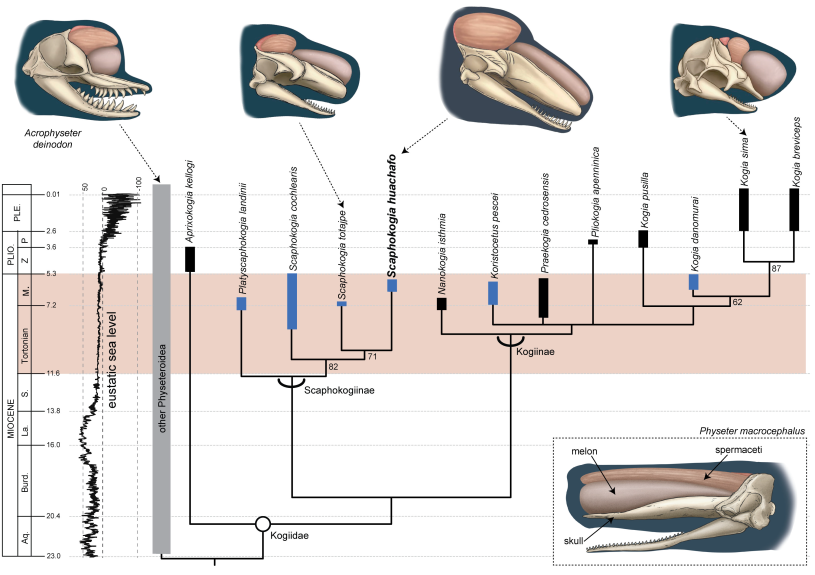
The specimen comes from the Pisco Formation, a late Miocene fossil assemblage in Peru that captures other strange marine mammals. The site has produced giant aquatic sloths; the Livyatan melvillei, a giant, orca-like sperm whale that fed on other whales; Odobenocetops, a long-tusked walrus-like whale that also fed on the bottom.
“So it's a whole fauna with very modern components, but every now and then you get these weird ones, and some of the most prominent groups of odontocetes in the Pisco Formation are sperm whales,” says Velez-Juarbe.
Its strangeness and its discovery at the Peruvian site inspired the authors to give the weird new sperm whale the name ‘huachafo,’ which references the Peruvian Spanish slang for exaggerated, tacky, or extravagant, a fitting nod to its strangeness and geographical home.


